
Close Menu
    Facebook X (Twitter) Instagram
    SciTechDaily
    • Biology
    • Chemistry
    • Earth
    • Health
    • Physics
    • Science
    • Space
    • Technology
    Facebook X (Twitter) Pinterest YouTube RSS
    SciTechDaily
    Home»Chemistry»New Catalysts Turn the Greenhouse Gas Methane Into Valuable Chemicals
    Chemistry

    New Catalysts Turn the Greenhouse Gas Methane Into Valuable Chemicals

    By Tokyo Institute of TechnologyMay 21, 20241 Comment4 Mins Read
    Facebook Twitter Pinterest Telegram LinkedIn WhatsApp Email Reddit
    Share
    Facebook Twitter LinkedIn Pinterest Telegram Email Reddit
    Methane or Ammonium Molecules
    In a recent study, researchers from the Tokyo Institute of Technology developed a new bifunctional zeolite catalyst that efficiently converts methane and nitrous oxide into valuable chemicals, offering a more sustainable and energy-efficient method than traditional processes. The catalyst’s unique ability to optimize the spatial distribution of Cu and acid sites enables it to effectively reduce greenhouse gas emissions while producing useful hydrocarbons, potentially guiding future decarbonization efforts in the chemical industry.

    Researchers developed a novel catalyst that converts methane into valuable chemicals more sustainably, potentially advancing efforts to decarbonize the chemical industry.

    Methane, a potent greenhouse gas, plays a crucial role both as an energy source and a vital chemical feedstock. Typically, methane undergoes conversion into methanol before being transformed into hydrocarbons. This process, however, demands elaborate industrial systems. Crucially, because methane is a highly stable molecule, converting it into methanol through traditional methods like steam methane reforming is highly energy-intensive.

    Against this backdrop, the catalytic conversion of methane into methanol or other chemicals has attracted much attention from scientists, who are eager to find more energy-efficient and sustainable solutions. Among recently reported catalysts, copper (Cu)-containing zeolites have shown promise for methane-to-methanol conversion at mild conditions. Unfortunately, the yield and selectivity of most reported catalysts have been low, meaning that large quantities of undesirable byproducts are generated alongside methanol.
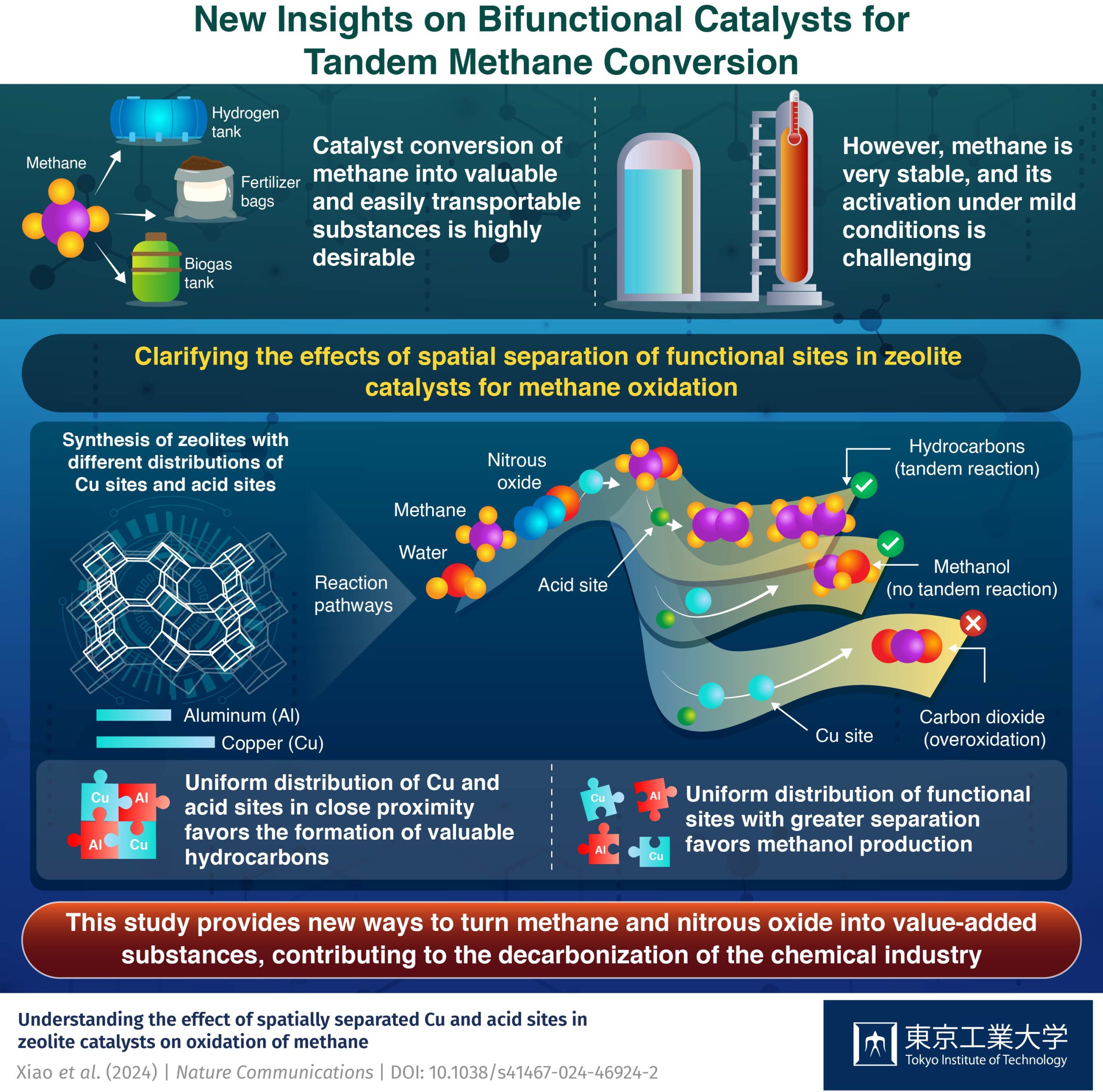
    New Insights on Bifunctional Catalysts for Tandem Methane Conversion
    This study provides new ways to turn methane and nitrous oxide into value-added substances, contributing to the decarbonization of the chemical industry. Credit: Tokyo Tech

    In a recent study published in the journal Nature Communications, a research team including Associate Professor Toshiyuki Yokoi from Tokyo Institute of Technology, Japan, investigated a new type of bifunctional zeolite catalyst. Interestingly, this Cu-containing, aluminosilicate-based zeolite is capable of converting methane and nitrous oxide, another greenhouse gas, directly into valuable compounds through a series of intermediate reactions.

    Optimizing Catalyst Structure for Enhanced Output

    One of the key questions the researchers addressed was how the spatial distribution of different active sites in the catalyst affected the output of the reactions. To this end, they prepared multiple catalysts using not only different concentrations of Cu and acid sites (proton) in aqueous solutions but also different physical mixing techniques for solid samples.

    Through various experimental and analytical techniques, the researchers found that the proximity between Cu and acid sites was crucial for determining the final products. More specifically, they reported that when Cu sites were near each other, the methanol produced in Cu sites from methane had a higher probability of being overoxidized by an adjacent Cu site, turning it into carbon dioxide. In contrast, when Cu sites and acid sites were close to each other, methanol reacted with nitrous oxide in an adjacent acid site instead to produce valuable hydrocarbons and harmless nitrogen gas.

    “We concluded that, for stable and efficient production of methanol and ultimately useful hydrocarbons from methane, it is necessary to uniformly distribute Cu sites and acid sites and have them be at an appropriate distance from each other,” explains Yokoi. “We also found that the distribution of products obtained is also influenced by the acid properties and pore structure of the zeolite catalyst.”

    One of the most notable advantages of the proposed catalyst is its ability to sustain tandem reactions, that is, a simple process that merges multiple steps into one and gets rid of two different harmful greenhouse gases simultaneously. This property will be key to making such catalytic systems attractive in an industrial setting.

    “Our work will hopefully guide future efforts to achieve methane oxidation to methanol and open avenues for promoting hydrocarbon synthesis using methanol as an intermediate,” concludes Yokoi.

    With any luck, this study will serve as a stepping stone toward the decarbonization of the chemical industry, contributing to the realization of a carbon-neutral society.

    Reference: “Understanding the effect of spatially separated Cu and acid sites in zeolite catalysts on oxidation of methane” by Peipei Xiao, Yong Wang, Lizhuo Wang, Hiroto Toyoda, Kengo Nakamura, Samya Bekhti, Yao Lu, Jun Huang, Hermann Gies and Toshiyuki Yokoi, 28 March 2024, Nature Communications.
    DOI: 10.1038/s41467-024-46924-2

    The study was funded by the Japan Society for the Promotion of Science.

    Never miss a breakthrough: Join the SciTechDaily newsletter.
    Follow us on Google and Google News.

    Catalysts Greenhouse Gas Methane Popular Tokyo Institute of Technology
    Share. Facebook Twitter Pinterest LinkedIn Email Reddit

    Related Articles

    Carbon Capture “Miracle Material” Breakthrough: MOF-525 Can Capture and Convert CO2 Into Useful Chemicals

    New Solar Technology Converts Greenhouse Gases Into Valuable Fuel

    Single Atom Catalyst Could Cut Methane Pollution 90% From Millions of Engines

    Illuminating Science: X-Rays Visualize How One of Nature’s Strongest Bonds Breaks

    Feeding the Future: Artificial Photosynthesis Transforms CO2 Into Food

    New “Artificial Photosynthesis” System Produces Methane With 10x Efficiency

    A Dirt Cheap Climate Change Solution? Common Clay Materials May Help Curb Methane Emissions

    MIT Develops a New Way to Harness Wasted Methane

    Working to Recycle Greenhouse Gases

    1 Comment

    1. Siddanagouda Patil on May 27, 2024 5:04 am

      what is the Zeolite specification in this study?

      Reply
    Leave A Reply Cancel Reply

    • Facebook
    • Twitter
    • Pinterest
    • YouTube

    Don't Miss a Discovery

    Subscribe for the Latest in Science & Tech!

    Trending News

    Scientists Uncover Potential Brain Risks of Popular Fish Oil Supplements

    Scientists Discover a Surprising Way To Make Bread Healthier and More Nutritious

    After 60 Years, Scientists Uncover Unexpected Brain Effects of Popular Diabetes Drug Metformin

    New Research Uncovers Hidden Side Effects of Popular Weight-Loss Drugs

    Scientists Rethink Extreme Warming After Surprising Ocean Discovery

    Landmark Study Links Never Marrying to Significantly Higher Cancer Risk

    Researchers Discover Unknown Beetle Species Just Steps From Their Lab

    Largest-Ever Study Finds Medicinal Cannabis Ineffective for Anxiety, Depression, PTSD

    Follow SciTechDaily
    • Facebook
    • Twitter
    • YouTube
    • Pinterest
    • Newsletter
    • RSS
    SciTech News
    • Biology News
    • Chemistry News
    • Earth News
    • Health News
    • Physics News
    • Science News
    • Space News
    • Technology News
    Recent Posts
    • Early Warning Signals of Esophageal Cancer May Be Hiding in Plain Sight
    • Researchers Have Discovered a THC-Free Cannabis Compound That May Replace Opioids
    • Common Blood Pressure Drug Shows Surprising Power Against Deadly Antibiotic-Resistant Superbug
    • Students Build Dark Matter Detector and Set New Experimental Limits
    • Scientists Discover Caffeine Can Repair Key Memory Circuits After Sleep Loss
    Copyright © 1998 - 2026 SciTechDaily. All Rights Reserved.
    • Science News
    • About
    • Contact
    • Editorial Board
    • Privacy Policy
    • Terms of Use

    Type above and press Enter to search. Press Esc to cancel.