
Close Menu
    Facebook X (Twitter) Instagram
    SciTechDaily
    • Biology
    • Chemistry
    • Earth
    • Health
    • Physics
    • Science
    • Space
    • Technology
    Facebook X (Twitter) Pinterest YouTube RSS
    SciTechDaily
    Home»Space»New Chandra Images Detail Supernova Remnants
    Space

    New Chandra Images Detail Supernova Remnants

    By Janet Anderson, Marshall Space Flight CenterNovember 20, 2014No Comments4 Mins Read
    Facebook Twitter Pinterest Telegram LinkedIn WhatsApp Email Reddit
    Share
    Facebook Twitter LinkedIn Pinterest Telegram Email Reddit
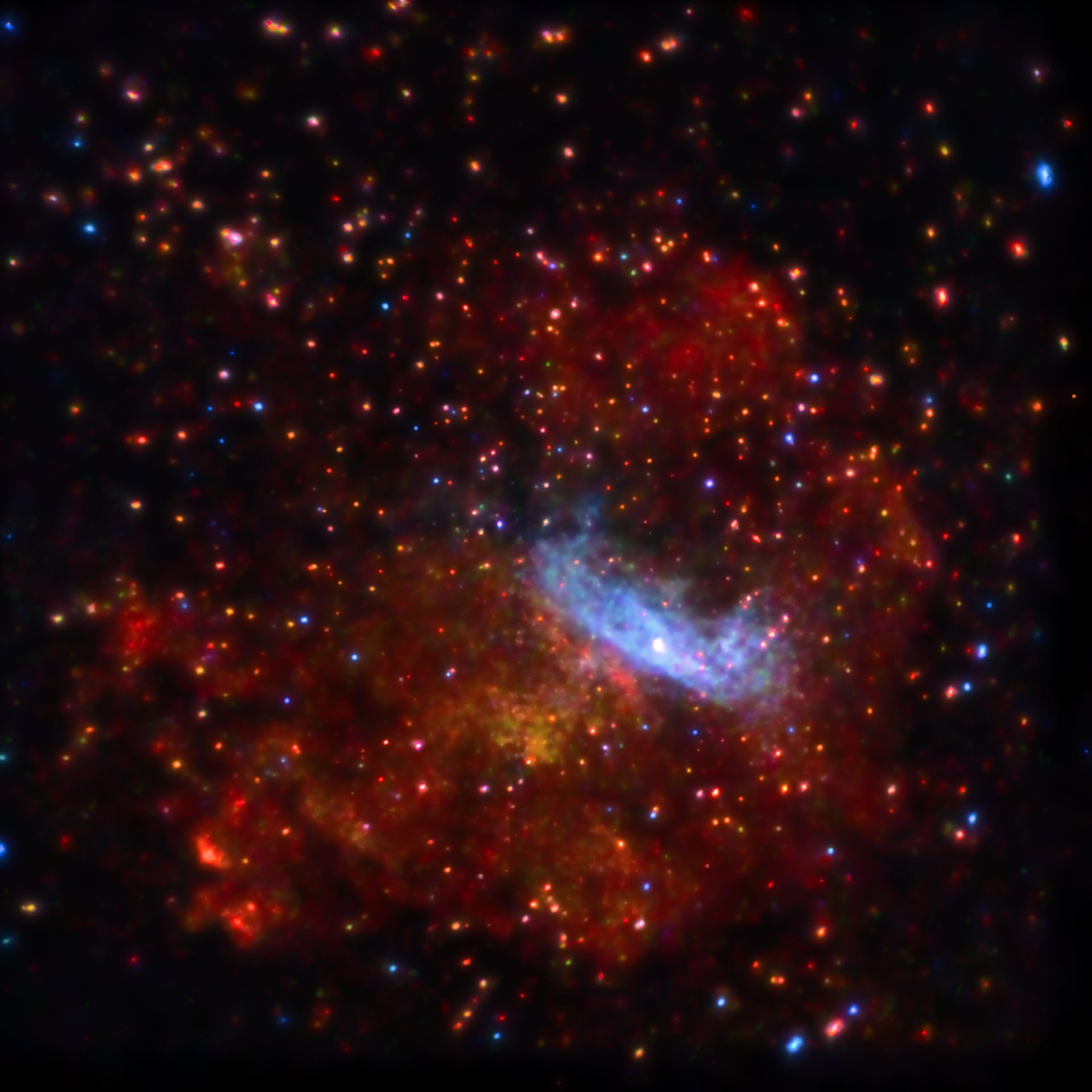
    Chandra Image of MSH 11-62
    A long observation with Chandra of the supernova remnant MSH 11-62 reveals an irregular shell of hot gas, shown in red, surrounding an extended nebula of high-energy X-rays, shown in blue. Even though scientists have yet to detect any pulsations from the central object within MSH 11-62, the structure around it has many of the same characteristics as other pulsar wind nebulas. The reverse shock and other, secondary shocks within MSH 11-62 appear to have begun to crush the pulsar wind nebula, possibly contributing to its elongated shape. (Note: the orientation of this image has been rotated by 24 degrees so that north is pointed to the upper left.) Credit: NASA/CXC/SAO/P. Slane et al.

    New observations from NASA’s Chandra X-ray Observatory reveal details of supernova remnant MSH 11-62 and G327.1-1.1.

    A supernova that signals the death of a massive star sends titanic shock waves rumbling through interstellar space. An ultra-dense neutron star is usually left behind, which is far from dead, as it spews out a blizzard of high-energy particles. Two new images from NASA’s Chandra X-ray Observatory provide fascinating views – including an enigmatic lobster-like feature – of the complex aftermath of a supernova.

    When a massive star runs out of fuel, the central regions usually collapse to form a neutron star. The energy generated by the formation of the neutron star triggers a supernova. As the outward-moving shock wave sweeps up interstellar gas, a reverse shock wave is driven inward, heating the material ejected by the star.

    Meanwhile, the rapid rotation and intense magnetic field of the neutron star, a.k.a. a pulsar, combine to generate a powerful wind of high-energy particles. This so-called pulsar wind nebula can glow brightly in X-rays and radio waves.

    A long observation with Chandra of the supernova remnant MSH 11-62 (left image) reveals an irregular shell of hot gas, shown in red, surrounding an extended nebula of high-energy X-rays, shown in blue. Even though scientists have yet to detect any pulsations from the central object within MSH 11-62, the structure around it has many of the same characteristics as other pulsar wind nebulas. The reverse shock and other, secondary shocks within MSH 11-62 appear to have begun to crush the pulsar wind nebula, possibly contributing to its elongated shape. (Note: the orientation of this image has been rotated by 24 degrees so that north is pointed to the upper left.)

    MSH 11-62 is located about 16,000 light-years from Earth. The foreground of MSH 11-62 is speckled with hundreds of sources associated with the open stellar cluster Trumpler 18, located at a distance of about 5,000 light-years, revealing a vast collection of stars.
    Chandra Image of a Supernova Remnant
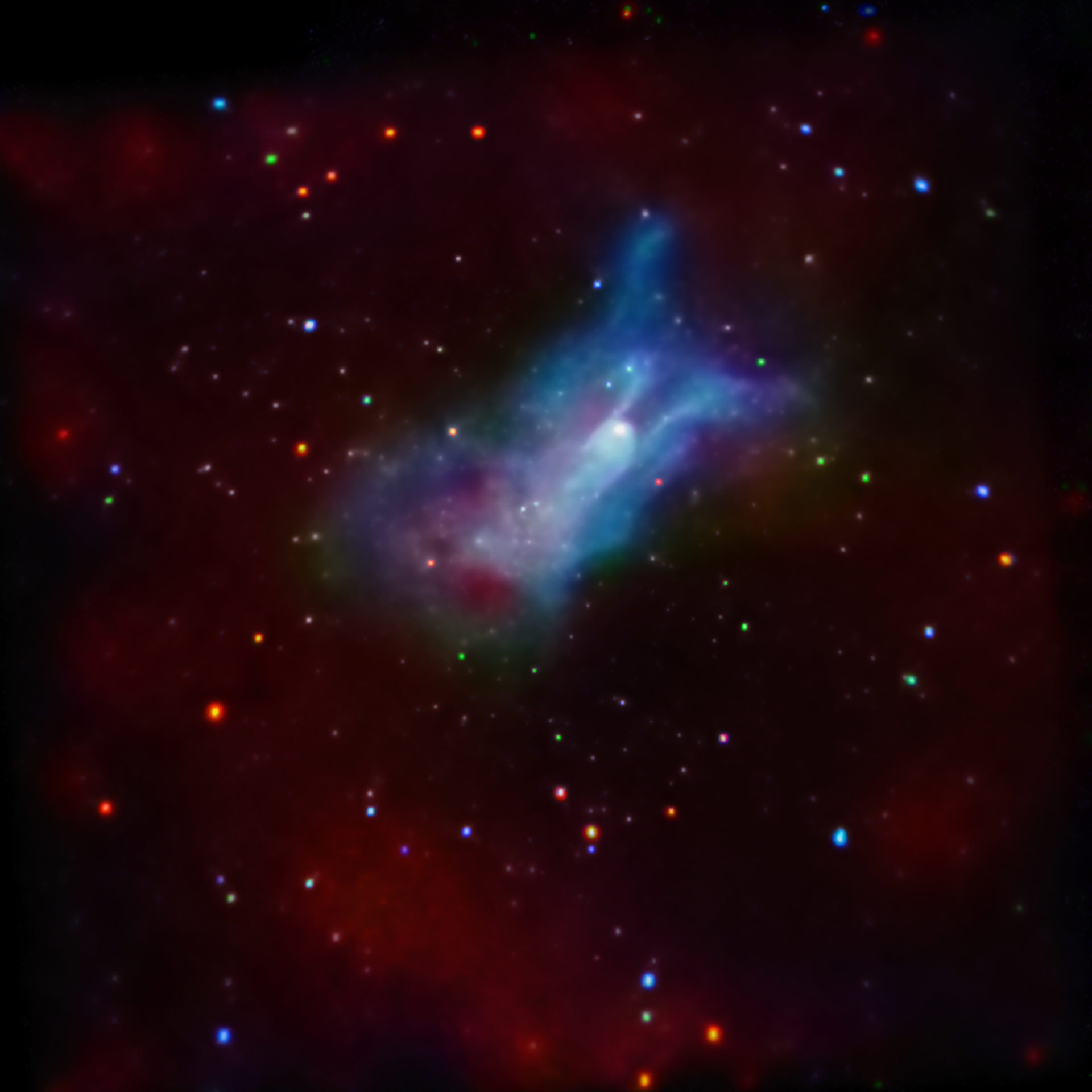
    The Chandra image of G327.1-1.1 shows an outward-moving shock wave (faint red color) and a bright pulsar wind nebula (blue). The pulsar wind nebula appears to have been distorted by the combined action of a reverse shock wave, which may have flattened it, and by the motion of the pulsar, which created a comet, or lobster-like tail. An asymmetric supernova explosion may have given a recoil kick to the pulsar, causing it to move rapidly and drag the pulsar wind nebula along with it. Two structures resembling lobster claws protrude from near the head of the pulsar wind nebula. The origin of these features, which may be produced by the interaction of the pulsar wind with the reverse shock, is unknown. Credit: NASA/CXC/GSFC/T. Temim et al.

    The supernova remnant G327.1-1.1, located about 29,000 light-years from Earth, is another spectacular debris field left behind when a massive star exploded. The Chandra image of G327.1-1.1 (right image) shows the outward-moving, or forward, shock wave (seen as the faint red color), and a bright pulsar wind nebula (blue). The pulsar wind nebula appears to have been distorted by the combined action of the reverse shock wave, which may have flattened it, and by the motion of the pulsar, which created a comet, or lobster-like tail. An asymmetric supernova explosion may have given a recoil kick to the pulsar, causing it to move rapidly and drag the pulsar wind nebula along with it.

    Two structures resembling lobster claws protrude from near the head of the pulsar wind nebula. The origin of these features, which may be produced by the interaction of the pulsar wind with the reverse shock, is unknown.

    These results are presented at the “15 Years of Chandra” symposium by Patrick Slane of the Harvard-Smithsonian Center for Astrophysics, Cambridge, Massachusetts, and Tea Temin of NASA’s Goddard Space Flight Center, Greenbelt, Maryland.

    NASA’s Marshall Space Flight Center in Huntsville, Alabama, manages the Chandra program for NASA’s Science Mission Directorate in Washington. The Smithsonian Astrophysical Observatory in Cambridge, Massachusetts, controls Chandra’s science and flight operations.

    Never miss a breakthrough: Join the SciTechDaily newsletter.
    Follow us on Google and Google News.

    Astronomy Astrophysics Chandra X-ray Observatory Supernova
    Share. Facebook Twitter Pinterest LinkedIn Email Reddit

    Related Articles

    Stellar Assassins: NASA’s Chandra Unmasks New Cosmic Threat to Planetary Life

    Mysterious Kilonova Explosion Afterglow Potentially Spotted for First Time

    A Cosmic Powder Keg: When a Stable Star Explodes

    Astronomers Capture Cosmic Hand Hitting a Wall – Watch Blast Wave Moving at 9 Million MPH

    Fragments of Titanium Found Blasting Out of a Famous Supernova

    Evidence of “Pulsar Wind Nebula” May Solve 34-Year-Old Astronomical Mystery

    How Do the Most Massive Stars Explode? Bubbles With Titanium Trigger Titanic Explosions

    New Clues to Remains of Star That Exploded Just Outside Our Galaxy

    Reclusive Neutron Star May Have Been Found in Famous Supernova SN 1987A

    Leave A Reply Cancel Reply

    • Facebook
    • Twitter
    • Pinterest
    • YouTube

    Don't Miss a Discovery

    Subscribe for the Latest in Science & Tech!

    Trending News

    Popular Supplement Ingredient Linked to Shorter Lifespan in Men

    Scientists May Have Found a Way To Repair Nerve Damage in Multiple Sclerosis

    “Totally Unexpected” – Scientists Discover Pancreatic Cancer’s Fatal Addiction

    A Strange Quantum Effect May Explain One of Biology’s Greatest Mysteries

    James Webb Telescope Reveals the Universe’s Hidden Cosmic Web in Stunning Detail

    Scientists Identify Simple Supplement That Greatly Reduces Alzheimer’s Damage

    You May Have a Dangerous Type of Cholesterol Even if Your Tests Look Normal

    Your Blood Pressure Reading Could Be Wrong Because of One Simple Mistake

    Follow SciTechDaily
    • Facebook
    • Twitter
    • YouTube
    • Pinterest
    • Newsletter
    • RSS
    SciTech News
    • Biology News
    • Chemistry News
    • Earth News
    • Health News
    • Physics News
    • Science News
    • Space News
    • Technology News
    Recent Posts
    • New Study Challenges What We Know About Consciousness and the Brain
    • Scientists Discover Ancient “Language Switches” Hidden in Human DNA
    • Scientists Discover “Good” Gut Microbes That Could Protect Against Autism and ADHD
    • Scientists Discover Testosterone Could Actually Protect Against Deadly Brain Cancer
    • Mediterranean Diet May Activate Secret Anti-Aging Proteins Inside Your Cells
    Copyright © 1998 - 2026 SciTechDaily. All Rights Reserved.
    • Science News
    • About
    • Contact
    • Editorial Board
    • Privacy Policy
    • Terms of Use

    Type above and press Enter to search. Press Esc to cancel.