
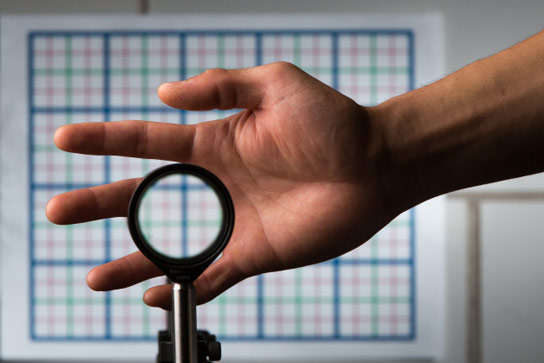
Using a combination of four standard lenses, researchers at the University of Rochester have developed a “cloaking” device that hides objects when you look at them straight on.
Inspired perhaps by Harry Potter’s invisibility cloak, scientists have recently developed several ways—some simple and some involving new technologies—to hide objects from view. The latest effort, developed at the University of Rochester, not only overcomes some of the limitations of previous devices, but it uses inexpensive, readily available materials in a novel configuration.
“There have been many high-tech approaches to cloaking and the basic idea behind these is to take light and have it pass around something as if it isn’t there, often using high-tech or exotic materials,” said John Howell, a professor of physics at the University of Rochester. Forgoing the specialized components, Howell and graduate student Joseph Choi developed a combination of four standard lenses that keep the object hidden as the viewer moves up to several degrees away from the optimal viewing position.
“This is the first device that we know of that can do three-dimensional, continuously multidirectional cloaking, which works for transmitting rays in the visible spectrum,” said Choi, a PhD student at Rochester’s Institute of Optics.
Many cloaking designs work fine when you look at an object straight on, but if you move your viewpoint even a little, the object becomes visible, explains Howell. Choi added that previous cloaking devices can also cause the background to shift drastically, making it obvious that the cloaking device is present.
In order to both cloak an object and leave the background undisturbed, the researchers determined the lens type and power needed, as well as the precise distance to separate the four lenses. To test their device, they placed the cloaked object in front of a grid background. As they looked through the lenses and changed their viewing angle by moving from side to side, the grid shifted accordingly as if the cloaking device was not there. There was no discontinuity in the grid lines behind the cloaked object, compared to the background, and the grid sizes (magnification) matched.
The Rochester Cloak can be scaled up as large as the size of the lenses, allowing fairly large objects to be cloaked. And, unlike some other devices, it’s broadband so it works for the whole visible spectrum of light, rather than only for specific frequencies.
Their simple configuration improves on other cloaking devices, but it’s not perfect. “This cloak bends light and sends it through the center of the device, so the on-axis region cannot be blocked or cloaked,” said Choi. This means that the cloaked region is shaped like a doughnut. He added that they have slightly more complicated designs that solve the problem. Also, the cloak has edge effects, but these can be reduced when sufficiently large lenses are used.
In a new paper submitted to the journal Optics Express, Howell and Choi provide a mathematical formalism for this type of cloaking that can work for angles up to 15 degrees, or more. They use a technique called ABCD matrices that describes how light bends when going through lenses, mirrors, or other optical elements.
While their device is not quite like Harry Potter’s invisibility cloak, Howell had some thoughts about potential applications, including using cloaking to effectively let a surgeon “look through his hands to what he is actually operating on,” he said. The same principles could be applied to a truck to allow drivers to see through blind spots on their vehicles.
Howell became interested in creating simple cloaking devices with off-the-shelf materials while working on a holiday project with his children. Together with his 14-year-old son and Choi, he recently published a paper about some of the possibilities, and also demonstrated simple cloaking with mirrors, like magicians would use, in a brief video (below).

To build your own Rochester Cloak, follow these simple steps:
- Purchase 2 sets of 2 lenses with different focal lengths f1 and f2 (4 lenses total, 2 with f1 focal length, and 2 with f2 focal length)
- Separate the first 2 lenses by the sum of their focal lengths (So f1 lens is the first lens, f2 is the 2nd lens, and they are separated by t1= f1+ f2).
- Do the same in Step 2 for the other two lenses.
- Separate the two sets by t2=2 f2 (f1+ f2) / (f1— f2) apart, so that the two f2 lenses are t2 apart.
NOTES:
- Achromatic lenses provide the best image quality.
- Fresnel lenses can be used to reduce the total length (2t1+t2)
- Smaller total length should reduce edge effects and increase the range of angles.
- For an easier, but less ideal, cloak, you can try the 3 lens cloak in the paper.
Reference: “Paraxial Ray Optics Cloaking” by Joseph S. Choi and John C. Howell, 16 September 2014, Optics Express.
DOI: 10.1364/OE.22.029465
Never miss a breakthrough: Join the SciTechDaily newsletter.
Follow us on Google and Google News.
1 Comment
The real cloaking device has been created. It can route sound waves around an object, making it invisible