
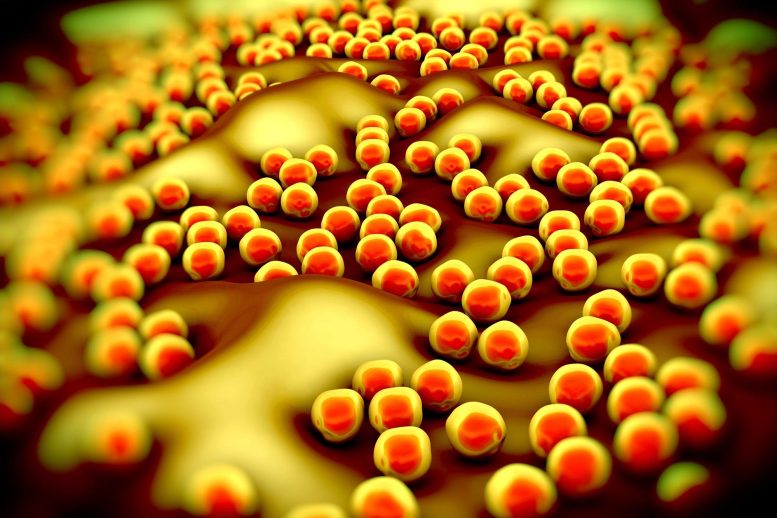
A compound that both inhibits the MRSA superbug and renders it more vulnerable to antibiotics in lab experiments has been discovered by researchers at the University of Bath in the UK.
Antibiotic resistance poses a major threat to human health around the world, and Staphylococcus aureus has become one of the most notorious multidrug-resistant pathogens. Led by Dr. Maisem Laabei and Dr. Ian Blagbrough at the University of Bath, scientists have discovered a compound that both inhibits the Methicillin-resistant Staphylococcus aureus (MRSA) superbug and renders it more vulnerable to antibiotics.
Staphylococcus aureus (staph) is a type of bacteria found on people’s skin. Staph bacteria are usually harmless, but they can cause serious infections that can lead to sepsis or death. Methicillin-resistant Staphylococcus aureus (MRSA) is a cause of staph infection that is difficult to treat because of resistance to some antibiotics.
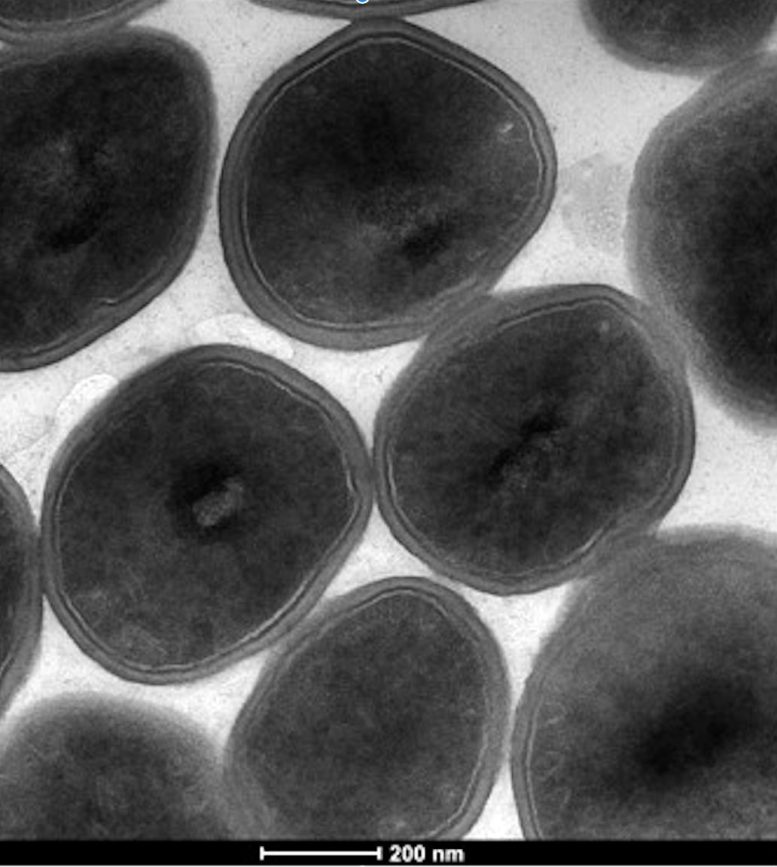
The novel compound – a polyamine – seems to destroy S. aureus, the bacterium that causes (among other things) deadly MRSA infections, by disrupting the pathogen’s cell membrane.
The compound was tested in-vitro against 10 different antibiotic-resistant strains of S. aureus. Some of the strains tested are known to be resistant to vancomycin – the final drug of choice given to patients fighting an MRSA infection. The new compound was completely successful against all strains, resulting in no further bacterial growth.
As well as destroying S. aureus directly, the study demonstrates that the compound is able to restore the sensitivity of multidrug-resistant strains of the bacteria to three important antibiotics (daptomycin, oxacillin, and vancomycin). This could mean that antibiotics that have lost their effectiveness through decades of overuse may, in time, reclaim their capacity to bring serious infections under control.
“We’re not entirely sure why these synergies occur between the compound and antibiotics, but we’re keen to explore this further,” said Dr. Laabei, a researcher from the Department of Live Sciences at Bath.
The Pathogen’s Vulnerability
Polyamines are naturally occurring compounds found in most living organisms that interact with negatively charged molecules such as DNA, RNA, and proteins. Until a decade ago, they were thought to be essential to all life, but scientists now know they are both absent in, and toxic to, S. aureus. Since making this discovery, scientists have been attempting to exploit the pathogen’s unusual vulnerability to polyamines to inhibit bacterial growth.
Now Dr. Laabei and his colleagues have found that a modified polyamine (named AHA-1394) is far more effective at destroying antibiotic-resistant strains of S. aureus than even the most active natural polyamine.
Explaining, Dr. Laabei said: “Using our novel compound, the pathogen is destroyed – meaning growth is inhibited – when it’s used at a concentration that’s over 128 times lower than that required to destroy the pathogen when we use a natural polyamine.
“This is important, as drugs that have the lowest minimum inhibitory concentration are likely to be more effective antimicrobial agents, and to be safer to the patient.”
Though further research is needed, Dr. Laabei believes the new compound “could have important implications in a clinical setting as a new treatment option.”
He said: “Preliminary research suggests the compound is non-toxic to humans, which of course is essential. In our next study, for which we’re seeking funding, we hope to focus on the precise mechanisms used by the compound to inhibit S. aureus. We believe the compound attacks the membrane of S. aureus, resulting in the membrane becoming permeable, resulting in bacterial death.”
The compound was also tested against biofilm – the thin, hard-to-treat layer of microorganisms that grows on hard surfaces (seen, for instance, as plaque on teeth or a stubborn film on urinary catheters) and can result in serious infection. The results were promising here too, with the compound preventing the formation of new biofilm, though not disrupting established biofilm.
Antibiotic Resistance
Antibiotic resistance (or antimicrobial resistance – AMR) poses a major threat to human health around the world, and S. aureus has become one of the most notorious multidrug-resistant pathogens.
A recent study looking back at the health effects of AMR in 2019 finds the pathogen was associated with one million deaths worldwide, as a result of infections not responding to antibiotics.
S. aureus is found in 30% of the population, living in people’s nasal passages and on the skin, and mostly it does not cause infection. Until quite recently, an MRSA infection was regarded as a hospital problem, and those affected were mostly people with an already compromised immune system. Over the past 20 years, however, for complex and only partially understood reasons, there has been an upswing in community-wide infections even among otherwise healthy individuals, bringing a sense of urgency to the quest to find fresh ways to tackle the problem.
“New treatments are urgently needed to treat infections,” said Dr. Laabei.
Reference: “Antibacterial activity of novel linear polyamines against Staphylococcus aureus” by Edward J. A. Douglas, Abdulaziz H. Alkhzem, Toska Wonfor, Shuxian Li, Timothy J. Woodman, Ian S. Blagbrough and Maisem Laabei, 22 August 2022, Frontiers in Microbiology.
DOI: 10.3389/fmicb.2022.948343
Funding for this research came from the GW4 Generator Award (GW4-GF2-015).
Never miss a breakthrough: Join the SciTechDaily newsletter.
Follow us on Google and Google News.
9 Comments
I have a time-kill study on MRSA at an FDA-certified lab with a high concentration of colloidal silver called NutraSilver that demonstrates a 99.9999% kill in under 60 seconds. Please contact me should you wish further proof.
Russell Altman, Sacramento, Ca.
SciTech is a Step-by-Step process like going over stairs to reach the next storey of the building. Elevators skip that process, yes !
Mr.Altman
You are so right!! I used to suffer from staph infections on a regular basis because of the fact that I was a intravenous heroin user I have since been clean for the past two and a half years but thanks to colloidal silver it saved my life I know that if I were not to have been recommended this for my staph infections I most likely would have died more than once. I am constantly telling other people about using this some listen some don’t but I know the ones that do this in say nothing but great things about it so yes you are definitely on to something I hope you get the notoriety you deserve!
wow, the disease is being spread through dirty medical mesh devices. the cdc and fda did investigate in 2012 the Bard ventralyx st and stents many mesh devices were contaminated with staph,strep.being not made in china instead made on dirty apt floor in india along with heart medicine pills packed with nothing but paint chips.a ‘voluntary recall’ is the best? the usa can do? plus covering it up.by horrendous extended litigation,takes 10 years for one lawsuitto settle.ridicoulous.i remember in 2013 when the dr cray cray tried to tell me i had to come back to hospital or die becsuse i tested positive for mrsa. laughed at them and told em,yes had it since 1984.
Because of us constantly trying as humans to beat virus strains we have forgotten the most fundamental and simplest of ways in which to defeat or overcome any virus. Natural immunity! Darewins law of nature! Every spiecies has to naturaly develope and overcome obstacles so that tge strongest of every species will servive to ensure the survival of their species.
Because hu.ans are so hell bent on fighting nature we will ultimately be the cause of our own demonize!
Continuously doing Gain of function research and/or the equivalent of we are causing the current and future issues of viruses that will ultimately destroy us!
I use MicroSure 8HD to protect agaist any virus
Microsure is also used for wound care
Hopefully this silver at 500ppm works
Colloidal silver HOME MADE YOUR SELF WORKS EVERY TIME. KILLS ALL ONE LIVING CELL ORGANIZIAM on contact.
Triples ur fighting cells immediately
. What they sell in stores has less than 10 present silver in it… IT WONT WORK. LEARN TO MAKE IT YOUR SELVES