
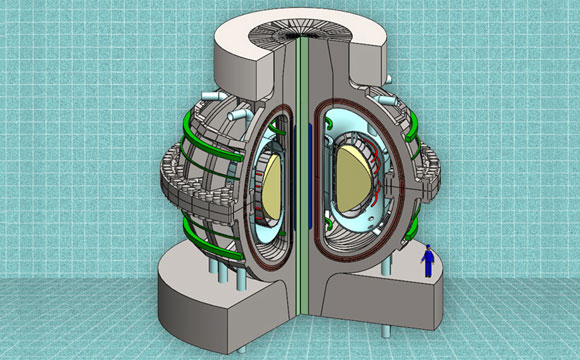
Advances in magnet technology have enabled MIT scientists to propose a new design for a practical compact tokamak fusion reactor.
It’s an old joke that many fusion scientists have grown tired of hearing: Practical nuclear fusion power plants are just 30 years away — and always will be.
But now, finally, the joke may no longer be true: Advances in magnet technology have enabled researchers at MIT to propose a new design for a practical compact tokamak fusion reactor — and it’s one that might be realized in as little as a decade, they say. The era of practical fusion power, which could offer a nearly inexhaustible energy resource, may be coming near.
Using these new commercially available superconductors, rare-earth barium copper oxide (REBCO) superconducting tapes, to produce high-magnetic field coils “just ripples through the whole design,” says Dennis Whyte, a professor of Nuclear Science and Engineering and director of MIT’s Plasma Science and Fusion Center. “It changes the whole thing.”
The stronger magnetic field makes it possible to produce the required magnetic confinement of the superhot plasma — that is, the working material of a fusion reaction — but in a much smaller device than those previously envisioned. The reduction in size, in turn, makes the whole system less expensive and faster to build, and also allows for some ingenious new features in the power plant design. The proposed reactor, using a tokamak (donut-shaped) geometry that is widely studied, is described in a paper in the journal Fusion Engineering and Design, co-authored by Whyte, Ph.D. candidate Brandon Sorbom, and 11 others at MIT. The paper started as a design class taught by Whyte and became a student-led project after the class ended.
Power plant prototype
The new reactor is designed for basic research on fusion and also as a potential prototype power plant that could produce significant power. The basic reactor concept and its associated elements are based on well-tested and proven principles developed over decades of research at MIT and around the world, the team says.
“The much higher magnetic field,” Sorbom says, “allows you to achieve much higher performance.”
Fusion, the nuclear reaction that powers the sun, involves fusing pairs of hydrogen atoms together to form helium, accompanied by enormous releases of energy. The hard part has been confining the superhot plasma — a form of electrically charged gas — while heating it to temperatures hotter than the cores of stars. This is where the magnetic fields are so important—they effectively trap the heat and particles in the hot center of the device.
While most characteristics of a system tend to vary in proportion to changes in dimensions, the effect of changes in the magnetic field on fusion reactions is much more extreme: The achievable fusion power increases according to the fourth power of the increase in the magnetic field. Thus, doubling the field would produce a 16-fold increase in the fusion power. “Any increase in the magnetic field gives you a huge win,” Sorbom says.
Tenfold boost in power
While the new superconductors do not produce quite a doubling of the field strength, they are strong enough to increase fusion power by about a factor of 10 compared to standard superconducting technology, Sorbom says. This dramatic improvement leads to a cascade of potential improvements in reactor design.
The world’s most powerful planned fusion reactor, a huge device called ITER that is under construction in France, is expected to cost around $40 billion. Sorbom and the MIT team estimate that the new design, about half the diameter of ITER (which was designed before the new superconductors became available), would produce about the same power at a fraction of the cost and in a shorter construction time.
But despite the difference in size and magnetic field strength, the proposed reactor, called ARC, is based on “exactly the same physics” as ITER, Whyte says. “We’re not extrapolating to some brand-new regime,” he adds.
Another key advance in the new design is a method for removing the fusion power core from the donut-shaped reactor without having to dismantle the entire device. That makes it especially well-suited for research aimed at further improving the system by using different materials or designs to fine-tune the performance.
In addition, as with ITER, the new superconducting magnets would enable the reactor to operate in a sustained way, producing a steady power output, unlike today’s experimental reactors that can only operate for a few seconds at a time without overheating of copper coils.
Liquid protection
Another key advantage is that most of the solid blanket materials used to surround the fusion chamber in such reactors are replaced by a liquid material that can easily be circulated and replaced, eliminating the need for costly replacement procedures as the materials degrade over time.
“It’s an extremely harsh environment for [solid] materials,” Whyte says, so replacing those materials with a liquid could be a major advantage.
Right now, as designed, the reactor should be capable of producing about three times as much electricity as is needed to keep it running, but the design could probably be improved to increase that proportion to about five or six times, Sorbom says. So far, no fusion reactor has produced as much energy as it consumes, so this kind of net energy production would be a major breakthrough in fusion technology, the team says.
The design could produce a reactor that would provide electricity to about 100,000 people, they say. Devices of a similar complexity and size have been built within about five years, they say.
“Fusion energy is certain to be the most important source of electricity on earth in the 22nd century, but we need it much sooner than that to avoid catastrophic global warming,” says David Kingham, CEO of Tokamak Energy Ltd. in the UK, who was not connected with this research. “This paper shows a good way to make quicker progress,” he says.
The MIT research, Kingham says, “shows that going to higher magnetic fields, an MIT specialty, can lead to much smaller (and hence cheaper and quicker-to-build) devices.” The work is of “exceptional quality,” he says; “the next step … would be to refine the design and work out more of the engineering details, but already the work should be catching the attention of policy makers, philanthropists, and private investors.”
The research was supported by the U.S. Department of Energy and the National Science Foundation.
Reference: “ARC: A compact, high-field, fusion nuclear science facility and demonstration power plant with demountable magnets” by B. N. Sorbom, J. Ball, T. R. Palmer, F. J. Mangiarotti, J. M. Sierchio, P. Bonoli, C. Kasten, D. A. Sutherland, H. S. Barnard, C. B. Haakonsen, J. Goh, C. Sung and D.G. Whyte, 27 September 2015, Fusion Engineering and Design.
DOI: 10.1016/j.fusengdes.2015.07.008
Never miss a breakthrough: Join the SciTechDaily newsletter.
Follow us on Google and Google News.
6 Comments
Quote:
[Fusion energy is certain to be the most important source of electricity on earth in the 22nd century, but we need it much sooner than that to avoid catastrophic global warming,” says David Kingham, CEO of Tokamak Energy Ltd. in the UK, who was not connected with this research. “This paper shows a good way to make quicker progress,” he says.]
There are plenty studies out there showing we can NOW have 100% renewable energy for all of our needs by some mix of wind, pv, hydro and biomass and if we want to avert the worst of climate change we have to act now, not just in 30 years or even 60.
The only ones in the way of an RE revolution are incumbent FF advocates that cling to coal, oil and gas as our main energy source to funnel money in their pockets.
I’m all for fusion as mankind (life) will need it down the road to make it out of this solar system, but it won’t help us TODAY to avoid catastrophic climate change. We already have the tech to do this now with PV, wind and other stuff, we don’t need to wait for fusion.
There is a alternative power source right now that would work.
But Greenpeace an the like have people running in fear.
1. Fusion is government pork just like many other aspects of government spending in the US and in Europe. If the billions spent on fusion were spent on PV instead most of our electricity needs would already be met. The project mentioned about is $40B. At today’s installed PV cost of roughly $4/Watt that equates to 1 Tera-watt of power!!
2. Jim: Why make a comment if it doesn’t say anything? What’s the secret? Is Greenpeace hiding Perpetual Motion or something?
3. The solution already available to us today is solar power combined with storage batteries. PV continues to improve as does battery tech, so the argument that it won’t work is moot. When PV manufacturing is also powered by it’s own PV cells the argument against how much power it takes to produce them also goes away. PV installation rates have increased exponentially. At some point we will realize, hey, we have all the electricity we need!! All by using the fusion power plant in the sky.
4. Also, an area that has not been addressed to any great degree is solar thermal energy to heat homes and water, and is not something that requires new technology or a rocket science major to understand. I built my own panels to heat my home in the winter, and hot water all year round. I save about 50% of my energy bill.
5. If the “world” really wanted to cut energy requirements it could. But politics and powerful corporations slow us down.
What the last commenter said was spot on. We have the workable affordable technology now to cut energy usage, de-centralize energy production, and stop the waste and risk of big energy projects including any kind of nuclear. We have more affordable solutions than battery storage. Optical solar mirror concentrator plants can store the solar heat in molten salt for 24 hour power. Also, pumped water (uphill) and associated downhill hydro-generation is also a 24-hour stored energy concept that works that isn’t extravagantly expensive. It can even be worked into water delivery systems like canals which have a regulated flow to produce 24-hour power and water delivery running on all our cylinders so to speak buy killing two problems with one approach.
One question I have about the safety of this design is, WHAT happens to a fusion power plant and the surrounding community if there is a breach of the magnetic field or the field entire drops due to a technical failure at the plant or act of sabotage or terrorism? What exactly will happen with millions of degrees hot plasma to the surrounding employees of the plant, the plant itself, and the surrounding community? I don’t think they’ve done any testing on this aspect have they? This needs to be answered before the public is going to accept the fabled “safer than fission reactors” mantra after all the bad nuclear incidents we have suffered so far. I’m not convinced there is ever a completely guaranteed safe way to contain this material and what happens if you fail to contain it.. what then? That is a big nasty surprise potentially waiting to be found out. Super hot material that could turn into a fission process escaping at millions of degrees setting fire to and incinerating everything and irradiating everything for how far of a distance from the plant?
It may be technically brilliant to some measure, BUT given the delicacy of things we have on our plate right now, is this seriously a risk worth taking to build ultra extravagantly expensive unknown time to completion, unknown time of longevity, unknown risk of failure, unproven technology based power plants like ITER when we have much more low-cost proven-safe generation technologies out there that can guarantee us a time-frame for saving the planet from the carbon-doom and nuclear fission-bomb power plant melt-down dooms we are still heading for with no abandon?
If you want to understand who is driving the mania about “global warming”, ask yourself who stands to gain the most if people believe this hogwash. It’s all the private investors who have money invested and want to see government’s pour additional funds into the pot. Follow the money.
Those with a bias for solar energy were around in the 1930’s, they would have developed WMD that killed by having little hammers pop out and clobber people very fast.