
Close Menu
    Facebook X (Twitter) Instagram
    SciTechDaily
    • Biology
    • Chemistry
    • Earth
    • Health
    • Physics
    • Science
    • Space
    • Technology
    Facebook X (Twitter) Pinterest YouTube RSS
    SciTechDaily
    Home»Health»New Details on Rare Immune Disease Uncovered by NIH Researchers in 11-Year Study
    Health

    New Details on Rare Immune Disease Uncovered by NIH Researchers in 11-Year Study

    By National Institutes of Health (NIH)May 8, 2023No Comments3 Mins Read
    Facebook Twitter Pinterest Telegram LinkedIn WhatsApp Email Reddit
    Share
    Facebook Twitter LinkedIn Pinterest Telegram Email Reddit
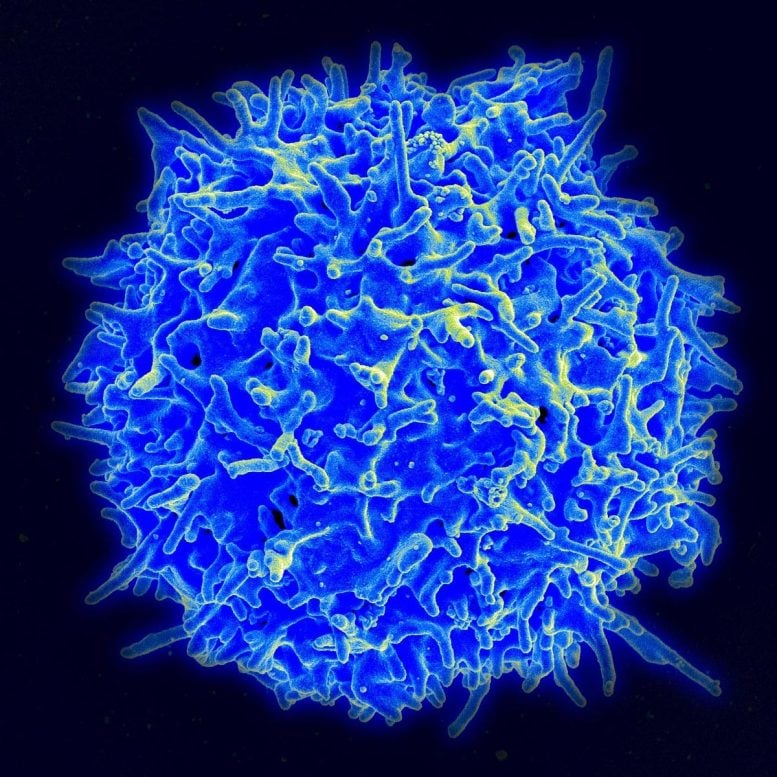
    Healthy Human T Cell Scanning Electron Micrograph
    Scanning electron micrograph of a human T cell from the immune system of a healthy donor. In an 11-year study by the National Institutes of Health, researchers further characterized idiopathic CD4 lymphocytopenia (ICL), a rare immune deficiency that increases vulnerability to infectious diseases, autoimmune diseases, and cancers. Credit: NIAID

    NIH Researchers Uncover New Details on Rare Immune Disease

    NIH researchers characterize ICL, a rare immune deficiency, linking severe cases to higher risk of infections and cancers.

    In an 11-year study, researchers at the National Institutes of Health (NIH) have further characterized idiopathic CD4 lymphocytopenia (ICL), a rare immune deficiency that leaves people vulnerable to infectious diseases, autoimmune diseases, and cancers. Researchers observed that people with the most severe cases of ICL had the highest risk of acquiring or developing several of the diseases associated with this immune deficiency. This study, published on May 4 in the New England Journal of Medicine, was led by Irini Sereti M.D., M.H.S. and Andrea Lisco, M.D., Ph.D. of the HIV Pathogenesis Section in the Laboratory of Immunoregulation at the National Institute of Allergy and Infectious diseases (NIAID), part of NIH, and conducted at the NIH Clinical Center.

    ICL is a condition marked by too few CD4+ T-cells, which are a type of white blood cell. The clinical definition of ICL is a CD4+ T-cell count of less than 300 cells per cubic millimeter (mm³) of blood for at least six weeks, in the absence of any disease or therapy associated with reduced white blood cells. Unlike HIV, a virus that suppresses the immune system if left untreated, there is no evidence that ICL is transmitted from person to person, and it has no known cause. There are limited therapeutic options for ICL.

    Infection, Cancer, and Autoimmune Risks

    In this observational study, the NIAID researchers quantified immune cells and noted the presence of opportunistic infections—infections that typically only affect people with suppressed immune systems—and other clinical conditions among 91 participant volunteers with ICL. The most prevalent opportunistic infections were human papillomavirus-related diseases (in 29% of participants), cryptococcosis (24%), molluscum contagiosum (9%), and mycobacterial diseases other than tuberculosis (5%). Participants with CD4+ T-cell counts below 100 cells per mm³ had a more than five-fold higher risk of opportunistic infections than those with CD4+ T-cell counts above 100 cells. Cancer risk was also higher in individuals with the lowest CD4+ T-cell counts, but the risk of autoimmune disease was lower.

    These findings further support the inverse correlation between CD4+ T-cell count and susceptibility to viral, fungal, and mycobacterial infections, as well as certain cancers, according to the authors. NIAID continues to pursue research on the natural history of rare conditions such as ICL to understand disease progression, as well as potential therapeutic interventions.

    “Reappraisal of Idiopathic CD4 Lymphocytopenia at 30 Years” by Andrea Lisco, M.D., Ph.D., Ana M. Ortega-Villa, Ph.D., Harry Mystakelis, M.D., M.H.S., Megan V. Anderson, R.N., B.A., Allyson Mateja, M.S.P.H., Elizabeth Laidlaw, P.A.-C., Maura Manion, M.D., Gregg Roby, R.N., B.S., Jeanette Higgins, Ph.D., Safia Kuriakose, Pharm.D., Magdalena A. Walkiewicz, Ph.D., Morgan Similuk, Sc.M., Jennifer W. Leiding, M.D., Alexandra F. Freeman, M.D., Virginia Sheikh, M.D. and Irini Sereti, M.D., M.H.S., 4 May 2023. New England Journal of Medicine.
    DOI: 10.1056/NEJMoa2202348

    Andrea Lisco, M.D., Ph.D. is an assistant clinical investigator in the HIV Pathogenesis Section of NIAID’s Laboratory of Immunoregulation, and Irini Sereti, M.D., M.H.S. is chief of the HIV Pathogenesis section. 

    Never miss a breakthrough: Join the SciTechDaily newsletter.
    Follow us on Google and Google News.

    Cancer Immunology Infectious Diseases National Institutes of Health
    Share. Facebook Twitter Pinterest LinkedIn Email Reddit

    Related Articles

    Scientists Pinpoint “Rogue Antibodies” Associated With Severe COVID-19 Blood Clotting

    New Study of Extra COVID-19 Vaccine Dose in People With Autoimmune Disease

    New Malaria Vaccine Shows Unprecedented Protection – Safe, Strong, and Lasting

    New Results From Monkeys Infected With SARS-CoV-2 Suggest COVID-19 Vaccines Will Be Successful

    Large Clinical Trial Testing Combination Monoclonal Antibody Therapy for Mild/Moderate COVID-19

    NIH Researchers Uncover Brain Damage in COVID-19 Patients, Despite No Infection of the Brain

    Mini Antibodies Produced by a Llama and Isolated by Neuroscientists Could Prevent COVID-19 Infection

    Monoclonal Antibodies to Prevent COVID-19: Phase 3 Clinical Trials Now Enrolling

    CBD May Help Reduce the Cytokine Storm and Avert Lung Destruction in COVID-19

    Leave A Reply Cancel Reply

    • Facebook
    • Twitter
    • Pinterest
    • YouTube

    Don't Miss a Discovery

    Subscribe for the Latest in Science & Tech!

    Trending News

    Popular Supplement Ingredient Linked to Shorter Lifespan in Men

    Scientists May Have Found a Way To Repair Nerve Damage in Multiple Sclerosis

    “Totally Unexpected” – Scientists Discover Pancreatic Cancer’s Fatal Addiction

    A Strange Quantum Effect May Explain One of Biology’s Greatest Mysteries

    James Webb Telescope Reveals the Universe’s Hidden Cosmic Web in Stunning Detail

    Scientists Identify Simple Supplement That Greatly Reduces Alzheimer’s Damage

    You May Have a Dangerous Type of Cholesterol Even if Your Tests Look Normal

    Your Blood Pressure Reading Could Be Wrong Because of One Simple Mistake

    Follow SciTechDaily
    • Facebook
    • Twitter
    • YouTube
    • Pinterest
    • Newsletter
    • RSS
    SciTech News
    • Biology News
    • Chemistry News
    • Earth News
    • Health News
    • Physics News
    • Science News
    • Space News
    • Technology News
    Recent Posts
    • After 50 Years of Mystery, Researchers Identify New Human Blood Group
    • Leading Climate Scientist Rebuts “Factually Incorrect” US Government Climate Claims
    • You’re Breathing Plastic: Study Finds 4% of City Air Pollution Is Microplastics
    • Cancer Mystery Solved: Scientists Discover How Melanoma Becomes “Immortal”
    • Scientists Uncover Cancer-Fighting Power of Popular Fatty Liver Drug
    Copyright © 1998 - 2026 SciTechDaily. All Rights Reserved.
    • Science News
    • About
    • Contact
    • Editorial Board
    • Privacy Policy
    • Terms of Use

    Type above and press Enter to search. Press Esc to cancel.