
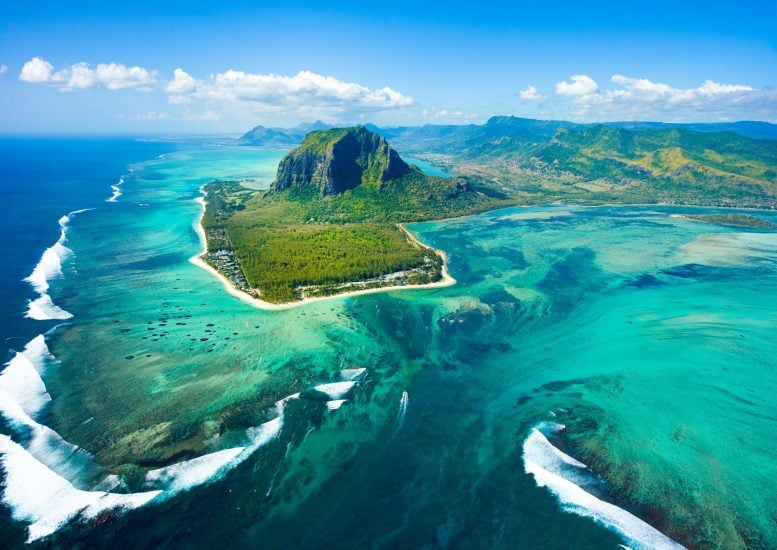
Mauritius, once a lush paradise, is losing its unique flora and fauna due to extinctions triggered by human activity and introduced species. Protecting native species can halt further extinctions.
The small island of Mauritius in the Indian Ocean is often envisioned as a lush paradise, dotted with large trees and teeming with a diverse array of exotic, beautifully colored animals.
However, this idyllic picture may not be accurate. Like many other locations around the world, the island and its natural habitat are facing the threat of mass extinction, and in just a matter of a few decades, the abundant flora and diverse fauna could be almost gone.
At least if the extinction of the many plants and animals on the island continues. They are part of a particularly sensitive ecosystem where animals help plants spread their seeds. However, if the animals disappear or are replaced by completely new species, the seeds will not spread in the same way as before. And that’s a big problem, according to a new study from the University of Copenhagen.
“Many plants, especially on tropical islands like Mauritius, rely on animals to help spread their seeds. If the animals that can help spread the seeds become extinct, the plants get into trouble because the animals which humans have brought to the island destroy the seeds instead. This increases the risk of the plants that are still on the island dying out,” says Julia Heinen. She is a postdoc at the Center for Macroecology, Evolution and Climate at Globe Institute at the University of Copenhagen and the first author of the new study.
If the plants die, the fruits growing on them will also disappear from the island. And this, in turn, creates new problems for the island’s own small ecosystem, because the animal species that feed on the fruits will also have problems.
Humans Came With New Animal Species – but They Don’t Help
Probably the most famous Mauritian bird that no longer exists is the dodo. It was last seen on the island in the 1600s. And it is nowhere else.
The same fate has befallen other of the island’s special plants and animals such as giant tortoises. And even though new animals have come to the island, they will not have the same characteristics as, for example, the dodo and giant tortoises, says Julia Heinen.
“After the dodo and other Mauritian animals have become extinct, other animals have come to the island. They have either come with the people or they have found their way to the island themselves. But they cannot replace the function of extinct animals in the ecosystem,” she says.
This is because they do not quite behave in the same way as the animals that no longer live on the island.
“Now there are rats, pigs, monkeys, and some other types of birds. And they actually eat the same fruits, but they handle them in a different way, and it doesn’t have a positive effect on the plants,” she says and adds:
“If we remove one species from the island, for example, the dodo, we destroy the connection to others. It’s like a house of cards. Then the plants that were eaten by the dodo and other animals in Mauritius will also be at risk of extinction.”
The Rats Are the Big Villains
It all started about 400 years ago when people came sailing to the island in their boats. On the ships, they had uninvited guests.
“Rats are a big problem when they arrive on an island. They hide on the ships with the humans, so when the humans came to the island, the rats were there. The rats eat and destroy seeds, but they are also fond of birds’ eggs,” says Julia Heinen.
In this way, since humans came to the island, the rats have helped destroy the small ecosystem. But there are still animals and plants that make the ecosystem run around. One of them is a special bat.
“The Mauritian fruit bat is a very unique and endangered animal that plays a vital role in the ecosystem because it is one of the few remaining animals that can disperse the plants over the island. But the authorities are actively killing the bats because they are noisy and eat the mangoes in people’s backyards,” explains Julia Heinen and continues:
“People are very frustrated, but the authorities ignore the science. And Mauritius is the last place on Earth the bat lives.”
The Remaining Animals Protect the Plants
It is only a few hundred years after humans arrived on the island that several plants and animals belonging to the island and the island’s ecosystem have become extinct. And now we are beginning to see the consequences of the animals no longer being on the island.
If we are to save the ecosystem on the island and other small, colorful, and lush islands, we must help it along the way.
“We don’t know yet how to stop extinctions on islands worldwide, but this study makes it clear that on Mauritius we can prevent the loss of the native plants if we stop culling the flying foxes, start conservation projects focused on the Mauritian Bulbul and continue to protect the Telfair’s skink.”
Reference: “Novel plant–frugivore network on Mauritius is unlikely to compensate for the extinction of seed dispersers” by Julia H. Heinen, F. B. Vincent Florens, Cláudia Baider, Julian P. Hume, W. Daniel Kissling, Robert J. Whittaker, Carsten Rahbek and Michael K. Borregaard, 23 February 2023, Nature Communications.
DOI: 10.1038/s41467-023-36669-9
Never miss a breakthrough: Join the SciTechDaily newsletter.
Follow us on Google and Google News.
2 Comments
When the bees go extinct from excessive temperature due to abrupt exponential climate change, humans won’t be far behind. In the Great Chain of Life, everything is dependent on everything else. Humans are deluded by consumerism and unbridled capitalism and forgot our complete and utter dependence on Nature and stable climate. Soon, humans will pay the ultimate price.
Earth is an island in space.