
Indigenous South Americans, not Europeans, were the Falklands’ first visitors.
Since its first recorded sighting by European explorers in the 1600s, scientists and historians have believed that Europeans were the first people to ever set foot on the Falkland Islands. Findings from a new University of Maine-led study, however, suggests otherwise; that human activity on the islands predates European arrival by centuries.
Kit Hamley, National Science Foundation graduate research fellow with the UMaine Climate Change Institute, spearheaded the first-ever scientific investigation into prehistoric human presence on the Southern Atlantic archipelago. She and her team collected animal bones, charcoal records and other evidence from across the islands over multiple expeditions and examined them for indications of human activity using radiocarbon dating and other laboratory techniques.
Charcoal, Fire Spikes, and Early Settlement Clues
One notable sign of pre-European human activity derived from an 8,000-year-old charcoal record collected from a column of peat on New Island, located in the southwestern edge of the territory. According to researchers, the record showed signs of a marked increase in fire activity in 150 C.E., then abrupt and significant spikes in 1410 C.E., and 1770 C.E., the latter of which corresponds with initial European settlement.
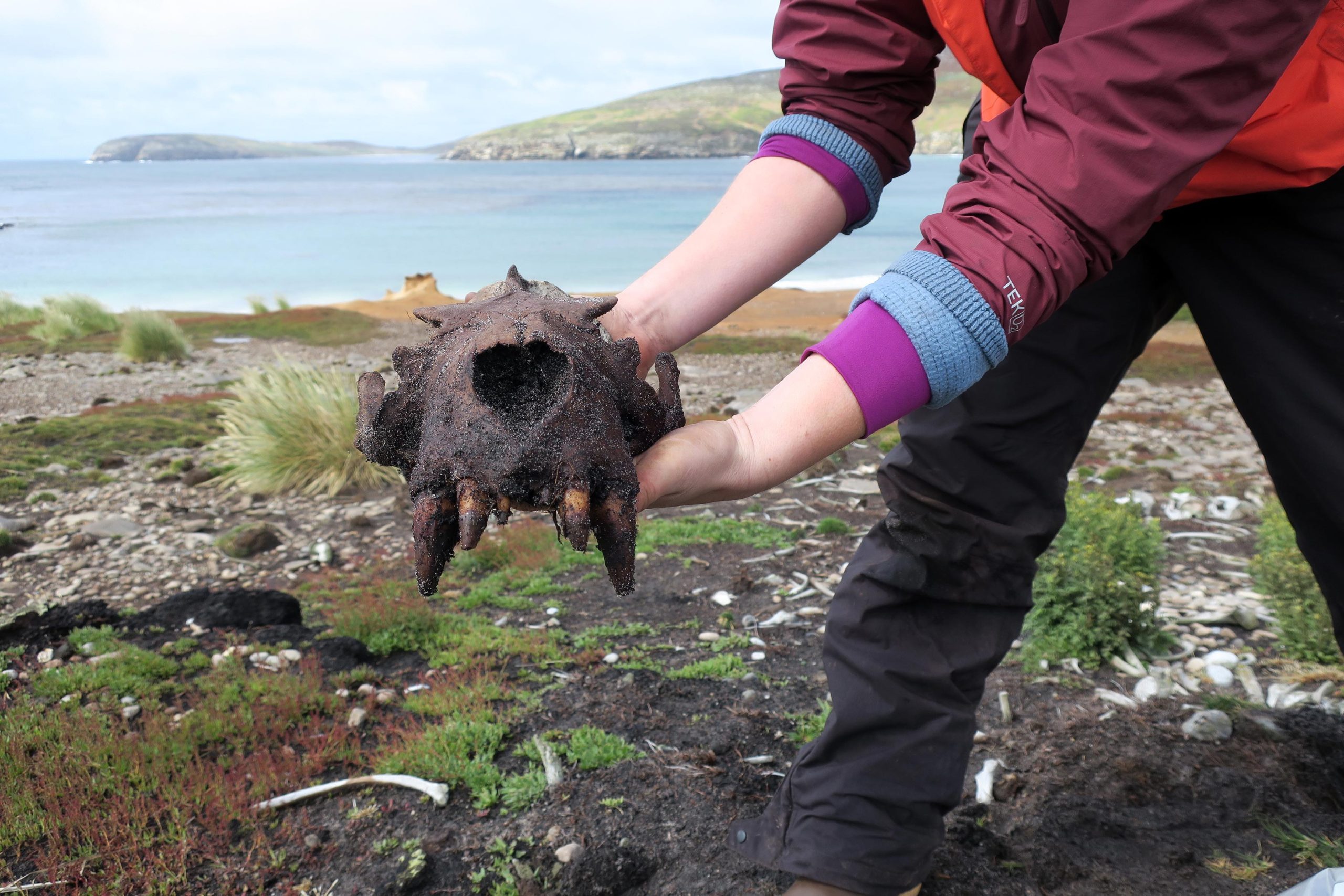
Researchers also gathered sea lion and penguin samples on New Island near the site where a landowner discovered a stone projectile point that is consistent with the technology Indigenous South Americans have used for the past 1,000 years. The bones were heaped in discrete piles at one site. Hamley says the location, volume and type of bones indicated that the mounds were likely assembled by humans.
Most of the evidence Hamley and her colleagues collected indicated that Indigenous South Americans likely traveled to the Falkland Islands between 1275 C.E. and 1420 C.E. Arrival dates prior to 1275 C.E., however, cannot be ruled out because some evidence dates back even earlier, according to researchers. For example, the team found a tooth from an extinct Falkland Islands fox called the warrah with a radiocarbon date of 3450 B.C.E., the oldest for the species. Regardless, all of the team’s findings indicate that people landed in the archipelago before British navigator John Strong in 1690, the first European to set foot on the archipelago.
Short-Term Stays, Lasting Ecological Footprints
Indigenous people likely visited the islands for multiple short-term stays, as opposed to long-term occupation, according to the UMaine researchers. As a result, they left few cultural materials there, but enough for Hamley and her colleagues to find a discernible anthropogenic and paleoecological footprint and conduct their study.
“These findings broaden our understanding of Indigenous movement and activity in the remote and harsh South Atlantic Ocean,” says Hamley, a UMaine Ph.D. student of ecology and environmental sciences. “This is really exciting because it opens up new doors for collaborating with descendant Indigenous communities to increase our understanding of past ecological changes throughout the region. People have long speculated that it was likely that Indigenous South Americans had reached the Falkland Islands, so it is really rewarding to get to play a role in helping bring that part of the past to life of the islands.”
UMaine researchers who participated in the study with Hamley include her adviser, Jacquelyn Gill, an associate professor of paleoecology and plant ecology; Daniel Sandweiss, a professor of anthropology; and Brenda Hall, a professor of glacial geology.
Other investigators involved in the research include Dulcinea Groff, a postdoctoral research scientist at the University of Wyoming and former UMaine Ph.D. student; Kathryn Krasinski, an assistant professor of anthropology at Adelphi University; John Southon; a researcher with the Department of Earth System Science at the University of California-Irvine; Paul Brickle, executive director of the South Atlantic Environmental Research Institute; and Thomas Lowell, a geology professor with the University of Cincinnati.
Science Advances, a journal from the American Association for the Advancement of Sciences (AAAS), published a report of their findings.
Hamley’s most recent study builds on her research into the warrah (Dusicyon australis), an extinct species of fox. The warrah was the only native and terrestrial mammal to reside on the Falkland Islands at the time of European arrival. Subsequent hunting wiped the species out in 1856, making it the first extinct canid in the historic record, Hamley says.
For years, various scholars, including Charles Darwin, have debated the warrah’s origins and how it came to the islands. Hamley hypothesizes that humans may have introduced the species to the archipelago prior to European settlement. Many previously rejected the theory based on a prior lack of scientific evidence, but the latest findings from Hamley’s team reopens that possibility, she says. Indigenous South Americans may have domesticated warrah as they have with other foxes and canids, and brought them to the islands during their voyages and short-term stays.
Evidence of Human-Warrah Connections
During a 2018 expedition to the islands, Hamely and her colleagues found three warrah bone samples at Spring Point Farm in West Falkland. Carbon dating and isotopic analysis revealed the warrah whose bones were analyzed “had a marine-based diet consisting primarily of apex marine predators” like sea lions and fur seals, a similar diet to seafaring Indigenous South Americans in prehistoric times, according to researchers. While these findings could reflect coastal scavenging, it may exemplify the food their potential human counterparts were procuring and eating, researchers say.
“This study has the potential to change the trajectory of future ecological research in The Falklands,” says Hamley. “The introduction of a top predator, like the warrah, could have had profound implications for the biodiversity of the islands, which are home to ground nesting seabirds such as penguins, albatross, and cormorants. It also changes the ever-captivating story of past human-canine relationships. We know that Indigenous South Americans domesticated foxes, but this study helps show how potentially important these animals were to those communities extending back thousands of years.”
Hamley conducted her research during three expeditions to the Falkland Islands in 2014, 2016 and 2018. During the 2016 journey, she participated in UMaine’s Follow a Researcher program, through which scientists give K–12 students a glimpse of their work through live expedition updates, Twitter chats and videos.
Building a New Picture of the Falklands’ Past
The study led by Hamley contributes to the growing body of scientific investigations into the ecological, anthropological and climate history of the Falklands Islands conducted by UMaine researchers. A 2020 UMaine-led study discovered that the establishment of seabird colonies on the islands in response to an abrupt regional cooling period 5,000 years ago changed its ecosystems.
“As the world warms, we hope our growing understanding of the pre-colonial history of the Falklands will help decision-makers balance the needs of wildlife and people, who rely on ecotourism, fisheries and other industries,” says Gill, an NSF CAREER researcher who was named a 2020 Friend of the Planet by the National Center for Science Education. “We’re only just beginning to piece together the role people played in the Falklands before European settlement. Because of centuries of colonialism on the mainland, a lot of the oral knowledge about this period was lost. Western science needs updating, and we hope future work will be done in collaboration with the modern-day Indigenous people in the region; their ancestors were the first experts here.”
Reference: “Evidence of prehistoric human activity in the Falkland Islands” by Kit M. Hamley, Jacquelyn L. Gill, Kathryn E. Krasinski, Dulcinea V. Groff, Brenda L. Hall, Daniel H. Sandweiss, John R. Southon, Paul Brickle and Thomas V. Lowell, 27 October 2021, Science Advances.
DOI: 10.1126/sciadv.abh3803
Never miss a breakthrough: Join the SciTechDaily newsletter.
Follow us on Google and Google News.
1 Comment
thanks alot of information