
Close Menu
    Facebook X (Twitter) Instagram
    SciTechDaily
    • Biology
    • Chemistry
    • Earth
    • Health
    • Physics
    • Science
    • Space
    • Technology
    Facebook X (Twitter) Pinterest YouTube RSS
    SciTechDaily
    Home»Space»New Details on the Unexpected Atmospheric Vortex Behavior on Titan
    Space

    New Details on the Unexpected Atmospheric Vortex Behavior on Titan

    By University of BristolNovember 21, 2017No Comments3 Mins Read
    Facebook Twitter Pinterest Telegram LinkedIn WhatsApp Email Reddit
    Share
    Facebook Twitter LinkedIn Pinterest Telegram Email Reddit
    Study Reveals Unexpected Atmospheric Vortex Behaviour on Titan
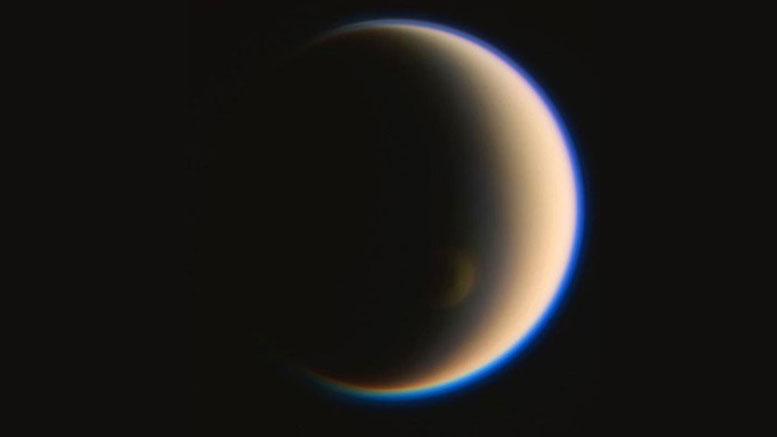
    Titan’s winter polar vortex imaged by the Cassini Spacecraft’s ISS camera. The vortex is now in deep winter and can only be seen because the polar clouds within the vortex extend high above Titan’s surface into the sunlight. The vortex was extremely cold from 2012-2015 giving rise to unusual nitrile ice clouds. Credit: NASA/JPL-Caltech/Space Science Institute/Jason Major

    New research shows that the recently reported unexpected behavior on Saturn’s largest moon Titan is due to its unique atmospheric chemistry.

    Titan’s polar atmosphere recently experiences an unexpected and significant cooling, contrary to all model predictions and differing from the behavior of all other terrestrial planets in our solar system.

    Titan is the largest moon of Saturn, is bigger than the planet Mercury, and is the only moon in our solar system to have a substantial atmosphere.

    Usually, the high-altitude polar atmosphere in a planet’s winter hemisphere is warm because of sinking air being compressed and heated — similar to what happens in a bicycle pump.

    Puzzlingly, Titan’s atmospheric polar vortex seems to be extremely cold instead.

    Before its fiery demise in Saturn’s atmosphere on September 15, the Cassini spacecraft obtained a long series of observations of Titan’s polar atmosphere covering nearly half of Titan’s 29.5 earth-year long year using the Composite Infrared Spectrometer (CIRS) instrument.

    The Cassini/CIRS observations showed that while the excepted polar hot spot did begin to develop at the start of winter in 2009, this soon developed into a cold spot in 2012, with temperatures as low as 120 K being observed until late 2015.

    Only in the most recent 2016 and 2017 observations has the expected hot spot returned.

    Lead author Dr. Nick Teanby from the University of Bristol’s School of Earth Sciences, said: “For the Earth, Venus, and Mars, the main atmospheric cooling mechanism is infrared radiation emitted by the trace gas CO2 and because CO2 has a long atmospheric lifetime it is well mixed at all atmospheric levels and is hardly affected by atmospheric circulation.

    “However, on Titan, exotic photochemical reactions in the atmosphere produce hydrocarbons such as ethane and acetylene, and nitriles including hydrogen cyanide and cyanoacetylene, which provide the bulk of the cooling.”

    These gases are produced high in the atmosphere, so have a steep vertical gradient, meaning that their abundances can be significantly modified by even modest vertical atmospheric circulations.

    Therefore, winter polar subsidence led to massive enrichments of these radiatively active gases over the southern winter pole.

    Researchers used the temperature and gas abundances measured with Cassini, coupled with a numerical radiative balance model of heating and cool rates, to show that trace gas enrichment was large enough to cause significant cooling and extremely cold atmospheric temperatures.

    This explains earlier observations of strange hydrogen cyanide ice clouds that were observed over the pole in 2014 with Cassini’s cameras.

    Dr. Teanby added: “This effect is so far unique in the solar system and is only possible because of Titan’s exotic atmospheric chemistry. “A similar effect could also be occurring in many exoplanet atmospheres having implications for cloud formation and atmospheric dynamics.”

    Reference: “The formation and evolution of Titan’s winter polar vortex” by Nicholas A. Teanby, Bruno Bézard, Sandrine Vinatier, Melody Sylvestre, Conor A. Nixon, Patrick G. J. Irwin, Remco J. de Kok, Simon B. Calcutt and F. Michael Flasar, 21 November 2017, Nature Communications.
    DOI: 10.1038/s41467-017-01839-z

    Never miss a breakthrough: Join the SciTechDaily newsletter.
    Follow us on Google and Google News.

    Cassini-Huygens Mission Planetary Science Titan University of Bristol
    Share. Facebook Twitter Pinterest LinkedIn Email Reddit

    Related Articles

    Cassini Reveals Clues about Saturn’s Moon Titan

    New Cassini Images of Titan’s Hydrocarbon Seas and Lakes

    NASA’s Cassini Detects Propylene on Titan for the First Time

    Cassini Reveals a Rigid and Weathered Ice Shell on Titan

    Cassini Helps Explain the Mystery of the Missing Waves on Titan

    Cassini Data Confirms PAHs Play Major Role in Production of Lower Haze on Titan

    Scientists Use Cassini Data to Create First Global Topographic Map of Titan

    Titan’s Methane May Run Out

    Cassini Spots a Nile Like River Valley on Titan

    Leave A Reply Cancel Reply

    • Facebook
    • Twitter
    • Pinterest
    • YouTube

    Don't Miss a Discovery

    Subscribe for the Latest in Science & Tech!

    Trending News

    Massive Study Warns Marijuana Use in Teens Is Linked to Serious Mental Illness

    Scientists Discover a Completely Unexpected Way T Cells Kill Cancer

    Scientists Just Found the Solar System’s Original “Planet Factory”

    Study Warns Widely Used Food Preservatives Linked to High Blood Pressure and Heart Disease

    New Treatment Could Reverse Osteoarthritis Within Weeks

    Physicists Have Measured “Negative Time” in Bizarre Quantum Experiment

    The Deadly Tapeworm Spreading Across America Has Reached the Pacific Northwest

    Could Low Vitamin D Be Making Your Pain Worse?

    Follow SciTechDaily
    • Facebook
    • Twitter
    • YouTube
    • Pinterest
    • Newsletter
    • RSS
    SciTech News
    • Biology News
    • Chemistry News
    • Earth News
    • Health News
    • Physics News
    • Science News
    • Space News
    • Technology News
    Recent Posts
    • Scientists Discover Two Strange Dead Stars That Defy Astronomical Expectations
    • Scientists Find a Smarter Way To Measure the Universe Using Exploding Stars
    • Earth May Be Seeding Venus With Life, According to New Research
    • Streetlights Are Trapping Thousands of Isopods in Mysterious “Death Spirals”
    • Scientists Have Discovered These Deadly Parasites Are Secretly Swapping DNA
    Copyright © 1998 - 2026 SciTechDaily. All Rights Reserved.
    • Science News
    • About
    • Contact
    • Editorial Board
    • Privacy Policy
    • Terms of Use

    Type above and press Enter to search. Press Esc to cancel.