
Close Menu
    Facebook X (Twitter) Instagram
    SciTechDaily
    • Biology
    • Chemistry
    • Earth
    • Health
    • Physics
    • Science
    • Space
    • Technology
    Facebook X (Twitter) Pinterest YouTube RSS
    SciTechDaily
    Home»Technology»New Device Stores Energy in Chemical Form Through Continuous Electrolysis
    Technology

    New Device Stores Energy in Chemical Form Through Continuous Electrolysis

    By Kyushu UniversityJanuary 2, 2018No Comments4 Mins Read
    Facebook Twitter Pinterest Telegram LinkedIn WhatsApp Email Reddit
    Share
    Facebook Twitter LinkedIn Pinterest Telegram Email Reddit
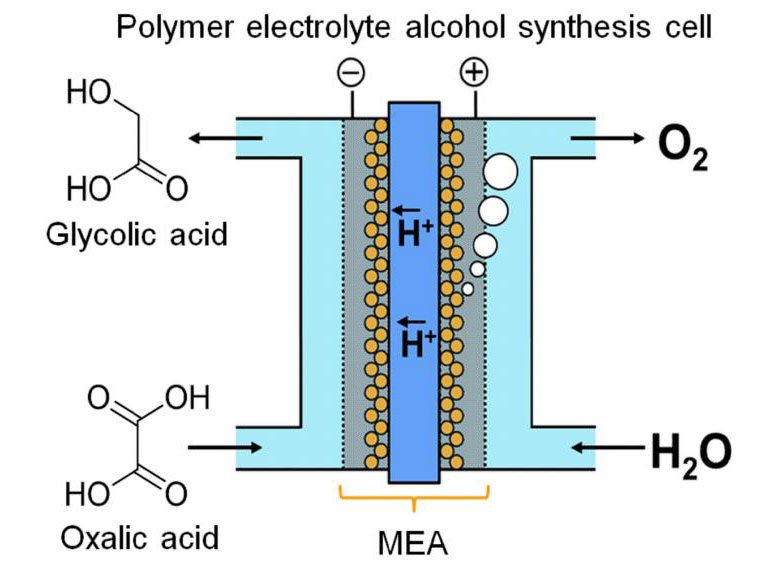
    Polymer Electrolyte Alcohol Electrosynthesis Cell
    A Kyushu University research team realized continuous electrochemical synthesis of an alcoholic compound from a carboxylic acid using a polymer electrolyte alcohol electrosynthesis cell, which enables direct power charge into alcoholic compound. Masaaki Sadakiyo / International Institute for Carbon-Neutral Energy Research, Kyushu University

    Interest in renewable energy continues to burgeon. Many renewables, though, can be frustratingly intermittent – when the sun stops shining, or the wind stops blowing, the power flickers. The fluctuating supply can be partly smoothed-out by energy storage during peak production times. However, storing electricity is not without its challenges either.

    Recently, a team at the International Institute for Carbon-Neutral Energy Research (I2CNER), within southern Japan’s Kyushu University, created a device to store energy in chemical form through continuous electrolysis.

    The researchers noted that glycolic acid (GC) has a much greater energy capacity than hydrogen, one of the more popular energy-storage chemicals. GC can be produced by four-electron reduction of oxalic acid (OX), a widely available carboxylic acid. As described in their publication in Scientific Reports, the team devised an electrolytic cell based on a novel membrane-electrode assembly. Sandwiched between two electrodes are an iridium oxide-based anode and a titanium dioxide (TiO2)-coated titanium (Ti) cathode, linked by a polymer membrane.

    “Flow-type systems are very important for energy storage with liquid-phase reaction,” study lead author Masaaki Sadakiyo explains. “Most electrolyzers producing alcohols operate a batch process, which is not suitable for this purpose. In our device, by using a solid polymer electrolyte in direct contact with the electrodes, we can run the reaction as a continuous flow without addition of impurities (e.g. electrolytes). The OX solution can effectively be thought of as a flowable electron pool.”

    Another key consideration is the cathode design. The cathodic reaction is catalyzed by anatase TiO2. To ensure a solid connection between catalyst and cathode, the team “grew” TiO2 directly on Ti in the form of a mesh or felt. Electron microscope images show the TiO2 as a wispy fuzz, clinging to the outside of the Ti rods like a coating of fresh snow. In fact, its job is to catalyze the electro-reduction of OX to GC. Meanwhile, at the anode, water is oxidized to oxygen.

    The team found that the reaction accelerated at higher temperatures. However, turning the heat up too high encouraged an unwanted by-process – the conversion of water to hydrogen. The ideal balance between these two effects was at 60°C. At this temperature, the device could be further optimized by slowing the flow of reactants, while increasing the amount of surface area available for the reaction.

    Interestingly, even the texture of the fuzzy TiO2 catalyst made a major difference. When TiO2 was prepared as a “felt,” by growing it on thinner and more densely packed Ti rods, the reaction occurred faster than on the “mesh” – probably because of the greater surface area. The felt also discouraged hydrogen production, by blanketing the Ti surface more snugly than the mesh, preventing the exposure of bare Ti.

    “In the right conditions, our cell converts nearly 100% of OX, which we find very encouraging,” co-author Miho Yamauchi says. “We calculate that the maximum volumetric energy capacity of the GC solution is around 50 times that of hydrogen gas. To be clear, the energy efficiency, as opposed to capacity, still lags behind other technologies. However, this is a promising first step to a new method for storing excess current.”

    Reference: “Electrochemical Production of Glycolic Acid from Oxalic Acid Using a Polymer Electrolyte Alcohol Electrosynthesis Cell Containing a Porous TiO2 Catalyst” by Masaaki Sadakiyo, Shinichi Hata, Xuedong Cui and Miho Yamauchi, 12 December 2017, Scientific Reports.
    DOI: 10.1038/s41598-017-17036-3

    Never miss a breakthrough: Join the SciTechDaily newsletter.
    Follow us on Google and Google News.

    Catalysts Energy Kyushu University Renewable Energy
    Share. Facebook Twitter Pinterest LinkedIn Email Reddit

    Related Articles

    Stanford Unveils Game-Changing Liquid Fuel Technology for Grid Energy Storage

    Patent-Pending Technology Converts “Waste” Carbon Into Valuable Chemicals and Useful Elements

    A Step Towards Seasonal Storage: “Freeze-Thaw Battery” Can Freeze Its Energy for Later Use

    Importing Canadian Energy To Drastically Reduce Carbon Emissions

    Designing Catalysts for Sustainable Fuels Using Electrochemistry

    Solar-Powered Electrochemical Reaction Uses Wastewater To Make the World’s No. 2 Chemical

    NREL Develops Switchable Photovoltaic Windows

    No More Blackouts? New Framework Guarantees the Stability of Microgrids

    Nanocatalyst Tolerates Carbon Monoxide in Fuel Cells, Transforms Impure Hydrogen into Electricity

    Leave A Reply Cancel Reply

    • Facebook
    • Twitter
    • Pinterest
    • YouTube

    Don't Miss a Discovery

    Subscribe for the Latest in Science & Tech!

    Trending News

    Largest-Ever Study Finds Medicinal Cannabis Ineffective for Anxiety, Depression, PTSD

    250-Million-Year-Old Egg Solves One of Evolution’s Biggest Mysteries

    Living With Roommates Might Be Changing Your Gut Microbiome Without You Knowing

    Century-Old Cleaning Chemical Linked to 500% Increased Risk of Parkinson’s Disease

    What if Your Memories Never Happened? Physicists Take a New Look at the Boltzmann Brain Paradox

    One of the Universe’s Largest Stars May Be Getting Ready To Explode

    Scientists Discover Enzyme That Could Supercharge Ozempic-Like Weight Loss Drugs

    Popular Sweetener Linked to DNA Damage – “It’s Something You Should Not Be Eating”

    Follow SciTechDaily
    • Facebook
    • Twitter
    • YouTube
    • Pinterest
    • Newsletter
    • RSS
    SciTech News
    • Biology News
    • Chemistry News
    • Earth News
    • Health News
    • Physics News
    • Science News
    • Space News
    • Technology News
    Recent Posts
    • Challenging the Narrative: New Study Shows U.S. Life Expectancy Is Rising Across All States
    • Mystery Illness Kills 5 in Burundi As Doctors Scramble for Answers
    • Bone-Strengthening Discovery Could Reverse Osteoporosis
    • The Most Elusive Number in Physics Just Got Even More Mysterious
    • Scientists Uncover Hidden Trigger Behind Stem Cell Aging
    Copyright © 1998 - 2026 SciTechDaily. All Rights Reserved.
    • Science News
    • About
    • Contact
    • Editorial Board
    • Privacy Policy
    • Terms of Use

    Type above and press Enter to search. Press Esc to cancel.