
Discovery by University of Warwick scientists challenges accepted rule of organic solar cell design.
- Could help to bring about low-cost, flexible, and stable organic solar cells for use on vehicles, curved surfaces, and windows
- Reducing the surface area of electrodes in organic solar cells doesn’t reduce performance, provided the conductive parts are close enough together
- Composites of insulating polymers and conducting nanoparticles could offer advantages over the limited range of materials currently used
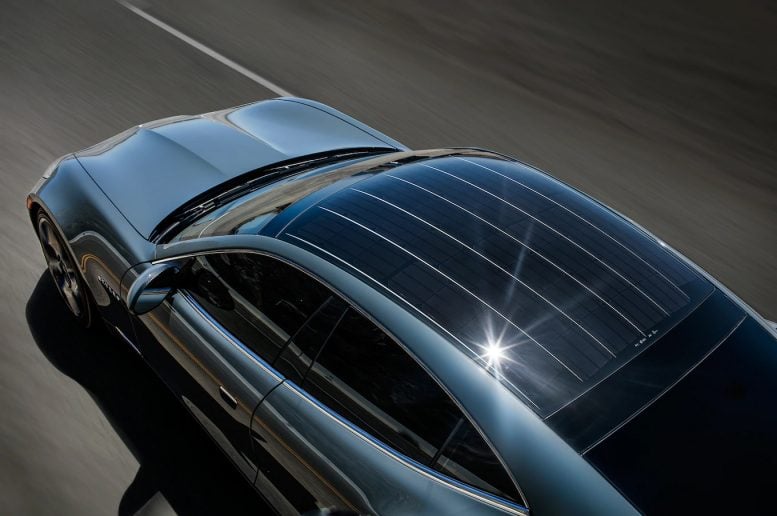
Solar cells that use mixtures of organic molecules to absorb sunlight and convert it to electricity, that can be applied to curved surfaces such as the body of a car, could be a step closer thanks to a discovery that challenges conventional thinking about one of the key components of these devices.
A basic organic solar cell consists of a thin film of organic semiconductors sandwiched between two electrodes which extract charges generated in the organic semiconductor layer to the external circuit. It has long been assumed that 100% of the surface of each electrode should be electrically conductive to maximize the efficiency of charge extraction.
Scientists at the University of Warwick have discovered that the electrodes in organic solar cells actually only need ~1% of their surface area to be electrically conductive to be fully effective, which opens the door to using a range of composite materials at the interface between the electrodes and the light-harvesting organic semiconductor layers to improve device performance and reduce cost. The discovery, published yesterday (September 11, 2019), is reported in Advanced Functional Materials.
The academic lead, Dr. Ross Hatton from the University’s Department of Chemistry, said: “It’s widely assumed that if you want to optimize the performance of organic solar cells you need to maximize the area of the interface between the electrodes and the organic semiconductors. We asked whether that was really true.”
The researchers developed a model electrode that they could systematically change the surface area of, and found that when as much as 99% of its surface was electrically insulating the electrode still performs as well as if 100% of the surface was conducting, provided the conducting regions aren’t too far apart.
High-performance organic solar cells have additional transparent layers at the interfaces between the electrodes and the light harvesting organic semiconductor layer that are essential for optimizing the light distribution in the device and improving its stability, but must also be able to conduct charges to the electrodes. This is a tall order and not many materials meet all of these requirements.
Dr. Dinesha Dabera, the post-doctoral researcher on this Leverhulme Trust funded project, explains: “This new finding means composites of insulators and conducting nanoparticles such as carbon nanotubes, graphene fragments or metal nanoparticles, could have great potential for this purpose, offering enhanced device performance or lower cost.
“Organic solar cells are very close to being commercialized but they’re not quite there yet, so anything that allows you to further reduce cost whilst also improving performance is going to help enable that.”
Dr Hatton, who was interviewed by Serena Bashal of the UK Youth Climate Coalition at the British Science Festival this week, explains: “What we’ve done is to demonstrate a design rule for this type of solar cell, which opens up much greater possibilities for materials choice in the device and so could help to enable their realization commercially.’’
Organic solar cells are potentially very environmentally friendly, because they contain no toxic elements and can be processed at low temperatures using roll-to-roll deposition, so can have an extremely low carbon footprint and a short energy payback time.
Dr. Hatton explains: “There is a fast-growing need for solar cells that can be supported on flexible substrates that are lightweight and color-tuneable. Conventional silicon solar cells are fantastic for large-scale electricity generation in solar farms and on the roofs of buildings, but they are poorly matched to the needs of electric vehicles and for integration into windows on buildings, which are no longer niche applications. Organic solar cells can sit on curved surfaces, and are very lightweight and low profile.
“This discovery may help enable these new types of flexible solar cells to become a commercial reality sooner because it will give the designers of this class of solar cells more choice in the materials they can use.”
Reference: “An Electrode Design Rule for Organic Photovoltaics Elucidated Using a Low Surface Area Electrode” by G. Dinesha M. R. Dabera, Jaemin Lee and Ross A. Hatton, 11 September 2019, Advanced Functional Materials.
DOI: 10.1002/adfm.201904749
Never miss a breakthrough: Join the SciTechDaily newsletter.
Follow us on Google and Google News.