
Close Menu
    Facebook X (Twitter) Instagram
    SciTechDaily
    • Biology
    • Chemistry
    • Earth
    • Health
    • Physics
    • Science
    • Space
    • Technology
    Facebook X (Twitter) Pinterest YouTube RSS
    SciTechDaily
    Home»Chemistry»New Electrocatalysts Developed for Green Production of Ammonia
    Chemistry

    New Electrocatalysts Developed for Green Production of Ammonia

    By Chinese Academy of SciencesNovember 14, 2022No Comments3 Mins Read
    Facebook Twitter Pinterest Telegram LinkedIn WhatsApp Email Reddit
    Share
    Facebook Twitter LinkedIn Pinterest Telegram Email Reddit
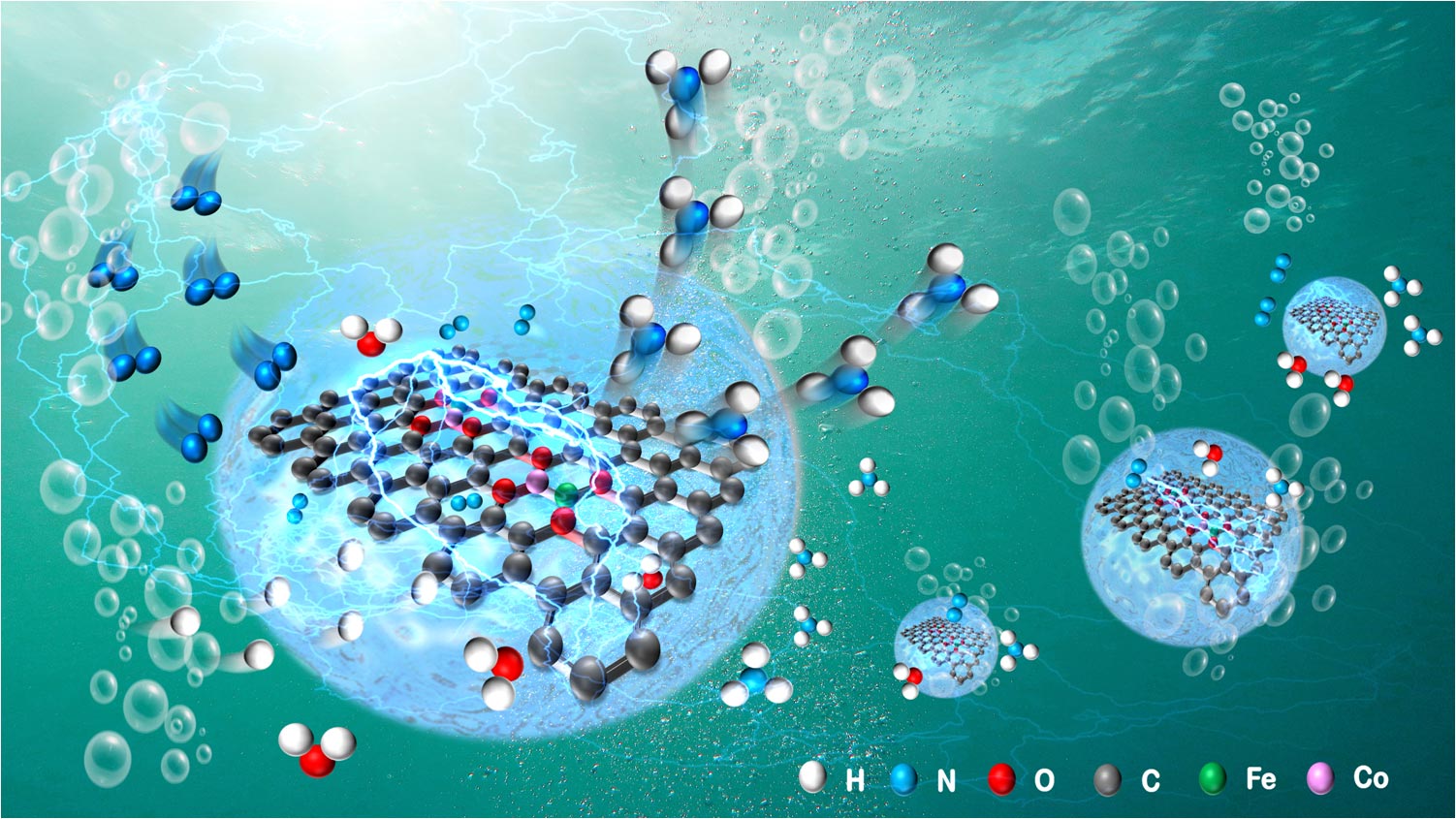
    Ammonia Synthesis by Electrocatalysis Schematic Diagram
    Schematic diagram of ammonia synthesis by electrocatalysis with bimetallic Fe–Co single-atom catalyst. Credit: Shengbo Zhang

    A new method using bacterial cellulose enables precise single-atom catalyst synthesis, enhancing green ammonia production efficiency.

    Scientists have demonstrated the use of controllably synthesized single-atom catalysts (SACs) to depict the relationship between electrocatalytic nitrogen reduction reaction (NRR) performance and single-atom (SA) loading.

    Conducted by researchers from the Hefei Institutes of Physical Science of the Chinese Academy of Sciences, the study will be published today (November 14) in the journal Nature Sustainability.

    A Sustainable Alternative to the Haber-Bosch Process

    Electrosynthesis of ammonia from NRR at ambient conditions has been widely regarded as a “green ammonia synthesis” technology to replace the traditional energy- and capital-intensive Haber-Bosch process.

    Scientists agree that the intriguing features of SACs may create a new catalytic paradigm. However, one of the key challenges hindering the rational design and development of SACs is the lack of insight into the relationship between performance and SA loading, due mainly to the inability to precisely control the synthesis of SACs with desired SA loading densities and active site coordination forms.

    Atomically Dispersed Bimetallic Iron–Cobalt Electrocatalysts for Green Production of Ammonia
    (a) HAADF-STEM images. (b) Plots of the loaded Fe and Co SAs against [Fe3+] and [Co2+]. (c) Fe and Co K edge EXAFS fitting curves. (d) Co K edge XANES spectra. (e) Solid-state 13C NMR spectra. (f) RNH3 and FE of corresponding catalysts. (g) Effect of catalyst loading density on the geometric area activity. (h) DFT optimized configurations. (i) DFT optimized configurations after the initial electrocatalytic NRR cycle. Credit: Shengbo Zhang

    Bacterial Cellulose as an Adsorption Regulator for Precise Catalyst Synthesis

    In this study, the researchers demonstrated an adsorption-regulated synthetic method that uses bacterial cellulose as an adsorption regulator to control Fe3+/Co2+ impregnation on bacterial cellulose through carbothermal reduction. Fe­–Co SAs were then fixed to bacterial cellulose-derived carbon via bimetallic [(O–C2)3Fe–Co(O–C2)3] coordination.

    Importantly, the scientists unveiled a suite of relationships that quantitatively define Fe3+/Co2+ distribution between bacterial cellulose and the adsorption solution, and the percentage conversion of impregnated Fe3+/Co2+ on bacterial cellulose to Fe/Co SAs on bacterial cellulose-derived carbon. They then demonstrated the use of such quantitative relationships to guide the controllable synthesis of bimetallic Fe–Co SACs with desired Fe/Co contents and atomic ratios.

    They showed that controllably synthesized SACs can depict the electrocatalytic relationship between NRR performance and SA loading. Single-atom electrocatalysts (SAECs) with a unity Fe/Co atomic ratio possess the highest site density and NRR performance for bimetallic Fe–Co SAs, making them capable of achieving a superb ammonia yield rate with exceptional faradaic efficiency.

    Coordination Bonds Enhance Catalyst Stability and Activity

    The catalytic activity of SACs, in contrast with other types of catalysts, is determined by the nature of the SA, the physiochemical properties of the support and, importantly, the coordination bonds that anchor the SA to the support.

    Under electrocatalytic NRR conditions, [(O–C2)3Fe–Co(O–C2)3] in the as-synthesized bimetallic Fe–Co SAECs is operando transformed into the more stable coordination configuration [(O–C2)3Fe–Co(O–C)C2], thus promoting and sustaining NRR performance.

    The researchers suggest that these new findings will be of great interest to the broad catalysis community.

    Reference: “Atomically dispersed bimetallic Fe–Co electrocatalysts for green production of ammonia” by Shengbo Zhang, Miaomiao Han, Tongfei Shi, Haimin Zhang, Yue Lin, Xusheng Zheng, Li Rong Zheng, Hongjian Zhou, Chun Chen, Yunxia Zhang, Guozhong Wang, Huajie Yin and Huijun Zhao, 14 November 2022, Nature Sustainability.
    DOI: 10.1038/s41893-022-00993-7

    Never miss a breakthrough: Join the SciTechDaily newsletter.
    Follow us on Google and Google News.

    Catalysts Chinese Academy of Sciences Sustainability
    Share. Facebook Twitter Pinterest LinkedIn Email Reddit

    Related Articles

    Copper-Based Electrocatalysts: Using Corrosion for Efficient Biomass Upgrading

    Researchers Unveil New Platform for Catalytic Syngas Conversion

    Extraordinary Discovery May Substantially Change Our Understanding of the Mechanism of Photosynthesis

    Designing Catalysts for Sustainable Fuels Using Electrochemistry

    Efficient New Catalytic Approach Directly Converts Raw Biomass Into Natural Gas With Low Carbon Footprint

    Researchers Capture Electron Transfer Image in Electrocatalysis Process

    More Sustainable Conversion of Sunlight and Luminescent Materials With Manganese

    Catalytic Hydrogenation of CO2 to Methanol: Low Temperature and High Efficiency

    Chemists Discover a New Way to Work with Heterogeneous Catalysts

    Leave A Reply Cancel Reply

    • Facebook
    • Twitter
    • Pinterest
    • YouTube

    Don't Miss a Discovery

    Subscribe for the Latest in Science & Tech!

    Trending News

    Your Blood Pressure Reading Could Be Wrong Because of One Simple Mistake

    Astronomers Stunned by Ancient Galaxy With No Spin

    Physicists May Be on the Verge of Discovering “New Physics” at CERN

    Scientists Solve 320-Million-Year Mystery of Reptile Skin Armor

    Scientists Say This Daily Walking Habit May Be the Secret to Keeping Weight Off After Dieting

    New Therapy Rewires the Brain To Restore Joy in Depression Patients

    Giant Squid Detected off Western Australia in Stunning Deep-Sea Discovery

    Popular Sugar-Free Sweetener Linked to Liver Disease, Study Warns

    Follow SciTechDaily
    • Facebook
    • Twitter
    • YouTube
    • Pinterest
    • Newsletter
    • RSS
    SciTech News
    • Biology News
    • Chemistry News
    • Earth News
    • Health News
    • Physics News
    • Science News
    • Space News
    • Technology News
    Recent Posts
    • Scientists Revive Ancient Chemistry Trick To Engineer Next-Generation Glass
    • Scientists Use AI To Supercharge Ultrafast Laser Simulations by More Than 250x
    • Scientists Just Found a Surprising Way To Destroy “Forever Chemicals”
    • Popular Supplement Ingredient Linked to Shorter Lifespan in Men
    • Scientists May Have Found a Way To Repair Nerve Damage in Multiple Sclerosis
    Copyright © 1998 - 2026 SciTechDaily. All Rights Reserved.
    • Science News
    • About
    • Contact
    • Editorial Board
    • Privacy Policy
    • Terms of Use

    Type above and press Enter to search. Press Esc to cancel.