
Close Menu
    Facebook X (Twitter) Instagram
    SciTechDaily
    • Biology
    • Chemistry
    • Earth
    • Health
    • Physics
    • Science
    • Space
    • Technology
    Facebook X (Twitter) Pinterest YouTube RSS
    SciTechDaily
    Home»Chemistry»New Fluorescent Compound Identified in Scorpions Could Help Protect Them From Parasites
    Chemistry

    New Fluorescent Compound Identified in Scorpions Could Help Protect Them From Parasites

    By American Chemical SocietyMarch 23, 2020No Comments2 Mins Read
    Facebook Twitter Pinterest Telegram LinkedIn WhatsApp Email Reddit
    Share
    Facebook Twitter LinkedIn Pinterest Telegram Email Reddit
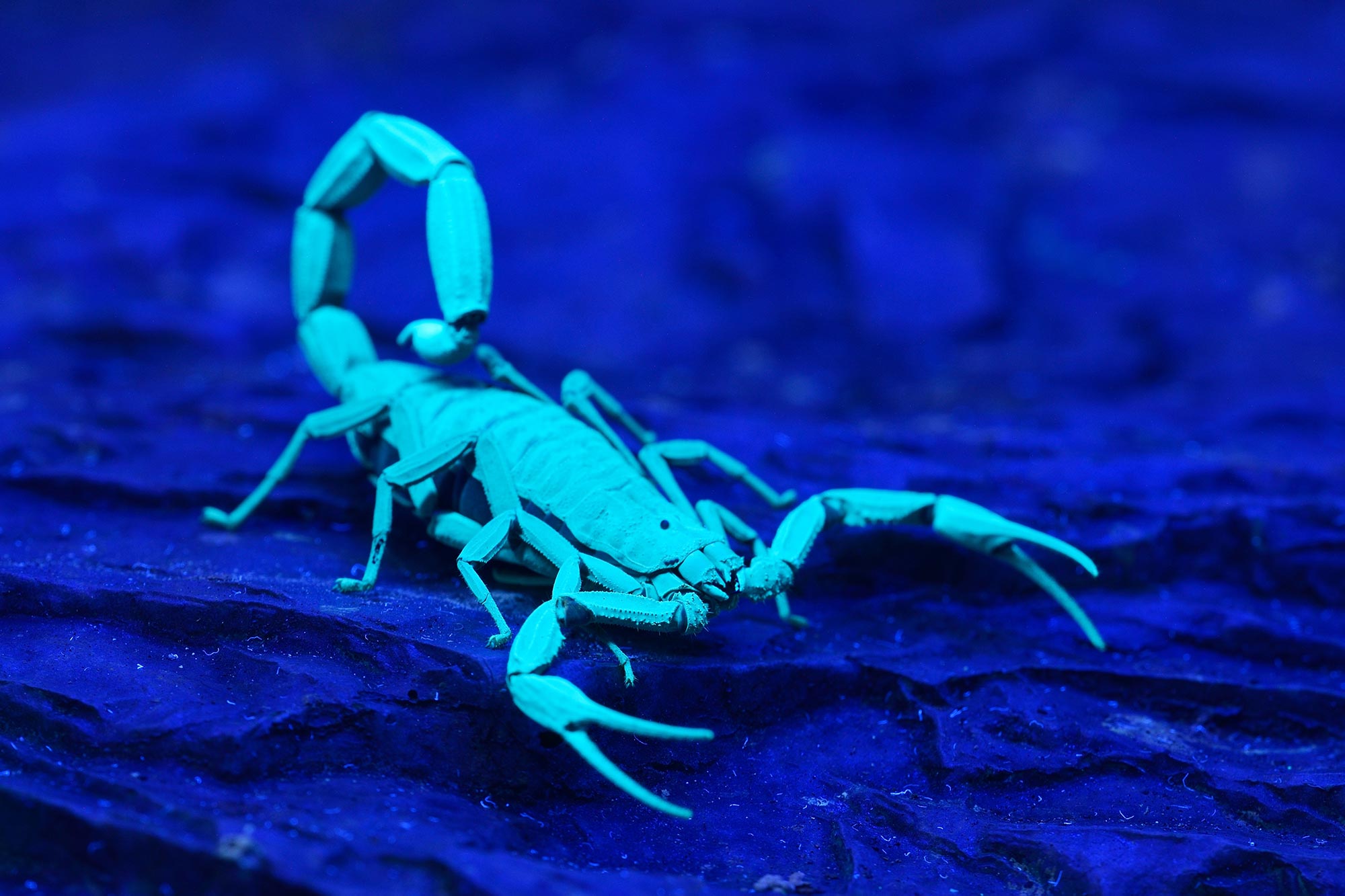
    Scorpion Fluorescent
    New fluorescent compound found in scorpion exoskeletons could shield them from parasites.

    Most scorpions glow a blue-green color when illuminated by ultraviolet light or natural moonlight. Scientists aren’t sure how this fluorescence benefits the creatures, but some have speculated that it acts as a sunscreen, or helps them find mates in the dark. Now, researchers reporting in ACS’ Journal of Natural Products have identified a new fluorescent compound from scorpion exoskeletons. The team says that the compound could protect these arachnids from parasites.

    More than 60 years ago, scientists first recognized scorpions’ propensity to glow under UV light. Until now, only two fluorescent compounds, β-carboline and 7-hydroxy-4-methylcoumarin, had been identified in scorpions’ hard outer shell, or exoskeleton. Masahiro Miyashita and colleagues wondered if there might be other fluorescent molecules with different chemical properties that were missed in previous studies.
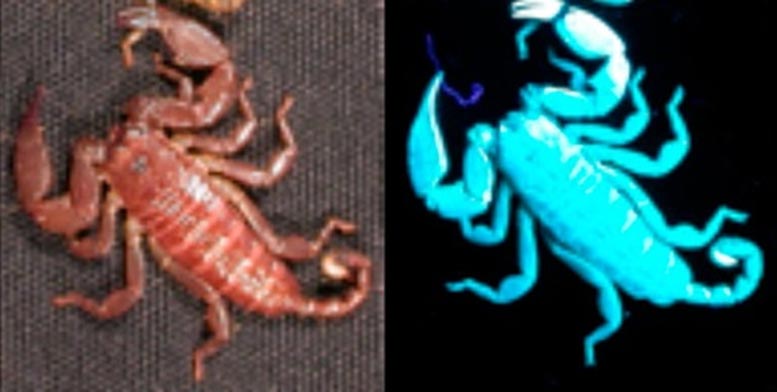
    Scorpion Fluorescent Compound
    Fluorescent compounds in the exoskeleton of scorpions make the creatures glow when viewed under a black (ultraviolet) light. Credit: Adapted from Journal of Natural Products 2020, DOI: 10.1021/acs.jnatprod.9b00972

    To find out, the researchers extracted compounds from molted exoskeletons of the scorpion Liocheles australasiae, using chemical conditions different from those used in prior experiments. They purified the compound showing the most intense fluorescence and identified its structure, which was a phthalate ester previously shown to have antifungal and anti-parasitic properties in other organisms. This finding suggests that the new molecule, which the researchers found in several additional scorpion species, could help guard against parasitic infections in these creatures. Compared with the two previously identified fluorescent compounds, the new molecule likely contributes more weakly to scorpion fluorescence, the scientists say.

    Reference: “A Fluorescent Compound from the Exuviae of the Scorpion, Liocheles australasiae” by Yusuke Yoshimoto, Masato Tanaka, Masahiro Miyashita, Mohammed Abdel-Wahab, Alhussin M. A. Megaly, Yoshiaki Nakagawa and Hisashi Miyagawa, 3 February 2020, Journal of Natural Products.
    DOI: 10.1021/acs.jnatprod.9b00972

    The authors acknowledge funding from the Sasakawa Scientific Research Grant from The Japan Science Society.

    Never miss a breakthrough: Join the SciTechDaily newsletter.
    Follow us on Google and Google News.

    American Chemical Society Parasites Scorpions
    Share. Facebook Twitter Pinterest LinkedIn Email Reddit

    Related Articles

    Mysterious Chemistry Behind a Creepy Photographic Technique Unveiled

    Human Cells Made Magnetic With Engineered Protein Crystals

    Super Durable, Flexible, Water-Repelling Material Inspired by Porcupinefish

    What’s in Dog Food? The Fascinating Chemistry Behind Kibble.

    Sustainable Organic Batteries for Safer, Environmentally Friendly Power Storage

    New Polyurethane Designed to Easily Degrade for Reuse

    Degradable Polyurethane Gives Its Components a Second Life

    Chocolate Interferes With Cannabis Potency Testing

    Perfect Shot of Espresso Every Time With Chemistry

    Leave A Reply Cancel Reply

    • Facebook
    • Twitter
    • Pinterest
    • YouTube

    Don't Miss a Discovery

    Subscribe for the Latest in Science & Tech!

    Trending News

    1.4-Million-Year-Old Footprints Reveal a Giant Human Relative

    Astronomers May Have Found the First Moon Beyond Our Solar System

    Underwater Cameras Expose the Secret Lives of Whale Sharks

    Why Dreaming Leaves the Brain Running Low on Energy

    CERN Experiments Detect Signs of the Universe’s Primordial Matter

    Study Finds a Surprising Link Between Gut Microbes and Aging

    Frequent Cannabis Users Wake Up With More “Stress Hormone”

    Scientists Reveal Hidden DNA Traces in the Shroud of Turin

    Follow SciTechDaily
    • Facebook
    • Twitter
    • YouTube
    • Pinterest
    • Newsletter
    • RSS
    SciTech News
    • Biology News
    • Chemistry News
    • Earth News
    • Health News
    • Physics News
    • Science News
    • Space News
    • Technology News
    Recent Posts
    • New Stroke Treatment Turns Brain Cavities Into Repair Hubs
    • World’s First Photonic Time Crystal Can Reshape Light in Trillionths of a Second
    • Meteorite That Smashed Through a New Jersey Roof Hid an Ancient Chemical Secret
    • Astronomers Find Ancient Black Holes Shining With the Power of a Trillion Suns
    • These “Good” Immune Cells Could Hold the Key to Spinal Cord Regeneration
    Copyright © 1998 - 2026 SciTechDaily. All Rights Reserved.
    • Science News
    • About
    • Contact
    • Editorial Board
    • Privacy Policy
    • Terms of Use

    Type above and press Enter to search. Press Esc to cancel.