
Close Menu
    Facebook X (Twitter) Instagram
    SciTechDaily
    • Biology
    • Chemistry
    • Earth
    • Health
    • Physics
    • Science
    • Space
    • Technology
    Facebook X (Twitter) Pinterest YouTube RSS
    SciTechDaily
    Home»Biology»New Fossils of Ancient Snake With Hind Legs Reveals Tantalizing Details of Evolution
    Biology

    New Fossils of Ancient Snake With Hind Legs Reveals Tantalizing Details of Evolution

    By Flinders UniversityDecember 7, 2019No Comments3 Mins Read
    Facebook Twitter Pinterest Telegram LinkedIn WhatsApp Email Reddit
    Share
    Facebook Twitter LinkedIn Pinterest Telegram Email Reddit
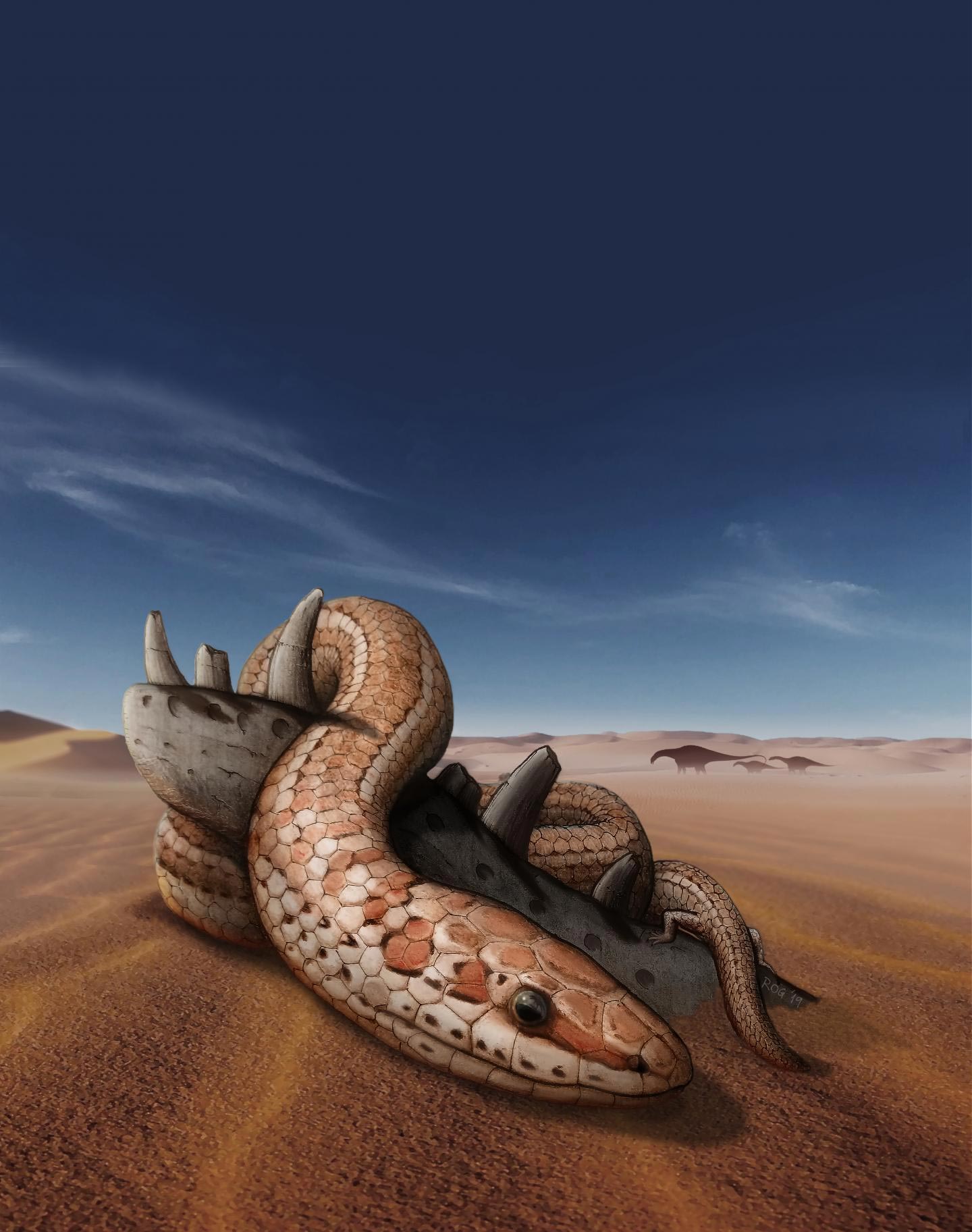
    Ancient Snake Najash rionegrina
    New fossils of an ancient legged snake, called Najash, shed light on the origin of the slithering reptiles. Credit: Raúl Gómez

    New fossils of an ancient legged snake, called Najash, shed light on the origin of the slithering reptiles, including how snakes got their bite and lost their legs.

    The fossil discoveries published in Science Advances have revealed they possessed hind legs during the first 70 million years of their evolution.

    They also provide details about how the flexible skull of snakes evolved from their lizard ancestors.

    The evolution of the snake body has captivated researchers for a long time — representing one of the most dramatic examples of the vertebrate body’s ability to adapt — but a limited fossil record has obscured our understanding of their early evolution until now.
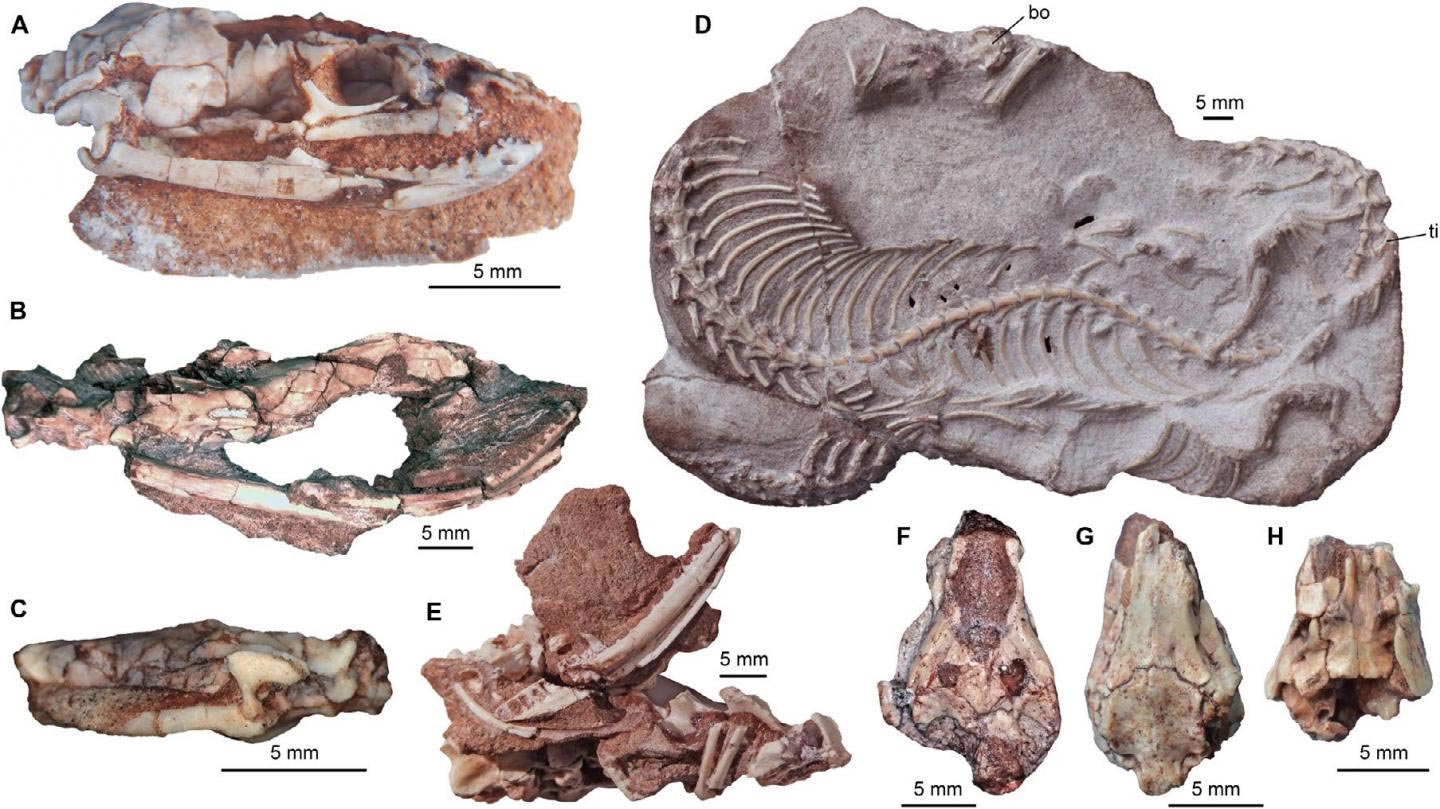
    Najash Specimens
    These are Najash specimens from LBPA as published in Science Advances. Credit: Science Advances

    Dr. Alessandro Palci, from Flinders University, was part of the international research team that performed high-resolution (CT) scanning and light microscopy of the preserved skulls of Najash to reveal substantial new anatomical data on the early evolution of snakes.

    “Snakes are famously legless, but then so are many lizards. What truly sets snakes apart is their highly mobile skull, which allows them to swallow large prey items. For a long time, we have been lacking detailed information about the transition from the relatively rigid skull of a lizard to the super flexible skull of snakes.”
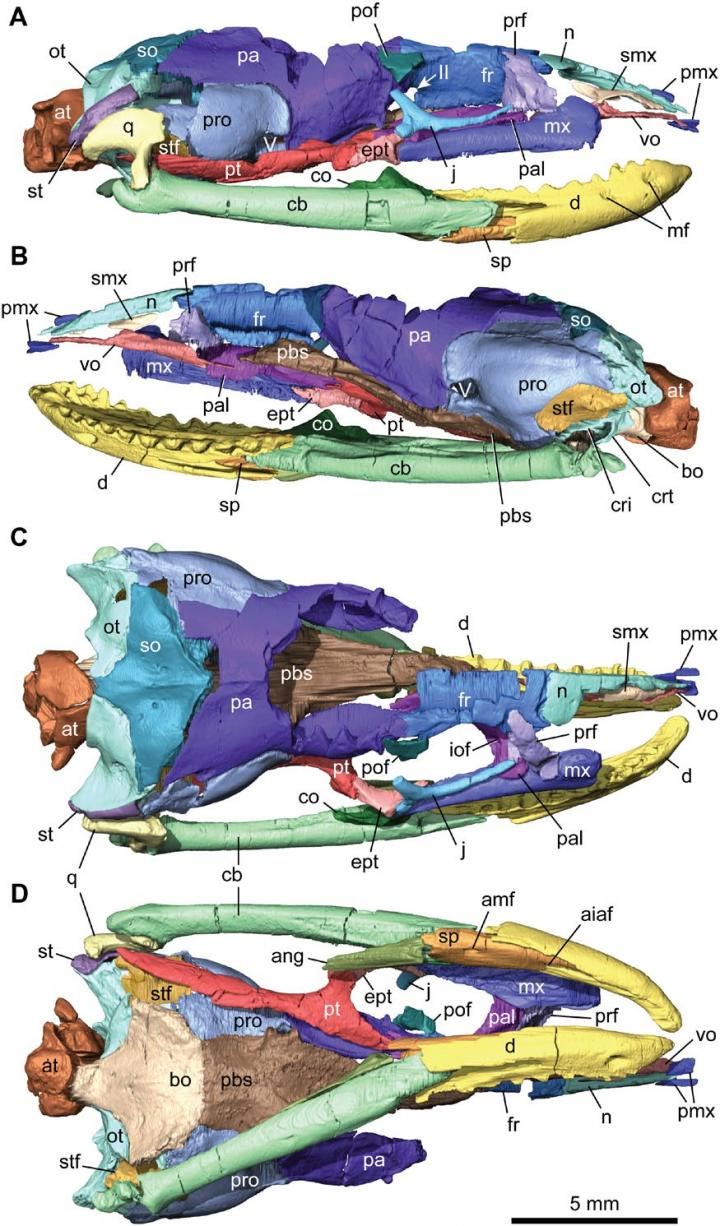
    CT Scan Reconstructions Articulated Najash Skull
    CT scan reconstructions of the articulated skull of Najash as published in Science Advances, AAAS. Credit: Science Advances

    “Najash has the most complete, three-dimensionally preserved skull of any ancient snake, and this is providing an amazing amount of new information on how the head of snakes evolved. It has some, but not all of the flexible joints found in the skull of modern snakes. Its middle ear is intermediate between that of lizards and living snakes, and unlike all living snakes it retains a well-developed cheekbone, which again is reminiscent of that of lizards.”

    Flinders University and South Australian Museum researcher Professor Mike Lee, was also part of the study, and adds “Najash shows how snakes evolved from lizards in incremental evolutionary steps, just like Darwin predicted.”

    The new snake family tree also reveals that snakes possessed small but perfectly formed hind legs for the first 70 million years of their evolution.

    “These primitive snakes with little legs weren’t just a transient evolutionary stage on the way to something better. Rather, they had a highly successful body plan that persisted across many millions of years, and diversified into a range of terrestrial, burrowing and aquatic niches,” says Professor Lee.

    Read 100 Million-Year-Old Snake Had Legs, but Cheekbone Provides Critical Insight Into Evolution for more on these discoveries.

    Reference: “New Skulls and Skeletons of the Cretaceous Legged Snake Najash, and the Evolution of the Modern Snake Body Plan” by Fernando F. Garberoglio, Sebastián Apesteguía, Tiago R. Simões, Alessandro Palci, Raúl O. Gómez, Randall L. Nydam, Hans C. E. Larsson, Michael S. Y. Lee and Michael W. Caldwell, 20 November 2019, Science Advances.
    DOI: 10.1126/sciadv.aax5833

    The study was led by Fernando F. Garberoglio at Universidad Maimónides in Buenos Aires, with collaborators M.W. Caldwell at University of Alberta, Dr Alessandro Palci and Professor Mike Lee at Flinders University and the South Australian Museum in Adelaide, R.O. Gómez at Universidad de Buenos Aires, R.L. Nydam at Midwestern University AZ; H.C.E. Larsson at McGill University and T.R. Simões at Harvard University.

    Never miss a breakthrough: Join the SciTechDaily newsletter.
    Follow us on Google and Google News.

    Evolution Flinders University Fossils Genetics Paleontology Popular Snake
    Share. Facebook Twitter Pinterest LinkedIn Email Reddit

    Related Articles

    34-Million-Year-Old Snake Discovered in Wyoming Changes Our Understanding of Evolution

    Paleontologists Reveal Jurassic Park in Eastern Morocco

    Evolutionary Origin of the Human Hand Revealed by Ancient Fish Fossil

    “Wonderchicken” – Origin of Modern Birds Revealed by Fossil From the Age of Dinosaurs

    Ancient Sea-Worm Mystery Solved by Student After 50 Years in “Wastebasket”

    This 100 Million-Year-Old Snake Had Legs, but Cheekbone Provides Critical Insight Into Evolution

    New Insight Into the Evolution of Sight From 54 Million Year-Old Fossil

    Newly Discovered Dinosaur (Mansourasaurus shahinae) Links Africa and Europe

    Calcified Bacteria Sheds Light on the Health Consequences of the Evolving Diet

    Leave A Reply Cancel Reply

    • Facebook
    • Twitter
    • Pinterest
    • YouTube

    Don't Miss a Discovery

    Subscribe for the Latest in Science & Tech!

    Trending News

    The Best Exercise Combination for Longevity, According to a 30-Year Study

    Popular Weight-Loss Drug Found To Slow Biological Aging in Landmark Human Trial

    NASA’s Fermi Telescope Caught a Supernova Doing Something Never Seen Before

    This Dinosaur Had the Claws of a Raptor but Hunted Like a Heron

    Doctors May Need To Rethink Calcium and Vitamin D Recommendations After Major Review

    Scientists Discover a Hidden Cause of Cellular Aging That Can Be Reversed

    Archaeologists Have Found Something Unexpected Inside a 1,600-Year-Old Egyptian Mummy

    Scientists May Have Found a Completely New Way To Treat Depression

    Follow SciTechDaily
    • Facebook
    • Twitter
    • YouTube
    • Pinterest
    • Newsletter
    • RSS
    SciTech News
    • Biology News
    • Chemistry News
    • Earth News
    • Health News
    • Physics News
    • Science News
    • Space News
    • Technology News
    Recent Posts
    • This Giant Tropical Fruit Could Hold a Surprising Secret to Saving Teeth
    • Scientists Discover Rogue Gene That Could Unlock New Cancer Treatments
    • Constantly Tired? Scientists Say These Vitamin Deficiencies May Be Why
    • Chemists Capture a Bizarre Molecular Structure Never Seen Before
    • Mass Spectrometry Breakthrough Detects Billions of Molecules at Once
    Copyright © 1998 - 2026 SciTechDaily. All Rights Reserved.
    • Science News
    • About
    • Contact
    • Editorial Board
    • Privacy Policy
    • Terms of Use

    Type above and press Enter to search. Press Esc to cancel.