
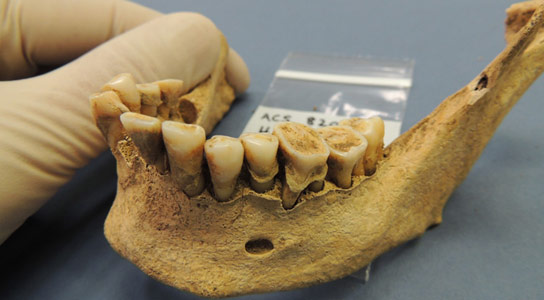
A newly published study from the University of Adelaide shows that calcified dental plaque (dental calculus) found on ancient teeth from 34 early European skeletons indicates that the transition from hunter-gatherer to farming shifted the oral microbial community to a disease-associated configuration.
DNA preserved in calcified bacteria on the teeth of ancient human skeletons has shed light on the health consequences of the evolving diet and behavior from the Stone Age to the modern day.
The ancient genetic record reveals the negative changes in oral bacteria brought about by the dietary shifts as humans became farmers, and later with the introduction of food manufacturing in the Industrial Revolution.
An international team, led by the University of Adelaide’s Australian Center for Ancient DNA (ACAD) where the research was performed, has published the results in Nature Genetics on February 17. Other team members include the Department of Archaeology at the University of Aberdeen and the Wellcome Trust Sanger Institute in Cambridge (UK).
“This is the first record of how our evolution over the last 7500 years has impacted the bacteria we carry with us, and the important health consequences,” says study leader Professor Alan Cooper, ACAD Director.
“Oral bacteria in modern man are markedly less diverse than historic populations and this is thought to contribute to chronic oral and other diseases in post-industrial lifestyles.”
The researchers extracted DNA from tartar (calcified dental plaque) from 34 prehistoric northern European human skeletons, and traced changes in the nature of oral bacteria from the last hunter-gatherers, through the first farmers to the Bronze Age and Medieval times.
“Dental plaque represents the only easily accessible source of preserved human bacteria,” says lead author Dr. Christina Adler, who conducted the research while a PhD student at the University of Adelaide, now at the University of Sydney.
“Genetic analysis of plaque can create a powerful new record of dietary impacts, health changes, and oral pathogen genomic evolution, deep into the past.”
Professor Cooper says: “The composition of oral bacteria changed markedly with the introduction of farming, and again around 150 years ago. With the introduction of processed sugar and flour in the Industrial Revolution, we can see a dramatically decreased diversity in our oral bacteria, allowing domination by caries-causing strains. The modern mouth basically exists in a permanent disease state.”
Professor Cooper has been working on the project with archaeologist and co-leader Professor Keith Dobney, now at the University of Aberdeen, for the past 17 years. Professor Dobney says: “I had shown tartar deposits commonly found on ancient teeth were dense masses of solid calcified bacteria and food, but couldn’t identify the species of bacteria. Ancient DNA was the obvious answer.”
However, the team was not able to sufficiently control background levels of bacterial contamination until 2007 when ACAD’s ultra-clean laboratories and strict decontamination and authentication protocols became available. The research team is now expanding its studies through time, and around the world, including other species such as Neandertals.
Reference: “Sequencing ancient calcified dental plaque shows changes in oral microbiota with dietary shifts of the Neolithic and Industrial revolutions” by Christina J Adler, Keith Dobney, Laura S Weyrich, John Kaidonis, Alan W Walker, Wolfgang Haak, Corey J A Bradshaw, Grant Townsend, Arkadiusz Sołtysiak, Kurt W Alt, Julian Parkhill and Alan Cooper, 17 February 2013, Nature Genetics.
DOI: 10.1038/ng.2536
Never miss a breakthrough: Join the SciTechDaily newsletter.
Follow us on Google and Google News.