
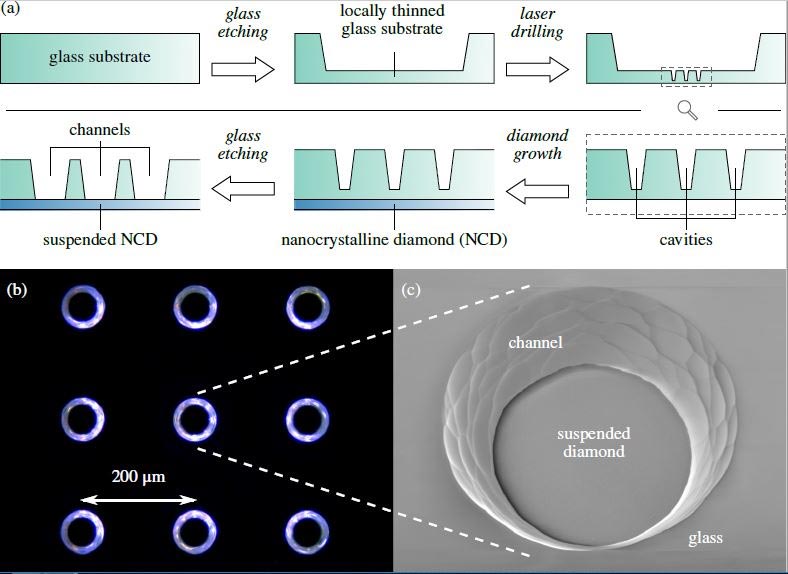
This figure appears in the researchers’ study, published in Diamond and Related Materials. (a) Schematics of the cross-section of a foundation before and after steps in the fabrication process. (b) Dark-field optical micrograph of the glass foundation with diamond-sealed channels that are created by the process described in (a). (c) Scanning electron microscope image of the center cavity, taken under a tilt of 25°. Credit: OIST
Diamonds Are Forever: New Foundation for Nanostructures
Devices smaller than the width of a human hair are key to technologies for drug delivery, semiconductors, and fuel production. But current methods for fabricating these micro- and nanostructures can be expensive and wasteful.
Researchers at the Okinawa Institute of Science and Technology Graduate University (OIST) have fabricated a novel glass and synthetic diamond foundation that can be used to create minuscule micro- and nanostructures. This new substrate is low-cost and leaves minimal waste, the researchers say, in a study published in Diamond and Related Materials.
“We’ve spent the last couple of decades throwing away plastics,” said Stoffel Janssens, the first author of the study, and a member of OIST’s Mathematics, Mechanics, and Materials Unit. “With sustainable materials like diamond and glass, we’re minimizing negative environmental impacts.”
Building a Nanostructure
Current processes in place for micro- and nanodevice fabrication can be costly and inefficient. Synthetic diamond, which has the same chemical structure as natural diamond, is resilient, low-cost, and sustainable, and glass is versatile and electrically insulating; technologies that combine the two are promising.
The researchers made their foundation using glass etching, a process that relies on acid to reduce a glass slab to a thickness of 50 micrometers (about the length of a typical cell in the human body). Janssens and his collaborators, Professor Eliot Fried, David Vázquez-Cortés, Alessandro Giussani, and James Kwiecinski, used a laser to drill cavities, approximately 40 micrometers in diameter and depth, into one side of the glass slab.
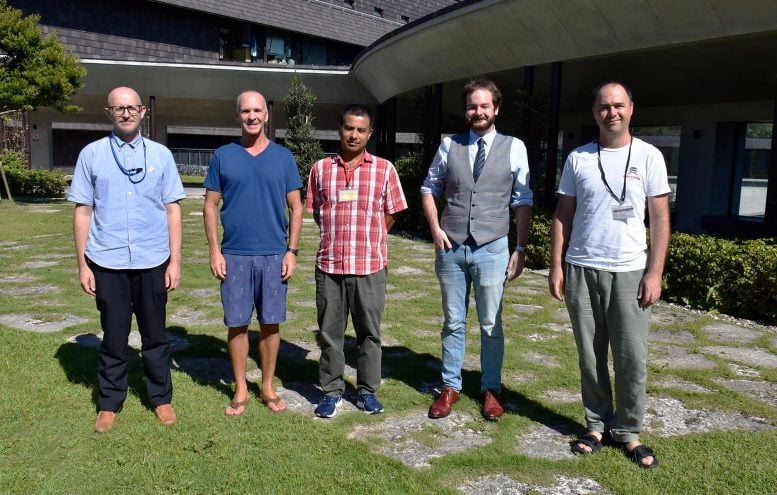
Researchers from OIST’s Mathematics, Mechanics and Materials Unit, pictured from left to right: Stoffel Janssens, Eliot Fried, David Vázquez-Cortés, James Kwiecinski, and Alessandro Giussani. Credit: OIST
Next, the scientists grew a 175-nanometer thick nanocrystalline diamond film on the other side of the glass and transformed the drilled cavities into small channels sealed with suspended diamonds. Combining diamond and glass creates a transparent structure in which scientists can grow and visualize living cells.
“During this fabrication process, the glass can easily become rough and opaque,” said Janssens. “There are so many small things that can go wrong; we made many adjustments to optimize our process.”
Moving forward, Janssens hopes to create porous diamond films tailored to deliver specific drugs. The researchers have filed a patent for the new foundation and are exploring its commercial potential.
“This type of research can only be done through the combined efforts of researchers with different backgrounds,” said Fried. “The interdisciplinarity of OIST and its collaborative environment made our work possible.”
Reference: “Nanocrystalline diamond-glass platform for the development of three-dimensional micro- and nanodevices” by Stoffel D. Janssens, David Vázquez-Cortés, Alessandro Giussani, James A. Kwiecinski and Eliot Fried, 10 August 2019, Diamond and Related Materials.
DOI: 10.1016/j.diamond.2019.107511
Never miss a breakthrough: Join the SciTechDaily newsletter.
Follow us on Google and Google News.
1 Comment
The glass can easily become rough and opaque.
https://adostuntcars2.io/