
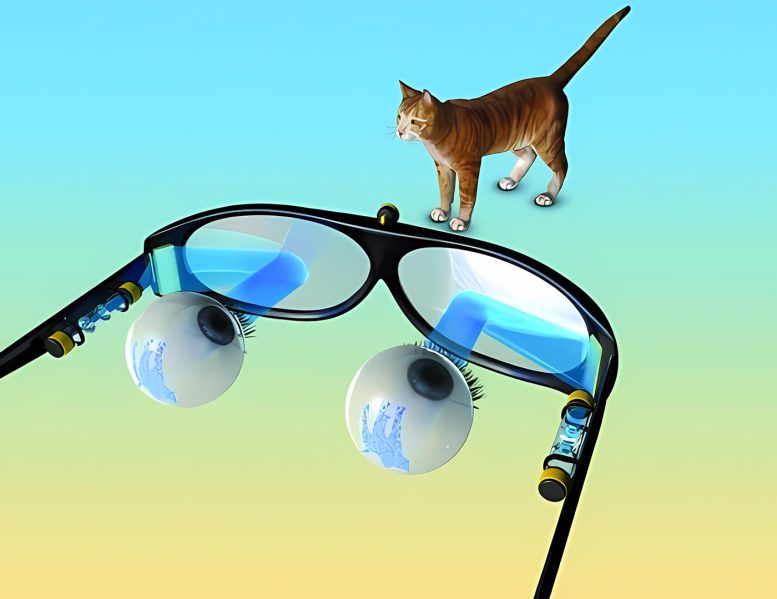
A team of researchers from the Technion-Israel Institute of Technology is combining computer-generated holography and optogenetics in an effort to develop a new strategy for restoring vision.
Computer-generated holography, they say, could be used in conjunction with a technique called optogenetics, which uses gene therapy to deliver light-sensitive proteins to damaged retinal nerve cells. In conditions such as Retinitis Pigmentosa (RP) — a condition affecting about one in 4000 people in the United States — these light-sensing cells degenerate and lead to blindness.
“The basic idea of optogenetics is to take a light-sensitive protein from another organism, typically from algae or bacteria, and insert it into a target cell, and that photosensitizes the cell,” Shoham explained.
Intense pulses of light can activate nerve cells newly sensitized by this gene therapy approach. But Shoham said researchers around the world are still searching for the best way to deliver the light patterns so that the retina “sees” or responds in a nearly normal way.
The plan is to someday develop a prosthetic headset or eyepiece that a person could wear to translate visual scenes into patterns of light that stimulate the genetically altered cells.
In their paper in the February 26 issue of Nature Communications, the Technion researchers show how light from computer-generated holography could be used to stimulate these repaired cells in mouse retinas. The key, they say, is to use a light stimulus that is intense, precise, and can trigger activity across a variety of cells all at once.
“Holography, what we’re using, has the advantage of being relatively precise and intense,” Shoham said. “And you need those two things to see.”
The researchers turned to holography after exploring other options, including laser deflectors and digital displays used in many portable projectors to stimulate these cells. Both methods had their drawbacks, Shoham said.
Digital light displays can stimulate many nerve cells at once, “but they have low light intensity and very low light efficiency,” Shoham said. The genetically repaired cells are less sensitive to light than normal healthy retinal cells, so they preferably need a bright light source like a laser to be activated.
“Lasers give intensity, but they can’t give the parallel projection” that would simultaneously stimulate all of the cells needed to see a complete picture, Shoham noted. “Holography is a way of getting the best of both worlds.”
The researchers have tested the potential of holographic stimulation in retinal cells in the lab, and have done some preliminary work with the technology in living mice with damaged retinal cells. The experiments show that holography can provide reliable and simultaneous stimulation of multiple cells at millisecond speeds.
But implementing a holographic prosthesis in humans is far in the future, Shoham cautioned.
His team is exploring other ways, aside from optogenetics, to activate damaged nerve cells. For instance, they are also experimenting with ultrasound for activating retinal and brain tissue.
Shoham said holography itself “also provides a very interesting path toward three-dimensional stimulation, which we don’t use so much in the retina, but is very interesting in other projects where it allows us to stimulate 3D brain tissue.”
In mid-February, the U.S. Food and Drug Administration approved the first artificial retina and retinal prosthesis, which works in a different fashion than the Technion project. The FDA-approved device, the Argus II, uses an artificial “retina” consisting of electrodes, and a glasses-like prosthesis to transmit light signals to the electrodes.
“I think Shy’s lab is very smart to pursue many methods of restoring vision,” said Eyal Margalit, a retinal disease specialist at the University of Nebraska Medical Center. He said researchers around the world are also looking for ways to use stem cells to replace damaged retinal cells, to transplant entire layers of healthy retinal cells, and in some cases “bypass the eye entirely, and stimulate the cortex of the brain directly” to restore lost vision.
Reference: “Holographic optogenetic stimulation of patterned neuronal activity for vision restoration” by Inna Reutsky-Gefen, Lior Golan, Nairouz Farah, Adi Schejter, Limor Tsur, Inbar Brosh and Shy Shoham, 26 February 2013, Nature Communications.
DOI: 10.1038/ncomms2500
Shoham’s co-authors on the paper included Dr. Inna Reutsky-Gefen, Lior Golan, Dr. Nairouz Farah, Adi Schejter, Limor Tsur, and Dr. Inbar Brosh.
Never miss a breakthrough: Join the SciTechDaily newsletter.
Follow us on Google and Google News.