
Researchers at the U.S. Department of Energy’s (DOE) Princeton Plasma Physics Laboratory (PPPL) have gained insight into a fundamental process found throughout the universe.
Scientists have found that the magnetic fields that run through plasma, a charged state of matter made up of free electrons and atomic nuclei, may influence the joining and violent snapping apart of the plasma’s magnetic field lines. This knowledge might aid scientists in predicting the possibility of coronal mass ejections which are massive burps of plasma from the sun that can endanger satellites and power infrastructure on Earth.
The researchers concentrated on the role of guide fields which are magnetic fields that run through plasma blobs or chunks known as plasmoids. The guide fields add rigidity to the system and ultimately affect the ratio of large plasmoids to small ones and help determine how much reconnection occurs.
Plasmoid reconnection is similar to parallel computing in smartphones or high-powered computers that forecast the weather. During this process, numerous processors are calculating at the same time, increasing the overall calculation rate. Similarly, plasmoids accelerate the overall pace of reconnection by causing it to occur in several locations at the same time.
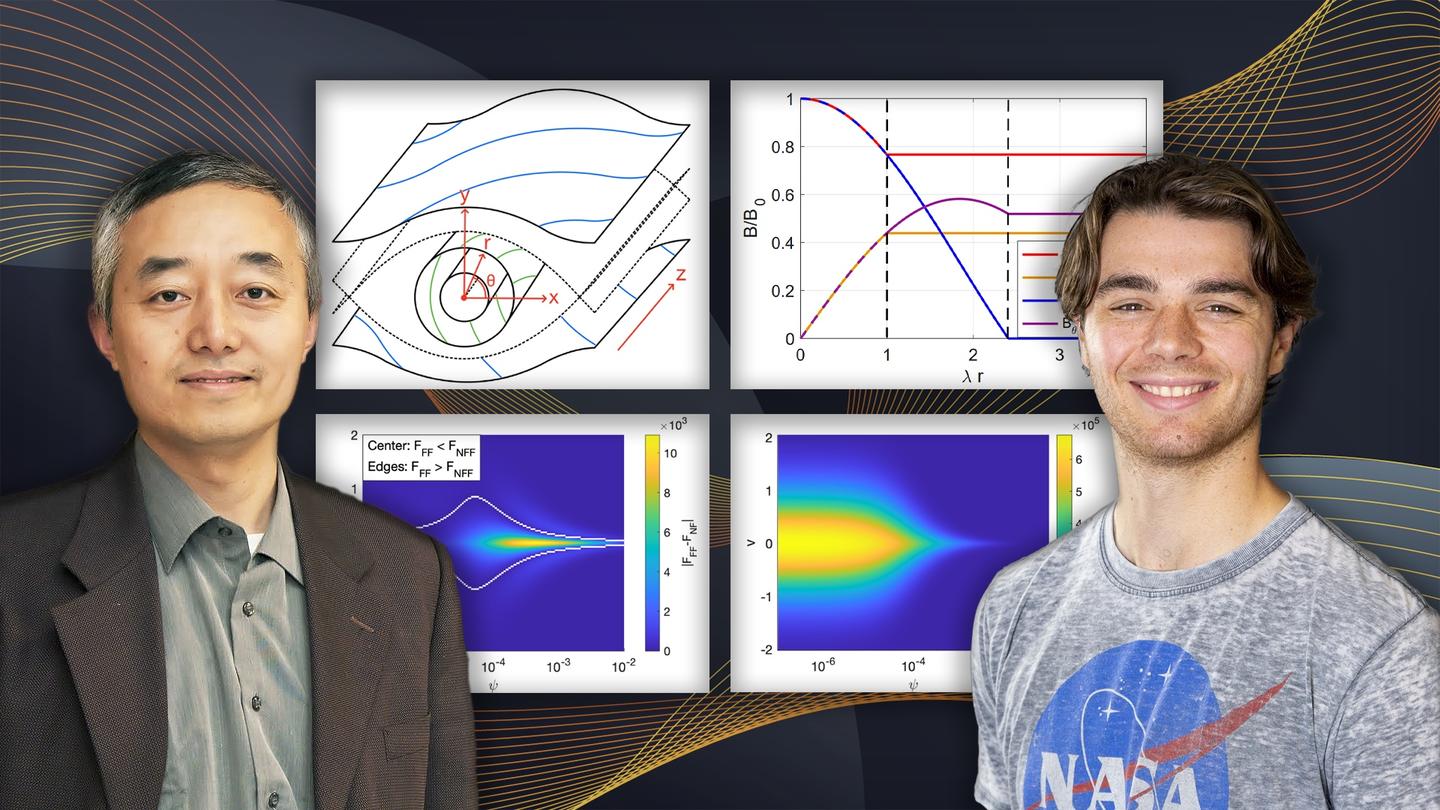
“Understanding how guide magnetic fields affect plasmoids could give us a better idea of what affects magnetic reconnection on the sun and stars, and throughout the cosmos,” said Stephen Majeski, lead author of a paper reporting the results in Physics of Plasmas and a graduate student in Princeton University’s Program in Plasma Physics. “Guide fields are a knob we can turn up to reveal new information.”
Solar Plasma Ejections and Their Effects on Earth
The results provide insight into the ejection of large masses of plasma that speed across space and strike the Earth’s magnetosphere, the sheath of magnetic field lines surrounding our planet that protects us from high-energy particles. These giant plasma burps, if large enough, could damage the satellites that enable smartphones to provide driving directions and other applications. The burps could also damage electrical power grids on Earth. “This is all something you definitely want to be aware of,” Majeski said.
“This is new territory for plasmoid reconnection research,” said Hantao Ji, professor of astrophysical science at Princeton University and distinguished research fellow at PPPL, who helps manage PPPL’s Magnetic Reconnection Experiment (MRX) that studies reconnection. “Majeski has added to our knowledge about guide fields to make progress toward understanding large-scale reconnection based on plasmoids. Nobody has looked at guide fields in this way before.”
Implications for Fusion Energy Research
Plasmoid reconnection with guide fields also occurs in doughnut-shaped tokamaks, the most widely used type of fusion facility around the world that use powerful magnets to confine plasma in the effort to harness on Earth fusion, the power that drives the sun and stars. Fusion combines light elements in the form of plasma to generate massive amounts of energy, a process that scientists are seeking to replicate for a virtually inexhaustible supply of power to generate electricity.
The researchers plan to make the models more accurate by including more physical effects, like the speed at which plasmoids combine. They also intend to perform experiments using MRX and PPPL’s new Facility for Laboratory Reconnection Experiment (FLARE), the large successor to MRX. FLARE will help probe how quickly reconnection takes place in large laboratory plasmas that are more relevant to astrophysical plasmas, and how the magnetic energy turns into explosive thermal energy.
Reference: “Guide field effects on the distribution of plasmoids in multiple scale reconnection” by Stephen Majeski, Hantao Ji, Jonathan Jara-Almonte and Jongsoo Yoo, 3 September 2021, Physics of Plasmas.
DOI: 10.1063/5.0059017
This research was supported by the DOE Office of Science (Fusion Energy Sciences).
Collaborators included PPPL physicists Jongsoo Yoo and Jonathan Jara-Almonte.
PPPL, on Princeton University’s Forrestal Campus in Plainsboro, N.J., is devoted to creating new knowledge about the physics of plasmas — ultra-hot, charged gases — and to developing practical solutions for the creation of fusion energy.
Never miss a breakthrough: Join the SciTechDaily newsletter.
Follow us on Google and Google News.
1 Comment
… now there is a question that kind of it is bothering me…
… in the start when there was a vast amount of gasses and the gasses collapsed and that was from a volume of space, and then it started to spin, but should the angular momentum be preserved that way…