
Close Menu
    Facebook X (Twitter) Instagram
    SciTechDaily
    • Biology
    • Chemistry
    • Earth
    • Health
    • Physics
    • Science
    • Space
    • Technology
    Facebook X (Twitter) Pinterest YouTube RSS
    SciTechDaily
    Home»Space»New Insight Into the Hole at the Heart of the Rosette Nebula
    Space

    New Insight Into the Hole at the Heart of the Rosette Nebula

    By Anna Harrison, University of LeedsFebruary 13, 2018No Comments4 Mins Read
    Facebook Twitter Pinterest Telegram LinkedIn WhatsApp Email Reddit
    Share
    Facebook Twitter LinkedIn Pinterest Telegram Email Reddit
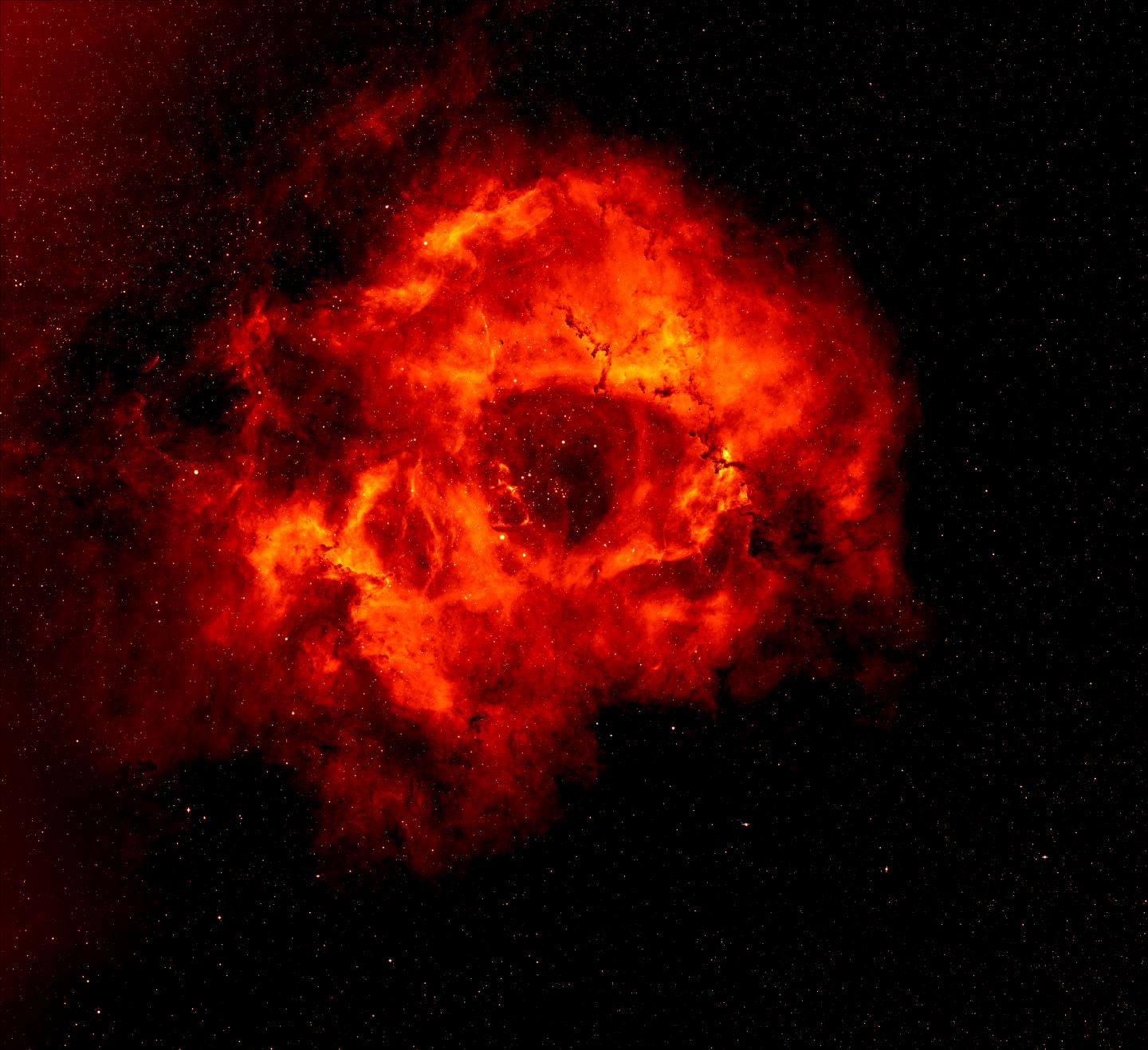
    New Insight Into the Heart of the Rosette Nebula
    Rosette Nebula image is based on data obtained as part of the INT Photometric H-Alpha Survey of the Northern Galactic Plane, prepared by Nick Wright, Keele University, on behalf of the IPHAS Collaboration. Credit: Nick Wright, Keele University

    A hole at the heart of a stunning rose-like interstellar cloud has puzzled astronomers for decades. But new research, led by the University of Leeds, offers an explanation for the discrepancy between the size and age of the Rosetta Nebula’s central cavity and that of its central stars.

    The Rosette Nebula is located in the Milky Way Galaxy roughly 5,000 light-years from Earth and is known for its rose-like shape and distinctive hole at its center. The nebula is an interstellar cloud of dust, hydrogen, helium, and other ionized gases with several massive stars found in a cluster at its heart.

    Stellar winds and ionizing radiation from these massive stars affect the shape of the giant molecular cloud. But the size and age of the cavity observed in the center of Rosette Nebula is too small when compared to the age of its central stars.

    Through computer simulations, astronomers at Leeds and at Keele University have found the formation of the Nebula is likely to be in a thin sheet-like molecular cloud rather than in a spherical or thick disc-like shape, as some photographs may suggest. A thin disc-like structure of the cloud focusing the stellar winds away from the cloud’s center would account for the comparatively small size of the central cavity.

    Study lead author, Dr. Christopher Wareing, from the School of Physics and Astronomy, said: “The massive stars that make up the Rosette Nebula’s central cluster are a few million years old and halfway through their lifecycle. For the length of time their stellar winds would have been flowing, you would expect a central cavity up to ten times bigger.
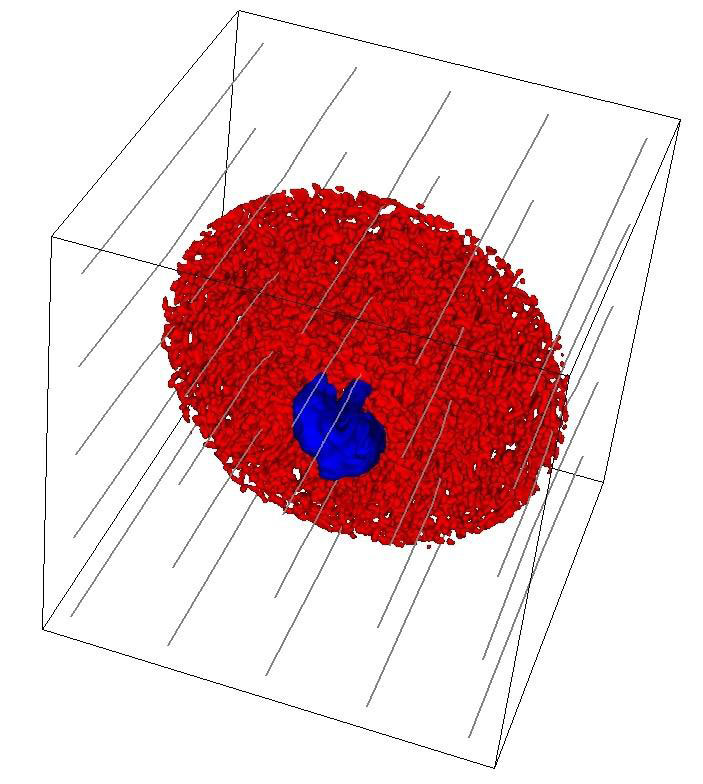
    3D View of the Heart of the Rosette Nebula
    This is a 3-D visualization of the simulated nebula, showing the dense disc-like molecular cloud in red, the tenuous stellar wind focused away from the disc in blue and the magnetic field lines in grey. The magnetic field is of key importance in forming a disc-like, not spherical, molecular cloud. Credit: C. J. Wareing et al., 2018, MNRAS

    “We simulated the stellar wind feedback and formation of the nebula in various molecular cloud models including a clumpy sphere, a thick filamentary disc, and a thin disc, all created from the same low density initial atomic cloud.

    “It was the thin disc that reproduced the physical appearance — cavity size, shape, and magnetic field alignment — of the Nebula, at an age compatible with the central stars and their wind strengths.

    “To have a model that so accurately reproduces the physical appearance in line with the observational data, without setting out to do this, is rather extraordinary.

    “We were also fortunate to be able to apply data to our models from the ongoing Gaia survey, as a number of the bright stars in the Rosette Nebula are part of the survey.

    Applying this data to our models gave us a new understanding of the roles individual stars play in the Rosette Nebula. Next, we’ll look at the many other similar objects in our Galaxy and see if we can figure out their shape as well.”

    The simulations, published today in the Monthly Notices of the Royal Astronomical Society, were run using the Advanced Research Computing center at Leeds. The nine simulations required roughly half a million CPU hours — the equivalent to 57 years on a standard desktop computer.

    Martin Callaghan, a member of the Advanced Research Computing team, said: “The fact that the Rosette Nebula simulations would have taken more than five decades to complete on a standard desktop computer is one of the key reasons we provide powerful supercomputing research tools. These tools enabled the simulations of the Rosette Nebula to be done in a matter of a few weeks.”

    Reference: “A new mechanical stellar wind feedback model for the Rosette Nebula” by C J Wareing, J M Pittard, N J Wright, S A E G Falle, 13 February 2018, MNRAS.
    DOI: 10.1093/mnras/sty148

    Never miss a breakthrough: Join the SciTechDaily newsletter.
    Follow us on Google and Google News.

    Astronomy Cosmology Nebula University of Leeds
    Share. Facebook Twitter Pinterest LinkedIn Email Reddit

    Related Articles

    Astronomers Discover a Structurally ‘Inside-Out’ Planetary Nebula

    Astronomers Reveal a Magnificent New Composite Image of the Crab Nebula

    Hubble Telescope Discovers Substellar Objects in the Orion Nebula

    New ESO Image of the Cat’s Paw and Lobster Nebulae

    Hubble Views the Heart of the Crab Nebula

    Astronomers Reveal the Secret Life of the Orion Nebula

    Astronomers Conclude That Fewer Than 1% of Stars Have a MMSN Disk

    Hubble Explores the Wings of the Twin Jet Nebula

    Survey of Carina Nebula Reveals Details of Star Formation

    Leave A Reply Cancel Reply

    • Facebook
    • Twitter
    • Pinterest
    • YouTube

    Don't Miss a Discovery

    Subscribe for the Latest in Science & Tech!

    Trending News

    Scientists Uncover Potential Brain Risks of Popular Fish Oil Supplements

    Scientists Discover a Surprising Way To Make Bread Healthier and More Nutritious

    After 60 Years, Scientists Uncover Unexpected Brain Effects of Popular Diabetes Drug Metformin

    New Research Uncovers Hidden Side Effects of Popular Weight-Loss Drugs

    Scientists Rethink Extreme Warming After Surprising Ocean Discovery

    Landmark Study Links Never Marrying to Significantly Higher Cancer Risk

    Researchers Discover Unknown Beetle Species Just Steps From Their Lab

    Largest-Ever Study Finds Medicinal Cannabis Ineffective for Anxiety, Depression, PTSD

    Follow SciTechDaily
    • Facebook
    • Twitter
    • YouTube
    • Pinterest
    • Newsletter
    • RSS
    SciTech News
    • Biology News
    • Chemistry News
    • Earth News
    • Health News
    • Physics News
    • Science News
    • Space News
    • Technology News
    Recent Posts
    • Scientists Finally Crack Decades-Old Mystery of “Breathing” Lasers
    • “Like Liquid Metal”: Scientists Create Strange Shape-Shifting Material
    • Early Warning Signals of Esophageal Cancer May Be Hiding in Plain Sight
    • Researchers Have Discovered a THC-Free Cannabis Compound That May Replace Opioids
    • Common Blood Pressure Drug Shows Surprising Power Against Deadly Antibiotic-Resistant Superbug
    Copyright © 1998 - 2026 SciTechDaily. All Rights Reserved.
    • Science News
    • About
    • Contact
    • Editorial Board
    • Privacy Policy
    • Terms of Use

    Type above and press Enter to search. Press Esc to cancel.