
Sensor is poised to improve landmine detection and non-destructive testing.
Detecting landmines can be a challenging and slow process. Detecting them from a moving vehicle would make the process more speedy, but at the expense of accuracy.
At The Optical Society’s (OSA) Laser Congress, held 29 September – 3 October 2019 in Vienna, Austria, researchers from the University of Mississippi, U.S.A., will report a new laser-based sensor that effectively detects buried objects even while the detector is in motion. This new device offers a significant improvement over existing technologies, which cannot be operated on the go and lose accuracy in the presence of external sources of sound or vibration.
Laser Doppler vibrometers (LDVs) combined with vibration excited in the ground have shown promise for detecting landmines and other buried objects, but their sensitivity to environmental vibrations means they must be operated from a special stable platform. The device, called a Laser Multi Beam Differential Interferometric Sensor (LAMBDIS), provides comparable detection capabilities but is far less sensitive to motion, allowing it to be used aboard a moving vehicle.
“The lingering scourge of landmines presents a serious challenge to rapid and accurate interrogation of large areas from moving vehicles,” said lead researcher Dr. Vyacheslav Aranchuk. “Our new device overcomes this challenge by using a series of laser beams and then combining their signals to create a rapid-detection scheme that also is robust enough to compensate for motion and other ‘noise’ that could overwhelm other techniques. LAMBDIS provides the measurement of vibration fields with high sensitivity, while having low sensitivity to the whole body motion of the object, or the sensor itself, allowing for the operation from a moving vehicle.”
Measurements without a reference beam
To detect buried objects, LDVs are used in conjunction with an audio source such as a loudspeaker, or a seismic source such as a mechanical shaker. The sound or seismic waves cause the ground to vibrate. The LDV can detect subtle differences in the vibration pattern where an object is buried, provided that the detector is stationary and the environment is sufficiently vibration-free.
Operation of traditional LDVs is based on interference of light reflected from an object with a reference beam internal to the LDV. As a result, motion of the LDV itself can cause LDV signals to be significantly higher than, and indistinguishable from, signals caused by object vibration.
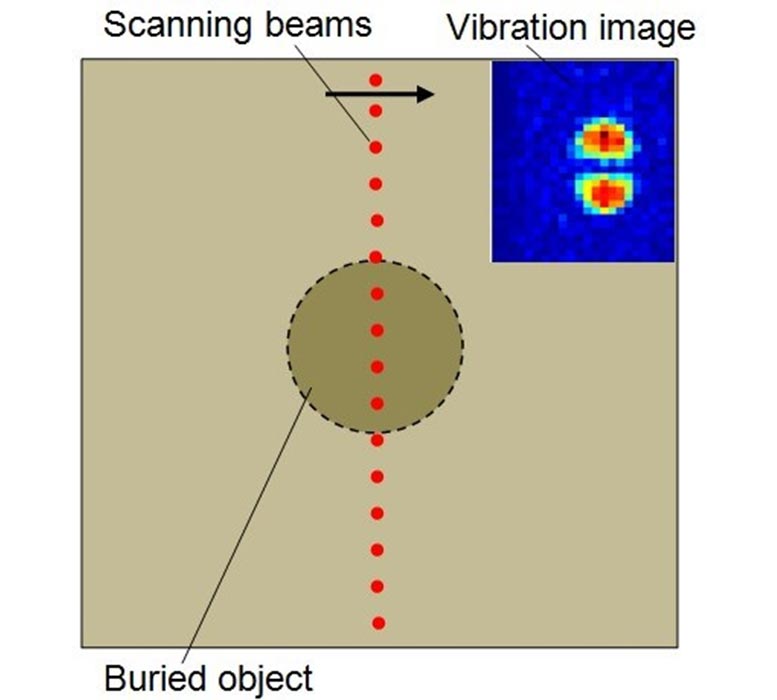
In the new work, the researchers used a linear array of 30 laser beams directed onto the interrogated area.
Optical elements, including a receiver lens and a shearing interferometer, are used to combine the light reflected from different points on the ground on a photodetector array (PDA) resulting in interference signals on the PDA outputs. The frequency of the signals is proportional to the vibration velocity between illuminated points due to the Doppler effect. Processing of the PDA signals reveals vibrations between illuminated points on the surface.
“Unlike LDVs, the LAMBDIS doesn’t use an internal reference beam, but detects a Doppler shift by using interference of light reflected from different points on the object,” said Aranchuk. “Due to the lack of a reference beam, the Doppler frequency caused by the sensor motion is practically the same for all reflected beams and is automatically subtracted from the interference signals. As a result, LAMBDIS has very low sensitivity to the motion of the sensor itself, while having high sensitivity to relative vibration between points on the object.”
Successful field tests
Researchers report the LAMBDIS device performed well under a wide range of conditions in laboratory and field tests. LAMBDIS was able to detect buried objects 7.5 meters (25 feet) to 20 meters (66 feet) away and from a vehicle traveling at 3.8 meters per second (about 8.5 miles per hour) with comparable results to a stable platform-mounted LDV. Researchers tested the device both with airborne and seismic sound sources and with different scanning angles, suggesting the device could provide accurate results in a variety of real-world conditions.
In addition to detecting landmines, LDVs are commonly used to inspect automobiles and aircraft components, assess bridge and structure vibrations, calibrate equipment and study materials, and in dental and biomedical applications. LAMBDIS could benefit such applications in cases where environmental noise or movement hinders the use of LDV devices.
Acknowledgment
This research is sponsored by the Department of the Navy, Office of Naval Research under ONR award number N00014-18-2489.
Never miss a breakthrough: Join the SciTechDaily newsletter.
Follow us on Google and Google News.