
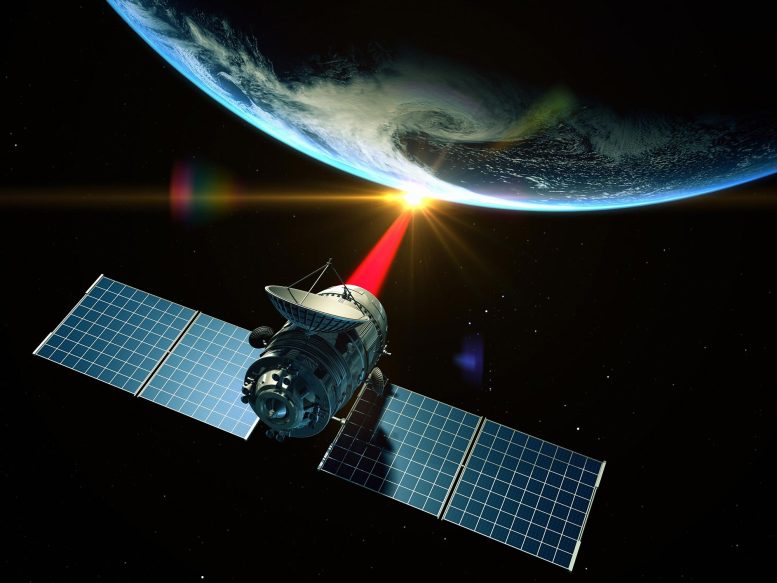
Russia’s new Kalina laser aims to blind satellite sensors, raising concerns about the future use of laser weapons in space and their potential to permanently damage satellites.
According to a recent report in The Space Review, Russia is building a new ground-based laser facility for interfering with satellites orbiting overhead. The basic idea is simple: flooding the optical sensors of other nations’ spy satellites with laser light to dazzle them.
Laser technology has evolved to the point where this type of anti-satellite defense is definitely plausible. However, there is limited evidence of any nation successfully testing such a laser.
If the Russian government is able to build it, lasers like this would be capable of shielding a large part of the country from the view of satellites with optical sensors. Worse, the technology also sets the stage for the more ominous possibility of laser weapons that can permanently disable satellites.
How Lasers Work
A laser is a device for creating a narrow beam of directed energy. The first laser was developed in 1960. Since that time, there have been several types created that use different physical mechanisms to generate photons, or particles of light.
In gas lasers, large amounts of energy are pumped into specific molecules such as carbon dioxide. Chemical lasers are powered by specific chemical reactions that release energy. Solid-state lasers use customized crystalline materials to convert electrical energy into photons. In all lasers, the photons are subsequently amplified by passing them through a special type of material called the gain medium and then focused into a coherent beam by a beam director.
The physics of lasers explained.
Laser Effects
Depending on the photon intensity and wavelength, the directed beam of energy formed by a laser can create a range of effects at its target. For instance, if the photons are in the visible part of the spectrum, a laser can deliver light at its target.
For a sufficiently high flow of high-energy photons, a laser can heat, vaporize, melt and even burn through the material of its target. The power level of the laser, the distance between the laser and its target, and the ability to focus the beam on the target are all important factors that determine the ability to deliver these effects of a target.
Laser Applications
The various effects generated by lasers find widespread applications in everyday life, including laser pointers, printers, DVD players, retinal and other medical surgery procedures, and industrial manufacturing processes such as laser welding and cutting. Researchers are developing lasers as an alternative to radio wave technology to boost communications between spacecraft and the ground.
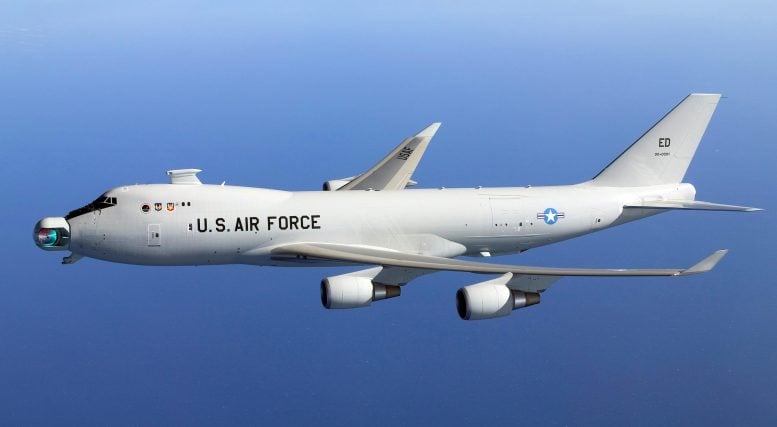
Lasers also find widespread application in military operations. One of the best known is the Airborne Laser (ABL), which the U.S. military intended to use to shoot down ballistic missiles. ABL involved a very large, high-power laser mounted on a Boeing 747. The program was ultimately doomed by the challenges associated with the thermal management and maintenance of its chemical laser.
A more successful military application is the Large Aircraft Infrared Counter Measures (LAIRCM) system, which is used to protect aircraft from heat-seeking antiaircraft missiles. LAIRCM shines light from a solid-state laser into the missile sensor as it approaches the aircraft, causing the weapon to become dazzled and lose track of its target.
The evolving performance of solid-state lasers has led to a proliferation of new military applications. The U.S. military is mounting lasers on Army trucks and Navy ships to defend against small targets such as drones, mortar shells, and other threats. The Air Force is studying the use of lasers on aircraft for defensive and offensive purposes.
The Russian Laser
The reputed new Russian laser facility is called Kalina. It is intended to dazzle, and therefore temporarily blind, the optical sensors of satellites that are collecting intelligence overhead. As with the U.S. LAIRCM, dazzling involves saturating the sensors with enough light to prevent them from functioning. Achieving this goal requires accurately delivering a sufficient amount of light into the satellite sensor. This is no easy feat given the very large distances involved and the fact that the laser beam must first pass through the Earth’s atmosphere.
Accurately pointing lasers over large distances into space is not new. For example, NASA’s Apollo 15 mission in 1971 placed meter-sized reflectors on the Moon that are targeted by lasers on Earth to provide positioning information. Delivering enough photons over large distances comes down to the laser power level and its optical system.
Kalina reportedly operates in a pulsed mode in the infrared and produces about 1,000 joules per square centimeter. By comparison, a pulsed laser used for retinal surgery is only about 1/10,000th as powerful. Kalina delivers a large fraction of the photons it generates across the large distances where satellites orbit overhead. It is able to do this because lasers form highly collimated beams, meaning the photons travel in parallel so the beam doesn’t spread out. Kalina focuses its beam using a telescope that has a diameter of several meters.
Spy satellites using optical sensors tend to operate in low-Earth orbit with an altitude of a few hundred kilometers. It generally takes these satellites a few minutes to pass over any specific point on the Earth’s surface. This requires Kalina to be able to operate continuously for that long while maintaining a permanent track on the optical sensor. These functions are carried out by the telescope system.
Based on the reported details of the telescope, Kalina would be able to target an overhead satellite for hundreds of miles of its path. This would make it possible to shield a very large area – on the order of 40,000 square miles (roughly 100,000 square kilometers) – from intelligence gathering by optical sensors on satellites. Forty thousand square miles is roughly the area of the state of Kentucky.
Russia claims that in 2019 it fielded a less capable truck-mounted laser dazzling system called Peresvet. However, there is no confirmation that it has been used successfully.
Laser power levels are likely to continue to increase, making it possible to go beyond the temporary effect of dazzling to permanently damaging the imaging hardware of sensors. While laser technology development is heading in that direction, there are important policy considerations associated with using lasers in this way. Permanent destruction of a space-based sensor by a nation could be considered a significant act of aggression, leading to a rapid escalation of tensions.
Lasers in Space
Of even greater concern is the potential deployment of laser weapons in space. Such systems would be highly effective because the distances to targets would likely be significantly reduced, and there is no atmosphere to weaken the beam. The power levels needed for space-based lasers to cause significant damage to spacecraft would be significantly reduced in comparison to ground-based systems.
Additionally, space-based lasers could be used to target any satellite by aiming lasers at propellant tanks and power systems, which, if damaged, would completely disable the spacecraft.
As technology advances continue, the use of laser weapons in space becomes more likely. The question then becomes: What are the consequences?
Written by Iain Boyd, Professor of Aerospace Engineering Sciences, University of Colorado Boulder.
This article was first published in The Conversation.
Never miss a breakthrough: Join the SciTechDaily newsletter.
Follow us on Google and Google News.
4 Comments
Just put a mirror cover on the sensors, and open it for observation only. Solved! Maybe…
Pentagon, call me…
China has already got a 6G laser up there ,capable of mass destruction,I wouldn’t be worried about Russia
scitechdaily.com Please do an article on China’s space laser.
The header of this article is just ridiculously biased … if Americans invented this it would have been described as “massive discovery for USA military arsenal” instead of using “Russian Ominous Technology”