
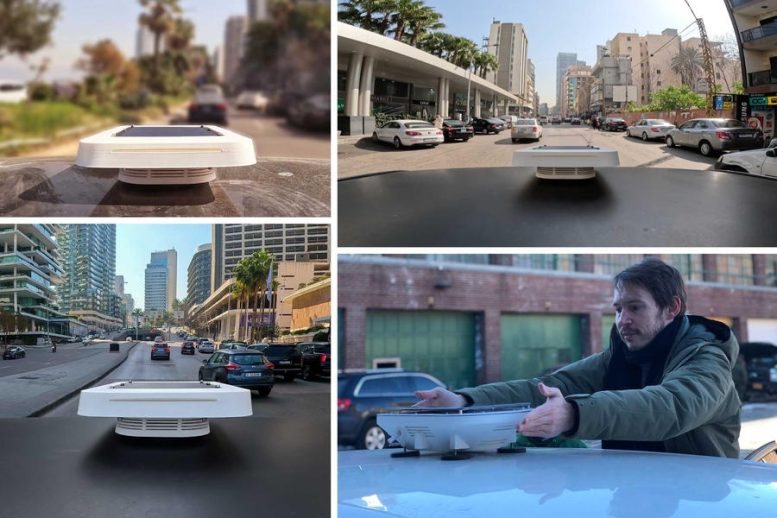
An open-source tool developed by MIT’s Senseable City Lab allows individuals to easily and affordably monitor air quality.
Air pollution poses a major threat to public health, with the World Health Organization attributing over 4 million premature deaths globally each year to poor air quality. Despite this, comprehensive measurement remains limited. However, an MIT research team is now introducing an open-source, affordable, and portable pollution detection device that could expand air quality monitoring capabilities.
Named Flatburn, this detector can be produced through 3D printing or by ordering inexpensive parts. The researchers have calibrated and tested it against cutting-edge machines and are publicly releasing all the information about it — how to build it, use it, and interpret the data.
A Vision for Citizen-Led Air Quality Monitoring
“The goal is for community groups or individual citizens anywhere to be able to measure local air pollution, identify its sources, and, ideally, create feedback loops with officials and stakeholders to create cleaner conditions,” says Carlo Ratti, director of MIT’s Senseable City Lab.
“We’ve been doing several pilots around the world, and we have refined a set of prototypes, with hardware, software, and protocols, to make sure the data we collect are robust from an environmental science point of view,” says Simone Mora, a research scientist at Senseable City Lab and co-author of a newly published paper detailing the scanner’s testing process. The Flatburn device is part of a larger project, known as City Scanner, using mobile devices to better understand urban life.
“Hopefully with the release of the open-source Flatburn we can get grassroots groups, as well as communities in less developed countries, to follow our approach and build and share knowledge,” says An Wang, a researcher at Senseable City Lab and another of the paper’s co-authors.
The paper was recently published in the journal Atmospheric Environment.
In addition to Wang, Mora, and Ratti the study’s authors are: Yuki Machida, a former research fellow at Senseable City Lab; Priyanka deSouza, an assistant professor of urban and regional planning at the University of Colorado at Denver; Tiffany Duhl, a researcher with the Massachusetts Department of Environmental Protection and a Tufts University research associate at the time of the project; Neelakshi Hudda, a research assistant professor at Tufts University; John L. Durant, a professor of civil and environmental engineering at Tufts University; and Fabio Duarte, principal research scientist at Senseable City Lab.
The Flatburn concept at Senseable City Lab dates back to about 2017, when MIT researchers began prototyping a mobile pollution detector, originally to be deployed on garbage trucks in Cambridge, Massachusetts. The detectors are battery-powered and rechargable, either from power sources or a solar panel, with data stored on a card in the device that can be accessed remotely.
The current extension of that project involved testing the devices in New York City and the Boston area, by seeing how they performed in comparison to already-working pollution detection systems. In New York, the researchers used 5 detectors to collect 1.6 million data points over four weeks in 2021, working with state officials to compare the results. In Boston, the team used mobile sensors, evaluating the Flatburn devices against a state-of-the-art system deployed by Tufts University along with a state agency.
In both cases, the detectors were set up to measure concentrations of fine particulate matter as well as nitrogen dioxide, over an area of about 10 meters. Fine particular matter refers to tiny particles often associated with burning matter, from power plants, internal combustion engines in autos and fires, and more.
Performance and Challenges of Flatburn Detectors
The research team found that the mobile detectors estimated somewhat lower concentrations of fine particulate matter than the devices already in use, but with a strong enough correlation so that, with adjustments for weather conditions and other factors, the Flatburn devices can produce reliable results.
“After following their deployment for a few months we can confidently say our low-cost monitors should behave the same way [as standard detectors],” Wang says. “We have a big vision, but we still have to make sure the data we collect is valid and can be used for regulatory and policy purposes,”
Duarte adds: “If you follow these procedures with low-cost sensors you can still acquire good enough data to go back to [environmental] agencies with it, and say, ‘Let’s talk.’”
The researchers did find that using the units in a mobile setting — on top of automobiles — means they will currently have an operating life of six months. They also identified a series of potential issues that people will have to deal with when using the Flatburn detectors generally. These include what the research team calls “drift,” the gradual changing of the detector’s readings over time, as well as “aging,” the more fundamental deterioration in a unit’s physical condition.
Empowering Communities with Actionable Data
Still, the researchers believe the units will function well, and they are providing complete instructions in their release of Flatburn as an open-source tool. That even includes guidance for working with officials, communities, and stakeholders to process the results and attempt to shape action.
“It’s very important to engage with communities, to allow them to reflect on sources of pollution,” says Mora.
“The original idea of the project was to democratize environmental data, and that’s still the goal,” Duarte adds. “We want people to have the skills to analyze the data and engage with communities and officials.”
Reference: “Leveraging machine learning algorithms to advance low-cost air sensor calibration in stationary and mobile settings” by An Wang, Yuki Machida, Priyanka deSouza, Simone Mora, Tiffany Duhl, Neelakshi Hudda, John L. Durant, Fábio Duarte and Carlo Ratti, 1 March 2023, Atmospheric Environment.
DOI: 10.1016/j.atmosenv.2023.119692
Never miss a breakthrough: Join the SciTechDaily newsletter.
Follow us on Google and Google News.