
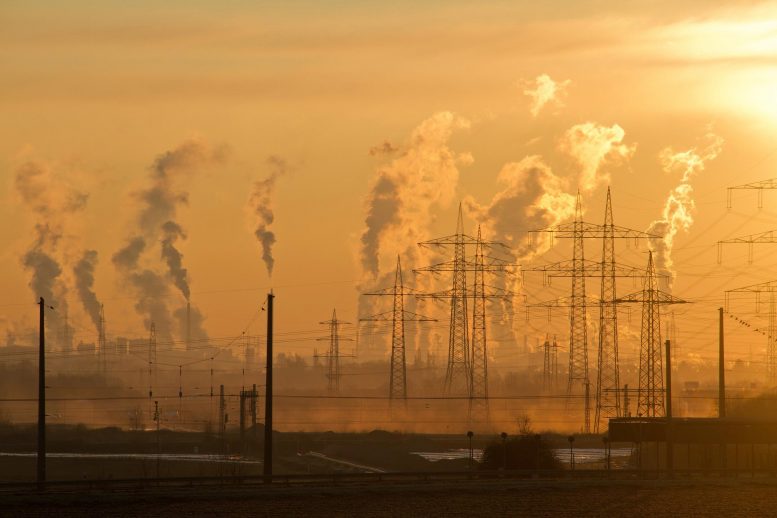
Researchers at the University of York have figured out why lowering particle pollution in certain developing nations causes an increase in surface ozone pollution, which has detrimental effects on human health, ecosystems, and agriculture.
Researchers at the University of York have figured out why, in certain growing countries, lowering particle pollution leads to an increase in surface ozone pollution, which has detrimental effects on human health, ecosystems, and agriculture.
The researchers claim that the results, which were published in Nature Geoscience, cast doubt on tried-and-true strategies for combating air pollution.
The primary component of “smog,” surface ozone, is produced by chemical reactions between nitrogen oxides (NOx) and volatile organic compounds (VOC). This occurs when pollutants released by automobiles, power plants, industrial boilers, refineries, chemical plants, and other sources react in the presence of sunlight.
The Surprising Increase in Ozone with Reduced Particle Pollution
The scientific community was startled to discover an increase in ozone pollution during the previous decade when nations like China improved air quality by lowering particle pollution, which is released through burning coal, producing steel, driving, and fires. The research has now provided new insight into the connection between these two contaminants.
The researchers have shown that in certain places, ozone and particles are tightly related, despite the fact that traditionally, policymakers have treated them as different issues. Peroxy radicals, which are short-lived ozone-making components, adhere to particle pollution and prevent it from going on to produce ozone. As the number of particles falls, more peroxy radicals are available for reactions, which leads to an increase in ozone.
In certain densely populated parts of China and India, the study’s model of the impacts of lowering particle pollution revealed that it might result in an increase in ozone of 20–30%. This would have a very serious impact on ecosystems and crop yield if left unmanaged.
Rethinking Air Pollution Strategies
The researchers are urging the development of fresh approaches that take into consideration this relationship between contaminants. By focusing on a broader variety of pollutants, particularly (VOCs) from chemicals and fuels and NOx from combustion, the issue can be overcome.
Co-lead author of the study, Professor Mathew Evans from the Department of Chemistry at the University of York said: “Particle pollution and ozone pollution have been viewed by policymakers around the world as separate issues, but our study emphasizes the need to look at them together. For 40 years we have thought that ozone depended only on volatile organic compounds and nitrogen oxides and it’s only now that we are putting the pieces of the puzzle together and seeing this relationship with particle pollution. Policy now needs to be adapted to this new knowledge.”
He continues, “tackling particulate matter in the atmosphere is rightly a priority because of the serious risk it poses to human health. However, this study highlights the complex choices facing governments in how they invest to manage air pollution. Solutions are not straightforward and there can be hidden connections between different pollutants.”
The WHO estimates that 4.2 million die prematurely every year as a result of exposure to outdoor air pollution. Developing countries such as India, China, and Africa are among the worst affected.
The Need for Broader Reductions in NOx and VOCs
The modeling study estimated that significant reductions in particle pollution in these areas would lead to the need to make dramatic reductions in the emissions of the NOx and VOCs – up to 50% in – order to keep ozone pollution in check.
Co-lead author of the study, Professor Alastair Lewis from the National Centre for Atmospheric Science added “this study shows that there can be risks in focusing too narrowly on just one pollutant. There has been a dramatic improvement in particle pollution in China over recent years, but emphasis only on particles can lead to unintended consequences. Action to accelerate the reduction in emissions of NOx and VOCs is now essential.”
Reference: “Suppression of surface ozone by an aerosol-inhibited photochemical ozone regime” by Peter D. Ivatt, Mathew J. Evans, and Alastair C. Lewis, 7 July 2022, Nature Geoscience.
DOI: 10.1038/s41561-022-00972-9
The study was funded by the Natural Environment Research Council, the Air Pollution and Human Health program (APHH)) and the National Centre for Atmospheric Science National Capability awards.
Never miss a breakthrough: Join the SciTechDaily newsletter.
Follow us on Google and Google News.
3 Comments
This summary article says little about photolysis, or the photochemical reactions that drive the creation of ozone. The lede photo suggests that one of the consequences of high aerosol levels is a reduction in the light intensity at ground level, including UVA and UVB. Cleaning up the aerosols increases the light intensity, providing a greater intensity of UV. This shouldn’t be a great surprise to people who have lived with smog, such as in the Los Angeles Basin, where the term smog originated. Smog is typically much worse during the Summer, when the sunlight is of greater intensity and daylight lasts longer.
Ozone is produced as a result of toxic combustion engine exhaust fumes breaking down from exposure to sunlight. How bad would it be IF these fumes DID NOT break down?
Toxic? You mean the combustion products water vapor and carbon dioxide necessary for plant photosynthesis? Most of the problem was formerly from unburned hydrocarbons, which have been pretty much eliminated in cars with the introduction of catalytic converters and burning the crankcase fumes with cycling through the cylinders. There continues to be a problem with turpenes released from natural vegetation and introduced ornamental plants, as well as industrial releases of various hydrocarbons. The epitome of that is the Great Smokey Mountains where the bluish haze is almost exclusively turpenes and photolysis-derived hydrocarbons. You overstate the role of exhaust fumes from modern cars.