
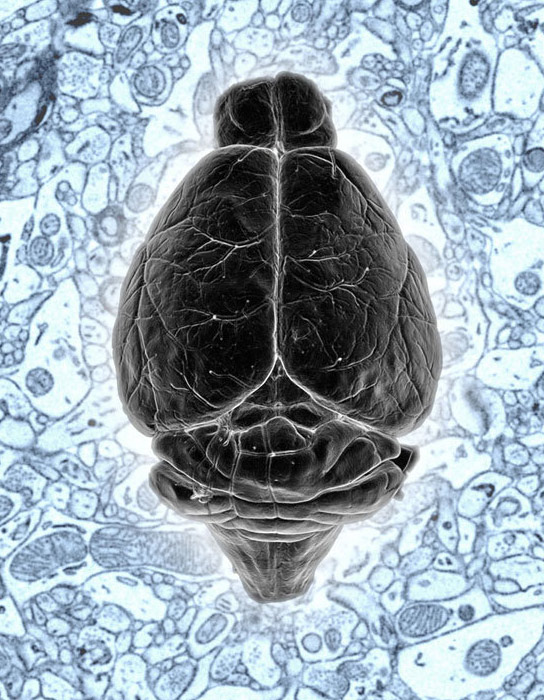
Researchers from the Max Planck Institute of Neurobiology have developed a special staining method that brings the reconstruction of all nerve cells and their connections within reach.
Learning, it is widely believed is based on changes in the connections between nerve cells. Knowing which nerve cells are connected to which other nerve cells would considerably help us to understand how the brain works. Scientists have therefore long been dreaming of mapping and then decoding the connectome, the circuit diagram of the brain. With the development of a special staining method, Shawn Mikula and Winfried Denk of the Max Planck Institute of Neurobiology in Martinsried have now closed one of the last methodological gaps: How to stain an entire brain. The mapping of a whole mouse brain now seems within reach, but even if the equipment works as designed alone the collection of the data will take several years, and the analysis of the approximately 40 petabytes of data may take decades.
A lot has happened since scientists in the late 19th century first started examining nerve cells under the microscope. Anatomy, chemistry, physiology, and cell biology in healthy as well as in sick brains have since been extensively explored. How thoughts and feelings arise from the activity of individual cells and what happens when cells disconnect from the network through degenerative diseases, for example, is still unclear. It is, therefore, clearly important to know the network’s connections, and finding all of those connections is the aim of connectomics.
The human brain contains around 100 billion cell-to-cell connections. While mapping a human brain’s connectome is true Science Fiction, the development of the serial block face scanning electron microscope and other imaging and analysis methods has brought the connectome of the mouse brain, which is 3000 times smaller than the human one, within reach. “A crucial step, which was still missing, was the preparation of a whole-brain sample”, says Shawn Mikula. For the last six years, he has been working on staining of a complete mouse brain so that the contrast is uniform across the brain and the ultra-structural information needed for tracing the brain’s wires and detecting its synapse doesn’t get destroyed. Previous staining methods could only reliably stain relatively small tissue samples. But once the brain is divided into small pieces neural wires can no longer pursued between the pieces, preventing the subsequent generation of a brain-wide map. Methods that aim to stain the whole brain either stained the brain too weakly or unevenly, or they destroyed the brain structures. As a result, the reconstruction of all nerve cell connections remained impossible.
Shawn Mikula and Winfried Denk have now presented their BROPA method for the staining of a whole brain. The abbreviation BROPA stands for a complex sequence of staining and rinsing steps, including osmium and pyrogallol solutions. The whole staining process takes around four weeks. “My patience was sorely, because it is not until the end of this period that one knows whether a change in the staining process was good or bad”, explains Shawn Mikula. But after a lot of waiting and refining, the two scientists are now satisfied with their new method: “Our results show that single axons can be followed reliably and synapses recognized with the serial block face scanning electron microscope in a BROPA stained mouse brain”, says Mikula. An important success for the team, as Winfried Denk invented the serial block face scanning electron microscope more than ten years ago with this goal in mind.
“We are now an important step closer to our goal of recording a complete mouse brain with all its cells and connections under the electron microscope”, explains Winfried Denk, Director at the Max Planck Institute of Neurobiology. As soon as the latest generation if instruments is delivered and tested, which is planned to take over a year, the scientists intend to start the project. “I estimate that just collecting the data will take around two-and-a-half years”, says Denk. At this time, around 40 petabytes of data will be generated. “We will manage the storage somehow, it’s the analysis we’re still worried about”, adds Mikula. The results so far show that automated computer programs can recognize BROPA stained synapses and cell bodies quite reliably. But even rare breaks will leave the nerve fibers unacceptably fragmented. “I am confident that we, as a field, will be able to solve that as well”, says Winfried Denk. Against the background of the deciphering of the human genome, this actually does not sound unlikely: When the first DNA sections were decoded in the mid-1970s, the sequencing of an entire human genome initially seemed as impossible as now does the connectomic mapping of an entire human brain.
Reference: “High-resolution whole-brain staining for electron microscopic circuit reconstruction” by Shawn Mikula, and Winfried Denk, 13 April 2015, Nature Methods.
DOI: 10.1038/nmeth.3361
Never miss a breakthrough: Join the SciTechDaily newsletter.
Follow us on Google and Google News.