
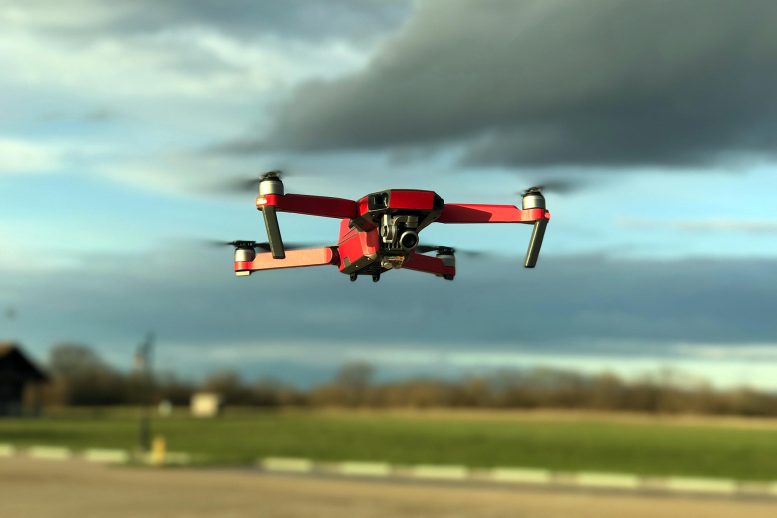
Skilled pilots approaching a runway usually can’t see small unmanned aircraft systems (sUAS) encroaching on their airspace, and they virtually never detect motionless drones, a newly published study shows.
During an airborne human factors experiment, certificated pilots failed to see a common type of quadcopter during 28 of 40 close encounters, researchers with Oklahoma State University and Embry-Riddle Aeronautical University reported.
In other words, the pilots got a bead on the invading drone in 12 out of 40 cases, or only about 30 percent of the time. When the drone was not moving, the task became even more difficult. A mere three out of 22 motionless drones were spotted by the pilots. Drones were detected at distances of between 213 and 2,324 feet (65 and 708 meters).
These findings, published in the International Journal of Aviation, Aeronautics, and Aerospace (IJAAA), illustrate a real and growing threat to aviation safety, said Dr. Ryan J. Wallace, assistant professor of Aeronautical Science at Embry-Riddle.
“Dangerous close encounters between aircraft and drones are becoming an increasingly common problem,” Wallace said. “Statistics on pilot sightings of drones continue to increase year over year, and what is being reported by pilots is probably just the tip of the iceberg. The vast majority of the time, unmanned aircraft are not being seen by pilots.”
Even in a best case scenario, if a drone was spotted at the study’s maximum detection range of 2,324 feet (708 meters), the pilot would have only about 21 seconds to avoid a collision. “That might be enough time if the drone was hovering in one spot, but not nearly enough if it’s in flight, headed for the aircraft,” said Dr. Matt Vance, assistant professor of aviation and space at Oklahoma State. “The situation is far more dangerous when both aircraft are moving,” he said. “Our eyes are attuned to movement. When a drone is not moving, it becomes part of the background.”
An aircraft’s final approach for landing is an especially risky time for a drone encounter because “it can catch you unaware and you have little time to react,” explained Dr. Jon M. Loffi, associate professor of aviation and space at Oklahoma State. “You don’t have the altitude to maneuver safely, and if an engine ingests a drone, that could bring the aircraft down.”
The research examined what happens as a pilot prepares to land and switches from instrument-guided flight to visual flight. Pilot participants were selected from a collegiate flight-training program. During the experiment, pilots conducted an approach to landing in a Cessna 172S while a DJI Phantom IV quadcopter-type drone flew a scripted series of maneuvers along the approach path. Pilots were told that they might or might not encounter a drone.
A Growing Problem
Currently, in the United States, there are more than 1.4 million registered, and likely many more unregistered drones, and they continue to proliferate, Wallace said. Close calls between drones and commercial aircraft are on the rise. On October 21, 2019, for example, a commercial crew on approach to Boston’s Logan International Airport reported a drone at about 3,500 feet above ground level – higher than U.S. Federal Aviation Administration (FAA) regulations allow. The event took place a week after another crew spotted a drone after takeoff from the same airport.
While the FAA “has made strides to secure control airspace from UAS incursions,” the study authors wrote, “their efforts have been met with mixed results.” There is currently no reliable method for tracking UAS flights within the United States.
The research team’s next project will involve rigging a drone with an electronic pinging device (UAvionics Ping), which uses ADS-B (automatic dependent surveillance-broadcast) technology to track aircraft. The study will assess whether the technology helps pilots pinpoint and avoid a collision with the drone.
Leveraging UAS remote identification data has been proposed as a way to reduce the risk of aircraft-drone accidents. As of January 2020, Vance noted, no aircraft will be allowed to fly in controlled airspace near airports without ADS-B tracking technology, but the law does not extend to small unmanned aircraft. If all drones had such technology, pilots would have a more complete picture of the skies around them, thereby improving safety, Vance said.
The study, “Cleared to Land: Pilot Visual Detection of Small Unmanned Aircraft During Final Approach” was co-authored by Wallace, Vance, and Loffi, along with Jamey Jacob, Jared C. Dunlap, Tyler A. Mitchell, and Seabrook R. Whyte of Oklahoma State, as well as Robert Thomas of Embry-Riddle. The research can be found on the IJAAA website.
Reference: “Cleared to Land: Pilot Visual Detection of Small Unmanned Aircraft During Final Approach” by Ryan J. Wallace, Samuel M. Vance, Jon M. Loffi, Jamey Jacob, Jared C. Dunlap, Taylor A. Mitchell, Robert Thomas and Seabrook R. Whyte, 29 October 2019, International Journal of Aviation, Aeronautics, and Aerospace (IJAAA).
DOI: 10.15394/ijaaa.2019.1421
Never miss a breakthrough: Join the SciTechDaily newsletter.
Follow us on Google and Google News.
4 Comments
Another question remains unanswered: How many of the drones spotted by pilots were in fact not drones? As noted, it’s very difficult to spot a small plastic object from an aircraft moving at several hundred kph so what were they actually seeing when they reported a drone sighting?
Being a pilot and having twenty some years in aviation, my best guess is the objects seen were drones.
As a layperson what is your opinion of what these pilot identified objects may have been instead? Not that I think you are asking a silly question, but we are talking open airspace where the only other small flyers flap their wings. Perhaps a UFO? Full of very tiny aliens?
Pilots are not car drivers, they actually have to pass competency tests on a regular basis to keep their license.
What I find funny it shows a dji drone. They dont have the ability to take off
and fly near airports. Maybe make it a requirement that all drones have this protection. I know autel ego actually uses as a sales pitch that they have no limits and can fly around airports. In my eyes that means your marketing to the irresponsible drone flyers. I love my dji mavic 2. And it’s great because sometimes you don’t know about a small airport but it tells you and won’t take off or if your flying it forcefully lands when u get to close.
I think one unstated(?) point of the article is security concerns. Modern jets have just two engines. Their reliability is so high they don’t need more. Just ask Sully. 😉
A team of two could pose a disturbing threat. A competent team could get around the built-in flight limitations using a home-built drone. I bet hobbyists are probably already flying DIY drones using plans pulled off the net.