
Close Menu
    Facebook X (Twitter) Instagram
    SciTechDaily
    • Biology
    • Chemistry
    • Earth
    • Health
    • Physics
    • Science
    • Space
    • Technology
    Facebook X (Twitter) Pinterest YouTube RSS
    SciTechDaily
    Home»Technology»Raptor-Inspired Drone With Morphing Wing and Tail for Unprecedented Flight Agility
    Technology

    Raptor-Inspired Drone With Morphing Wing and Tail for Unprecedented Flight Agility

    By Ecole Polytechnique Fédérale de LausanneNovember 1, 2020No Comments3 Mins Read
    Facebook Twitter Pinterest Telegram LinkedIn WhatsApp Email Reddit
    Share
    Facebook Twitter LinkedIn Pinterest Telegram Email Reddit
    Raptor Inspired Drone Morphing Wing Tail
    Raptor-inspired drone with morphing wing and tail. Credit: 2020 EPFL/Alain Herzog

    EPFL engineers have developed a drone with a feathered wing and tail that give it unprecedented flight agility.

    The northern goshawk is a fast, powerful raptor that flies effortlessly through forests. This bird was the design inspiration for the next-generation drone developed by scientists of the Laboratory of Intelligent Systems of EPFL led by Dario Floreano. They carefully studied the shape of the bird’s wings and tail and its flight behavior and used that information to develop a drone with similar characteristics.

    “Goshawks move their wings and tails in tandem to carry out the desired motion, whether it is rapid changes of direction when hunting in forests, fast flight when chasing prey in the open terrain, or when efficiently gliding to save energy,” says Enrico Ajanic, the first author and PhD student in Floreano’s lab. And Floreano adds “Our design extracts principles of avian agile flight to create a drone that can approximate the flight performance of raptors, but also tests the biological hypothesis that a morphing tail plays an important role in achieving faster turns, decelerations, and even slow flight.”

    Raptor Inspired Drone Wing
    Wing close-up of raptor-inspired drone. Credit: 2020 EPFL/Alain Herzog

    A drone that moves its wings and tail

    The engineers already designed a bird-inspired drone with morphing wing back in 2016. In a step forward, their new model can adjust the shape of its wing and tail thanks to its artificial feathers. “It was fairly complicated to design and build these mechanisms, but we were able to improve the wing so that it behaves more like that of a goshawk,” says Ajanic. “Now that the drone includes a feathered tail that morphs in synergy with the wing, it delivers unparalleled agility.” The drone changes the shape of its wing and tail to change direction faster, fly slower without falling to the ground, and reduce air resistance when flying fast. It uses a propeller for forward thrust instead of flapping wings because it is more efficient and makes the new wing and tail system applicable to other winged drones and airplanes.
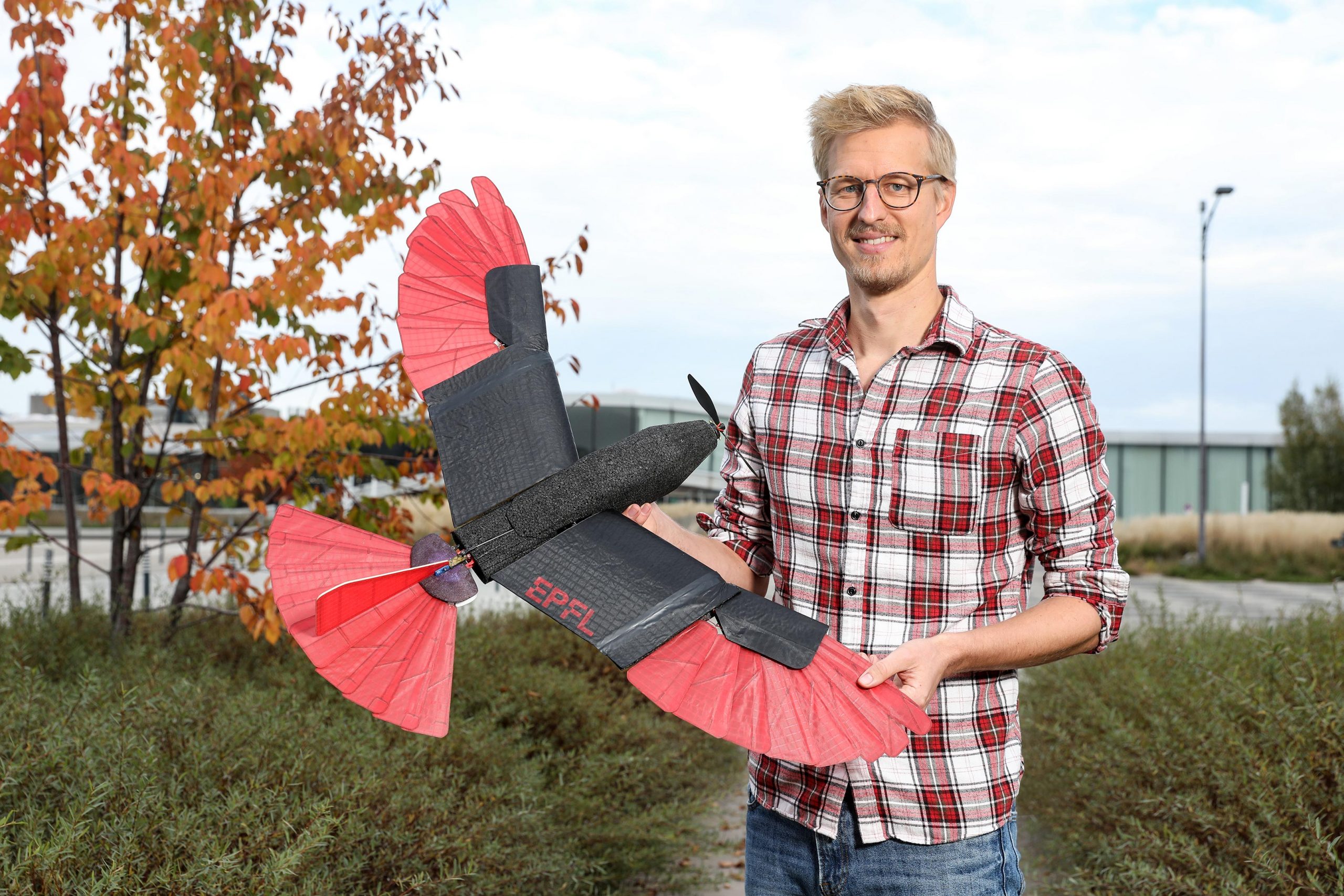
    Enrico Ajanic
    Enrico Ajanic with the raptor-inspired drone developed at EPFL. Credit: 2020 EPFL/Alain Herzog

    The advantage of winged drones over quadrotor designs is that they have a longer flight time for the same weight. However, quadrotors tend to have greater dexterity, as they can hover in place and make sharp turns. “The drone we just developed is somewhere in the middle. It can fly for a long time yet is almost as agile as quadrotors,” says Floreano. This combination of features is especially useful for flying in forests or in cities between buildings.

    Opportunities for artificial intelligence

    Flying this new type of drone isn’t easy, due to the large number of wing and tail configurations possible. To take full advantage of the drone’s flight capabilities, Floreano’s team plans to incorporate artificial intelligence into the drone’s flight system so that it can fly semi-automatically. The team’s research has been published in Science Robotics.
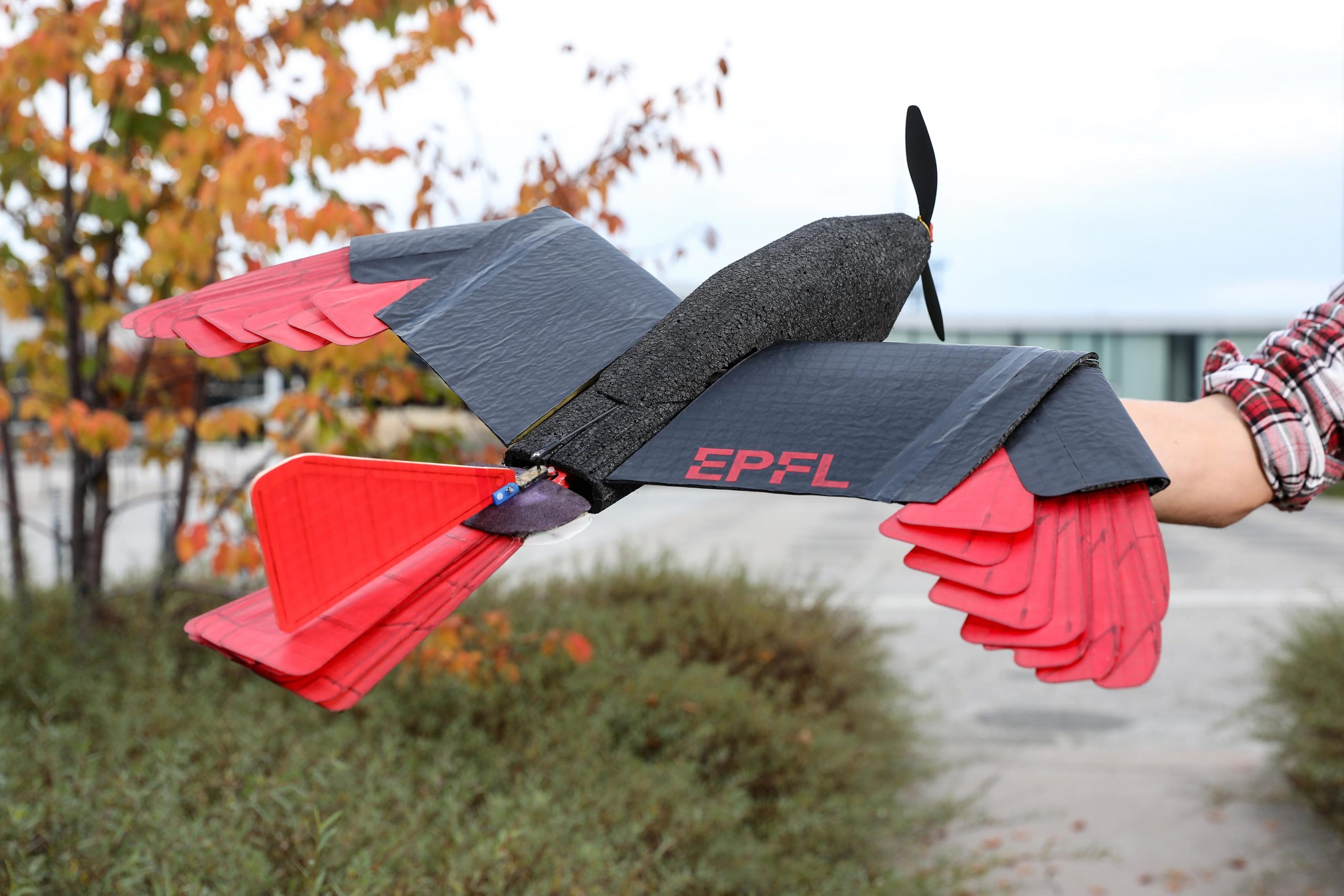
    Raptor Inspired Drone
    Raptor-inspired drone with morphing wing and tail. Credit: 2020 EPFL/Alain Herzog

    Reference: “Bioinspired wing and tail morphing extends drone flight capabilities” by Enrico Ajanic, Mir Feroskhan, Stefano Mintchev, Flavio Noca and Dario Floreano, 28 October 2020, Science Robotics.
    DOI: 10.1126/scirobotics.abc2897

    Funding: NCCR Robotics

    Never miss a breakthrough: Join the SciTechDaily newsletter.
    Follow us on Google and Google News.

    Drones EPFL Robotics
    Share. Facebook Twitter Pinterest LinkedIn Email Reddit

    Related Articles

    Secrets of Highly Efficient Swimming Uncovered for Design of Next-Generation Underwater Drones

    New Algorithm Flies Drones Faster Than World-Class Human Racing Pilots

    New MIT Algorithm Helps Robots Collaborate to Get the Job Done

    Insect-Inspired Flying Robots: Researchers Introduce a New Generation of Tiny, Agile Drones

    Ultra-Light Robotic Insect Uses Soft Artificial Muscles to Move – Survives Being Flattened by a Fly Swatter

    Soft, Flexible Artificial Skin Produces a Realistic Sense of Touch [Video]

    New Low-Power Chip Will Help Miniature Drones Navigate

    New Chip Design Method May Result in Miniature Smart Drones

    “Cheetah-Cub Robot” Runs Like a Cat

    Leave A Reply Cancel Reply

    • Facebook
    • Twitter
    • Pinterest
    • YouTube

    Don't Miss a Discovery

    Subscribe for the Latest in Science & Tech!

    Trending News

    New Pill Lowers Stubborn Blood Pressure and Protects the Kidneys

    Humans May Have Hidden Regenerative Powers, New Study Suggests

    Scientists Just Solved the Mystery of Why Crabs Walk Sideways

    Doctors Are Surprised by What This Vaccine Is Doing to the Heart

    This Popular Supplement May Boost Your Brain, Not Just Your Muscles

    Scientists Say This Simple Supplement May Actually Reverse Heart Disease

    Warming Oceans Could Trigger a Dangerous Methane Surge

    This Simple Movement Could Be Secretly Cleaning Your Brain

    Follow SciTechDaily
    • Facebook
    • Twitter
    • YouTube
    • Pinterest
    • Newsletter
    • RSS
    SciTech News
    • Biology News
    • Chemistry News
    • Earth News
    • Health News
    • Physics News
    • Science News
    • Space News
    • Technology News
    Recent Posts
    • Scientists Warn of Rising Male Childlessness As Global Fertility Changes
    • New Discovery Challenges Decades-Old Theory of DNA Damage and Aging
    • Scientists Just Rewrote Biology: “Hidden” Mechanism Could Transform Diabetes Treatment
    • Scientists Solve 320-Million-Year Mystery of Reptile Skin Armor
    • Hidden Heart Risk Found in 1 in 5 People, Study Warns
    Copyright © 1998 - 2026 SciTechDaily. All Rights Reserved.
    • Science News
    • About
    • Contact
    • Editorial Board
    • Privacy Policy
    • Terms of Use

    Type above and press Enter to search. Press Esc to cancel.