
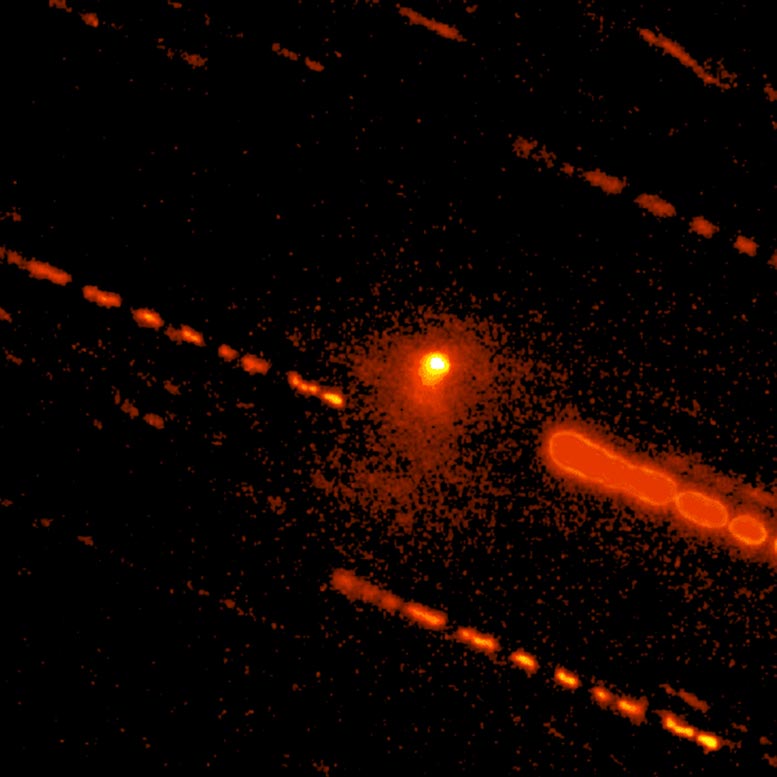
Centaurs are minor planets believed to have originated in the Kuiper Belt in the outer solar system. They sometimes have comet-like features such as tails and comae—clouds of dust particles and gas—even though they orbit in a region between Jupiter and Neptune where it is too cold for water to readily sublimate, or transition, directly from a solid to a gas.
Only 18 active Centaurs have been discovered since 1927, and much about them is still poorly understood. Discovering activity on Centaurs is also observationally challenging because they are faint, telescope time-intensive and because they are rare.
A team of astronomers, led by doctoral student and Presidential Fellow Colin Chandler in Northern Arizona University’s Astronomy and Planetary Science PhD program, earlier this year announced their discovery of activity emanating from Centaur 2014 OG392, a planetary object first found in 2014. They published their findings in a paper in The Astrophysical Journal Letters, “Cometary Activity Discovered on a Distant Centaur: A Nonaqueous Sublimation Mechanism.” Chandler is the lead author, working with four NAU co-authors: graduate student Jay Kueny, associate professor Chad Trujillo, professor David Trilling and Ph.D. student William Oldroyd.
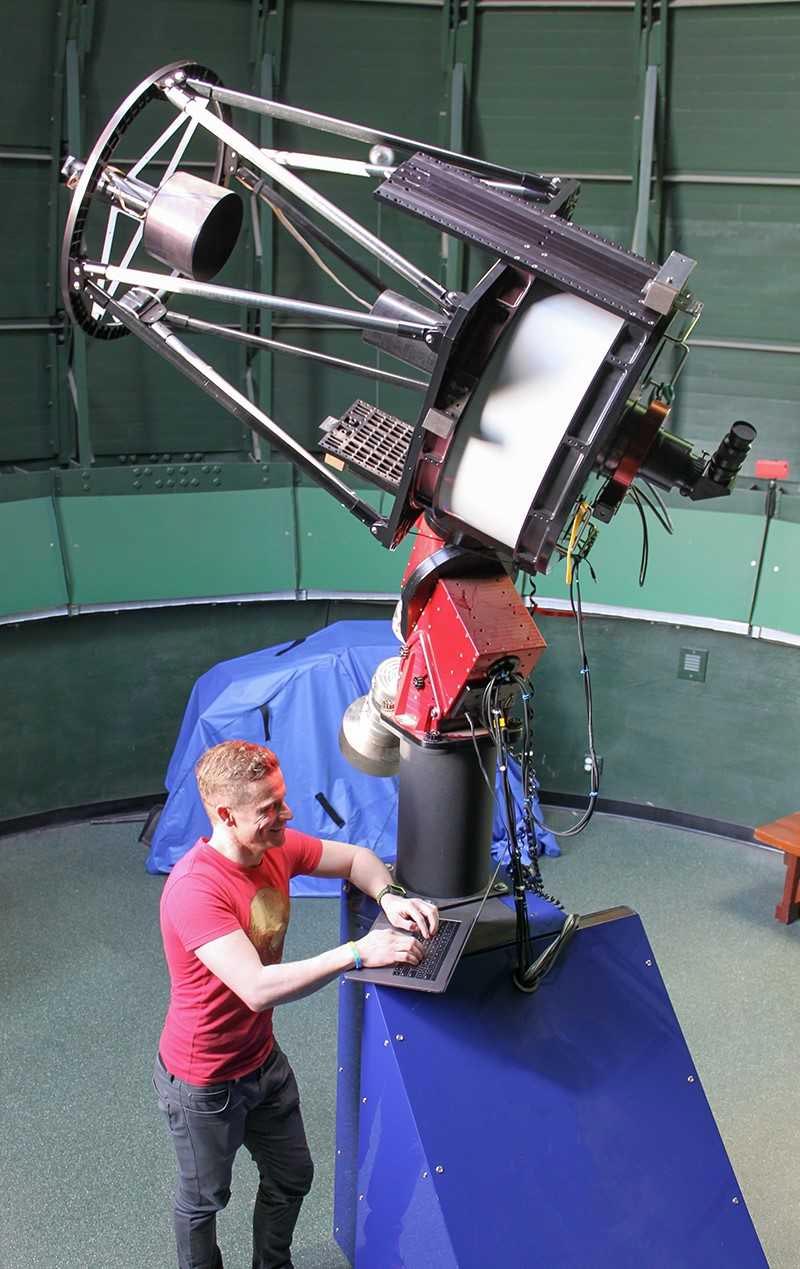
The team’s research involved developing a database search algorithm to locate archival images of the Centaur as well as a follow-up observational campaign.
“Our paper reports the discovery of activity emanating from Centaur 2014 OG392, based on archival images we uncovered, plus our own new observational evidence acquired with the Dark Energy Camera at the Inter-American Observatory in Cerro Tololo, Chile, the Walter Baade Telescope at the Las Campanas Observatory in Chile and the Large Monolithic Imager at Lowell Observatory’s Discovery Channel Telescope in Happy Jack, Arizona,” Chandler said.
“We detected a coma as far as 400,000 km from 2014 OG392 and our analysis of sublimation processes and dynamical lifetime suggest carbon dioxide and/or ammonia are the most likely candidates for causing activity on this and other active Centaurs. We developed a novel technique that combines observational measurements, for example, color and dust mass, with modeling efforts to estimate such characteristics as the object’s volatile sublimation and orbital dynamics.”
As a result of the team’s discovery, the Centaur has recently been reclassified as a comet, and will be known as “C/2014 OG392 (PANSTARRS).”
“I’m very excited that the Minor Planet Center awarded a new comet designation befitting the activity we discovered on this unusual object,” he said.
This week, Chandler has been invited to present the results at the 52nd Division for Planetary Sciences (DPS) of the American Astronomical Society (AAS) 2020 meeting.
Reference: “Cometary Activity Discovered on a Distant Centaur: A Nonaqueous Sublimation Mechanism” by Colin Orion Chandler, Jay K. Kueny, Chadwick A. Trujillo, David E. Trilling and William J. Oldroyd, 6 April 2020, The Astrophysical Journal Letters.
DOI: 10.3847/2041-8213/ab7dc6
Chandler’s research is funded by Grant No. 2018258765 through the National Science Foundation’s Graduate Research Fellowship Program (GRFP), a highly competitive opportunity that only about 2,000 students receive each year.
Never miss a breakthrough: Join the SciTechDaily newsletter.
Follow us on Google and Google News.
22 Comments
So glad I found this site.
Coma or comma
Coma
Me so glad found this activity.
WEIRD…
Minor correction.
Centaurs used to be classified as a subtype of dwarf planet (and thus, also a minor planet), but the new classification excludes them from being dwarf planets altogether. They can still be minor planets, but this is not always the case: some centaurs are smaller Solar System bodies, and some are even natural planetary satellites.
You can see some amazing stuff in space, and you don’t always need a tele-scope.
Fascinating information to consider
You are standing on a rock in the middle of nowhere
It is sad but true that we will only remain in our own Galaxy and it’s like the ocean that we don’t explore we should only explore our own Galaxy because we will never reach the outer galaxys
because of expansion
Well, if we wait long enough, we would be able to explore the Andromeda galaxy without leaving the Milky Way… in about a billion years or so.
All so ridiculous and considering the cost, beyond stupid. We should explore and develop our oceans for that is the next logical move
EXACTLY!!!! 95% of Earth’s waters have yet to be surveyed. Travel to other planets (Mars), is at least 10-15 years away (in my opinion). Let’s exhaust all possibilities before inhabiting exploring and inhabiting othet planets and risk lives!!!!
Those of you who want to look down and not up from now on you will see nothing but a reflection of space when you look down at water so with a heavy head, keep your head up.
?(if you did no what would you say) ? Famously said by Robert H.Auld. I had the pleasure to meet him. , Who’s Who the book of Who’s Who is better left for you .
I THINK WE SHOULD BE EXplORING our waters which we need for life
Isn’t exploration how we learn what promotes life – in any direction- skyward or in the oceans? Can space be ruled out before exploring?
That said, we do know the ocean is a source of life. It’s exploration should at least merit the efforts and investment of space. It shouldn’t have to be either/or.
Why is it a problem that this body can have a coma when it is beyond the distance where the coma could be from water ice? Could it not be from CO2 sublimating at a much lower temperature? Perhaps from nitrogen? If we rule out possible explanations because we have “never seen anything like this before” we are at risk of dismissing realty because it doesn’t nicely fit into our comfortable little familiar view of things as we know them. For centuries we said “All swans are white” until we saw black swans and had to reconsider.
More and more we hear life found here life found there. They are prepping us for the real truth people!
Which they will only provide tiny amounts of as they see fit. No, we are not alone guys!
There is a ton of life out there and WE (humans) are the least evolved! Everybody, hit your meditation pillows because we have a great deal of catching up to do! We can’t even see past black and white in this country! Most people choose greed and wealth over life, love, health, equality, and unity! We definitely need to worry about ourselves!
MY Why does it have to be inner or outer space. Can’t it be both. There is so much that we need to find out about what has happened on our planets past. I tip my hat to any explorer who has spent his life doing just that. “EXPLORING”
Why no news on the sunburst June 30,2019 I even videoed the event.
The search for “Life” is just people spending our money to prove for themselves their is no God.