
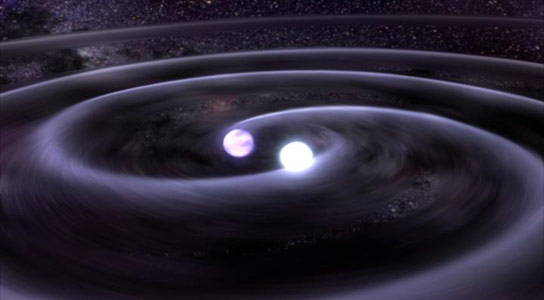
A newly published study contradicts previous assumptions about the behavior of gravitational waves, demonstrating that stars can absorb the energy of gravitational waves.
Scientists have shown how gravitational waves—invisible ripples in the fabric of space and time that propagate through the universe—might be “seen” by looking at the stars. The new model proposes that a star that oscillates at the same frequency as a gravitational wave will absorb energy from that wave and brighten, an overlooked prediction of Einstein’s 1916 theory of general relativity. The study, which was published today in the Monthly Notices of the Royal Astronomical Society: Letters, contradicts previous assumptions about the behavior of gravitational waves.
“It’s pretty cool that a hundred years after Einstein proposed this theory, we’re still finding hidden gems,” said Barry McKernan, a research associate in the Museum’s Department of Astrophysics, who is also a professor at CUNY’s Borough of Manhattan Community College; a faculty member at CUNY’s Graduate Center; and a Kavli Scholar at the Kavli Institute for Theoretical Physics.
Gravitational waves can be thought of like the sound waves emitted after an earthquake, but the source of the “tremors” in space are energetic events like supernovae (exploding stars), binary neutron stars (pairs of burned-out cores left behind when stars explode), or the mergers of black holes and neutron stars. Although scientists have long known about the existence of gravitational waves, they’ve never made direct observations but are attempting to do so through experiments on the ground and in space. Part of the reason why detection is difficult is because the waves interact so weakly with matter. But McKernan and his colleagues from CUNY, the Harvard-Smithsonian Center for Astrophysics, the Institute for Advanced Study, and Columbia University, suggest that gravitational waves could have more of an effect on matter than previously thought. The new model shows that stars with oscillations—vibrations—that match the frequency of gravitational waves passing through them can resonate and absorb a large amount of energy from the ripples.
“It’s like if you have a spring that’s vibrating at a particular frequency and you hit it at the same frequency, you’ll make the oscillation stronger,” McKernan said. “The same thing applies with gravitational waves.”
If these stars absorb a large pulse of energy, they can be “pumped up” temporarily and made brighter than normal while they discharge the energy over time. This could provide scientists with another way to detect gravitational waves indirectly.
“You can think of stars as bars on a xylophone—they all have a different natural oscillation frequency,” said co-author Saavik Ford, who is a research associate in the Museum’s Department of Astrophysics as well as a professor at the Borough of Manhattan Community College, CUNY; a faculty member at CUNY’s Graduate Center; and a Kavli Scholar at the Kavli Institute for Theoretical Physics. “If you have two black holes merging with each other and emitting gravitational waves at a certain frequency, you’re only going to hit one of the bars on the xylophone at a time. But because the black holes decay as they come closer together, the frequency of the gravitational waves changes and you’ll hit a sequence of notes. So you’ll likely see the big stars lighting up first followed by smaller and smaller ones.”
The work also presents a different way to indirectly detect gravitational waves. From the perspective of a gravitational wave detector on Earth or in space, when a star at the right frequency passes in front of an energetic source such as merging black holes, the detector will see a drop in the intensity of gravitational waves measured. In other words, stars—including our own Sun—can eclipse background sources of gravitational waves.
“You usually think of stars as being eclipsed by something, not the other way around,” McKernan said.
The researchers will continue to study these predictions and try to determine how long it would take to observe these effects from a telescope or detector.
Other authors include Bence Kocsis, from the Harvard-Smithsonian Center for Astrophysics and the Institute for Advanced Study, and Zoltan Haiman from Columbia
University.
Support for this work was provided by NASA grant #APRA 08-0117, #NNX11AE05G, and #NNX11AF29G, National Science Foundation grant #PAARE AST-1153335 and #PHY 11-25915, a Borough of Manhattan Community College Faculty Development Grant, a CUNY Chancellor’s Research Fellowship, the W.M. Keck Foundation Fund of the Institute for Advanced Study, and the Kavli Institute for Theoretical Physics.
Reference: “Stars as resonant absorbers of gravitational waves” by B. McKernan, K. E. S. Ford, B. Kocsis and Z. Haiman, 18 September 2014, MNRAS Letters.
DOI: 10.1093/mnrasl/slu136
arXiv: 1405.1414
Never miss a breakthrough: Join the SciTechDaily newsletter.
Follow us on Google and Google News.