
Close Menu
    Facebook X (Twitter) Instagram
    SciTechDaily
    • Biology
    • Chemistry
    • Earth
    • Health
    • Physics
    • Science
    • Space
    • Technology
    Facebook X (Twitter) Pinterest YouTube RSS
    SciTechDaily
    Home»Space»New Model Reveals How Earth’s Moon Formed
    Space

    New Model Reveals How Earth’s Moon Formed

    By Jim Shelton, Yale UniversityApril 29, 20193 Comments3 Mins Read
    Facebook Twitter Pinterest Telegram LinkedIn WhatsApp Email Reddit
    Share
    Facebook Twitter LinkedIn Pinterest Telegram Email Reddit
    Magma Key to the Moon’s Makeup
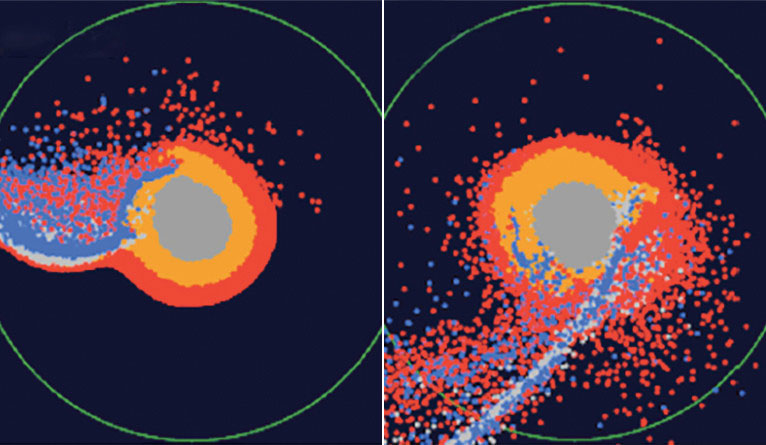
    Snapshots of numerical modeling of the moon’s formation by a giant impact. The central part of the image is a proto-Earth; red points indicate materials from the ocean of magma in a proto-Earth; blue points indicate the impactor materials.

    For more than a century, scientists have squabbled over how the Earth’s moon formed. But researchers at Yale and in Japan say they may have the answer.

    Many theorists believe a Mars-sized object slammed into the early Earth, and material dislodged from that collision formed the basis of the moon. When this idea was tested in computer simulations, it turned out that the moon would be made primarily from the impacting object. Yet the opposite is true; we know from analyzing rocks brought back from Apollo missions that the moon consists mainly of material from Earth.

    A new study published April 29 in Nature Geoscience, co-authored by Yale geophysicist Shun-ichiro Karato, offers an explanation.

    The key, Karato says, is that the early, proto-Earth — about 50 million years after the formation of the Sun — was covered by a sea of hot magma, while the impacting object was likely made of solid material. Karato and his collaborators set out to test a new model, based on the collision of a proto-Earth covered with an ocean of magma and a solid impacting object.

    The model showed that after the collision, the magma is heated much more than solids from the impacting object. The magma then expands in volume and goes into orbit to form the moon, the researchers say. This explains why there is much more Earth material in the moon’s makeup. Previous models did not account for the different degree of heating between the proto-Earth silicate and the impactor.

    “In our model, about 80% of the moon is made of proto-Earth materials,” said Karato, who has conducted extensive research on the chemical properties of proto-Earth magma. “In most of the previous models, about 80% of the moon is made of the impactor. This is a big difference.”

    Karato said the new model confirms previous theories about how the moon formed, without the need to propose unconventional collision conditions — something theorists have had to do until now.

    For the study, Karato led the research into the compression of molten silicate. A group from the Tokyo Institute of Technology and the RIKEN Center for Computational Science developed a computational model to predict how material from the collision became the moon.

    The first author of the study is Natsuki Hosono of RIKEN. Additional co-authors are Junichiro Makino and Takayuki Saitoh.

    Reference: “Terrestrial magma ocean origin of the Moon” by Natsuki Hosono, Shun-ichiro Karato, Junichiro Makino and Takayuki R. Saitoh, 29 April 2019, Nature Geoscience.
    DOI: 10.1038/s41561-019-0354-2

    Never miss a breakthrough: Join the SciTechDaily newsletter.
    Follow us on Google and Google News.

    Astronomy Moon Planetary Science
    Share. Facebook Twitter Pinterest LinkedIn Email Reddit

    Related Articles

    Lunar Far Side Mystery Linked to Massive Ancient Impact

    The Moon Was Hit Again: NASA Scientists Discover a Newly Formed Crater

    Io’s Volcanoes Are Not Located Where Scientists Expected

    Pre-existing Mineral Deposits on the Moon Can Survive Lunar Impacts

    Presence of Water in the Primary Crust Indicates That the Early Moon Was Wet

    Saturn-Like Rings May Have Formed Solar System’s Moons

    New Theoretical Models Salvage Moon-Forming Impact Theory

    Simulation May Explain Saturnian System

    Catalog of Moon’s Craters May Reveal Ice Beyond Moon’s Poles

    3 Comments

    1. Edward Gazsi on May 1, 2019 12:42 pm

      How fortuitous that the moon wound up being exactly 400 times smaller than the sun and 400 times closer to the earth than the sun. Makes for the perfect eclipse. Coincidence? I don’t think so. Check out Genesis 1.

      Reply
    2. Mark Keller on May 6, 2019 4:41 am

      The Moon’s orbit grows a little bit further from the Earth each year due to tidal friction. In less than a blink of an eye in galactic time, that perfect coincidence you site will be a quaint memory. Also might I add, in the very distant past, the very same Moon once orbited much closer to the Earth and that would have rendered the coincidental 400 times number irrelevant as well. Genesis says nothing about either of those facts.

      Reply
    3. mateo on January 20, 2024 7:05 pm

      omg!!!!!!!!!!

      Reply
    Leave A Reply Cancel Reply

    • Facebook
    • Twitter
    • Pinterest
    • YouTube

    Don't Miss a Discovery

    Subscribe for the Latest in Science & Tech!

    Trending News

    What Causes Chronic Pain? Scientists Identify Key Culprit in the Brain

    Semaglutide Shows Surprising Mental Health Benefits in Massive 100,000-Person Study

    This Liquid Snapped Instead of Flowing and Scientists Were Shocked

    Breakthrough Alzheimer’s Drug Rewires the Brain Instead of Just Clearing Plaques

    Scientists Discover Hidden “Footprint of Death” That Could Transform How We Fight Disease

    A Simple Nose Swab Could Detect Alzheimer’s Years Before Symptoms Appear

    Scientists Just Rewrote the Timeline of Complex Life on Earth

    Teenager’s Fossil Find Leads to Discovery of Shark Teeth in 5 Million-Year-Old Whale Skull

    Follow SciTechDaily
    • Facebook
    • Twitter
    • YouTube
    • Pinterest
    • Newsletter
    • RSS
    SciTech News
    • Biology News
    • Chemistry News
    • Earth News
    • Health News
    • Physics News
    • Science News
    • Space News
    • Technology News
    Recent Posts
    • Scientists Discover How Multiple Sclerosis Kills Brain Cells
    • Scientists Discover Why the Brain Gets Stuck in Schizophrenia
    • Scientists Engineer “Tumor-Eating” Bacteria That Devour Cancer From Within
    • Even “Failed” Diets May Deliver Long-Term Health Gains, Study Finds
    • Childhood Junk Food May Rewire the Brain for Life
    Copyright © 1998 - 2026 SciTechDaily. All Rights Reserved.
    • Science News
    • About
    • Contact
    • Editorial Board
    • Privacy Policy
    • Terms of Use

    Type above and press Enter to search. Press Esc to cancel.