
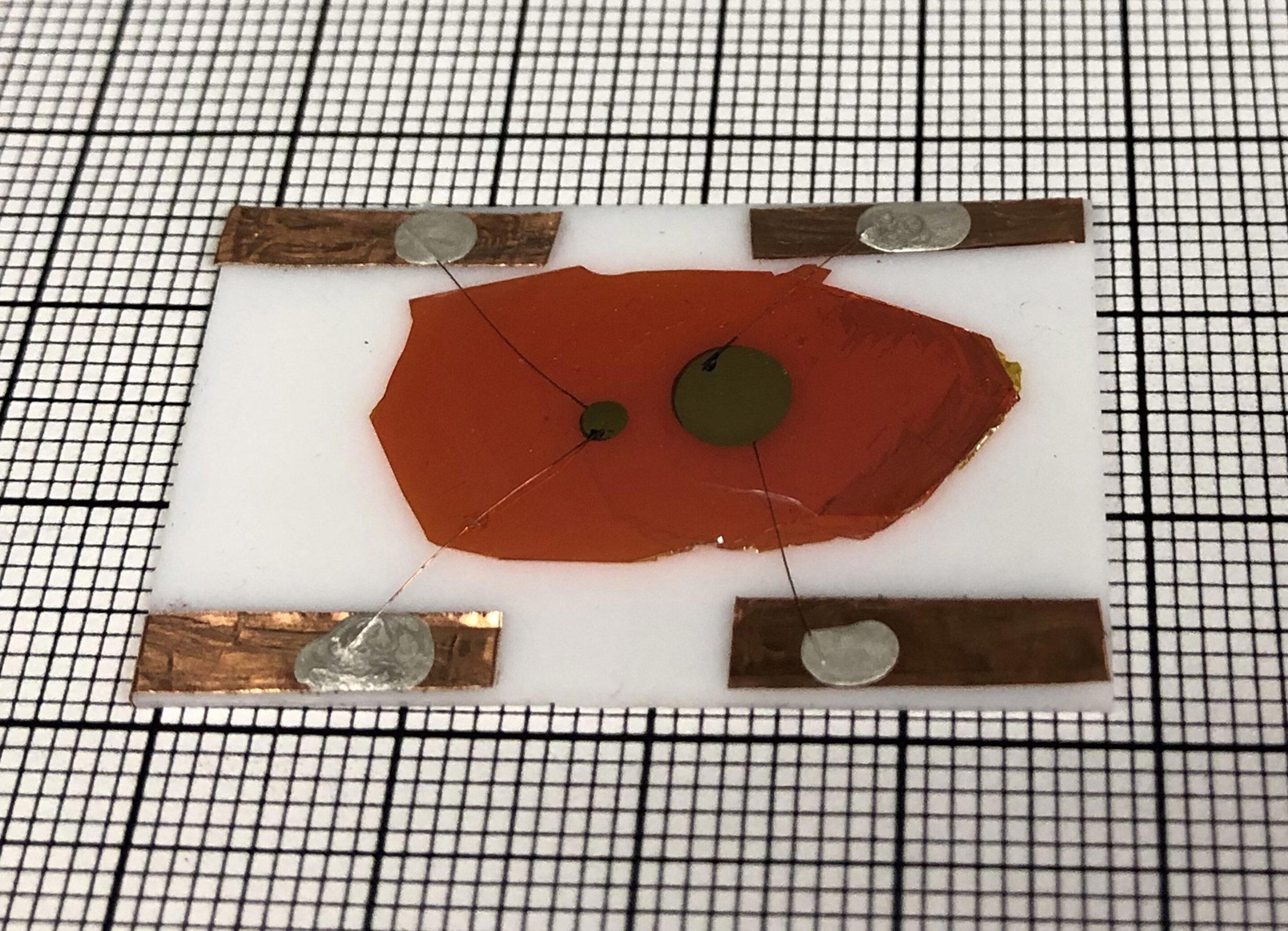
Researchers demonstrate first stable semiconductor neutron detector.
Homeland Security might soon have a new tool to add to its arsenal.
Researchers at Northwestern University and Argonne National Laboratory have developed a new material that opens doors for a new class of neutron detectors.
With the ability to sense smuggled nuclear materials, highly efficient neutron detectors are critical for national security. Currently, there are two classes of detectors which either use helium gas or flashes of light. These detectors are very large — sometimes the size of a wall.
Northwestern and Argonne’s material introduces a third class: a semiconductor that can absorb neutrons and generate electrical signals that can be easily measured. The semiconductor-based detector is also highly efficient and stable. It can be used both in small, portable devices for field inspections and very large detectors that use arrays of crystals.
The study will be published in the January 16, 2020, issue of the journal Nature.

“People have imagined semiconductor neutron detectors for a long time,” said Northwestern’s Mercouri Kanatzidis, who led the research. “The idea was there, but no one had the right material to do it.”
Kanatzidis is the Charles E. and Emma H. Morrison Professor of Chemistry in Northwestern’s Weinberg College of Arts and Sciences. He has a joint appointment with Argonne.
When heavy elements, such as uranium and plutonium, decay, their atoms eject neutrons from their nuclei. Most neutron detectors are so-called scintillators that work by sensing ejected neutrons and then emitting light to alert the user. This new material is a semiconductor and does not emit light, but instead directly detects electrical signals induced by the neutrons. In addition to security applications, neutron detectors are used in radiation safety, astronomy, plasma physics, materials science, and crystallography.
“It’s important to have all sizes of neutron detectors and as many kinds as possible.” — Mercouri Kanatzidis
Whereas classic types of thermal neutron detectors have been in use since the 1950s, a practical semiconductor material has remained elusive. Excellent at absorbing neutrons, lithium quickly emerged as the most promising material for neutron-detecting devices. But integrating lithium into a semiconductor and making it stable (lithium crumbles when it meets water) was another story.
“You can find good semiconductors, but they don’t have lithium,” Kanatzidis said. “Or you can find stable lithium compounds that are not good semiconductors. We found the best of both worlds. The specific lithium-6 isotope, which is reasonably abundant and low cost, is a strong neutron absorber.”
In their study, Kanatzidis and his team discovered the right combination of materials to make a working device that also keeps lithium stable. Their new material — lithium-indium-phosphorous-selenium — is layered in structure and enriched with the lithium-6 isotope.
“The crystal structure is special,” Kanatzidis said. “The lithium is inside the layers, so water cannot reach it. That’s a big, important feature of this material.”
The resulting semiconductor neutron detector can detect thermal neutrons from even a very weak source — and can do so within nanoseconds. It also can discriminate between neutrons and other types of nuclear signals, such as gamma rays. This prevents false alarms.
One final added bonus: the material contains a very high amount of lithium. So a smaller fraction of the material can absorb the same amount of neutrons as a giant device. This leads to devices small enough to fit in your hand.
“It’s important to have all sizes of neutron detectors and as many kinds as possible, such as our new semiconductor,” Kanatzidis said. “You want ones that are as big as a wall, where you can pass a truck right by it. But you also want small ones that can be portable for inspections out in the field.”
Reference: “Direct thermal neutron detection by the 2D semiconductor 6LiInP2Se6” by Daniel G. Chica, Yihui He, Kyle M. McCall, Duck Young Chung, Rahmi O. Pak, Giancarlo Trimarchi, Zhifu Liu, Patrick M. De Lurgio, Bruce W. Wessels and Mercouri G. Kanatzidis, 15 January 2020, Nature.
DOI: 10.1038/s41586-019-1886-8
The study, “Direct thermal neutron detection by the 2D semiconductor 6LiInP2Se6,” was supported by the National Science Foundation (award number DMR-1708254) and the U.S. Department of Energy (award number DE-AC02-06CH11357). Graduate student Daniel Chica and research assistant professor Yihui He, both members of Kanatzidis’ lab, are the paper’s co-first authors. Argonne scientist Duck Young Chung was a lead collaborator in the effort.
Never miss a breakthrough: Join the SciTechDaily newsletter.
Follow us on Google and Google News.