
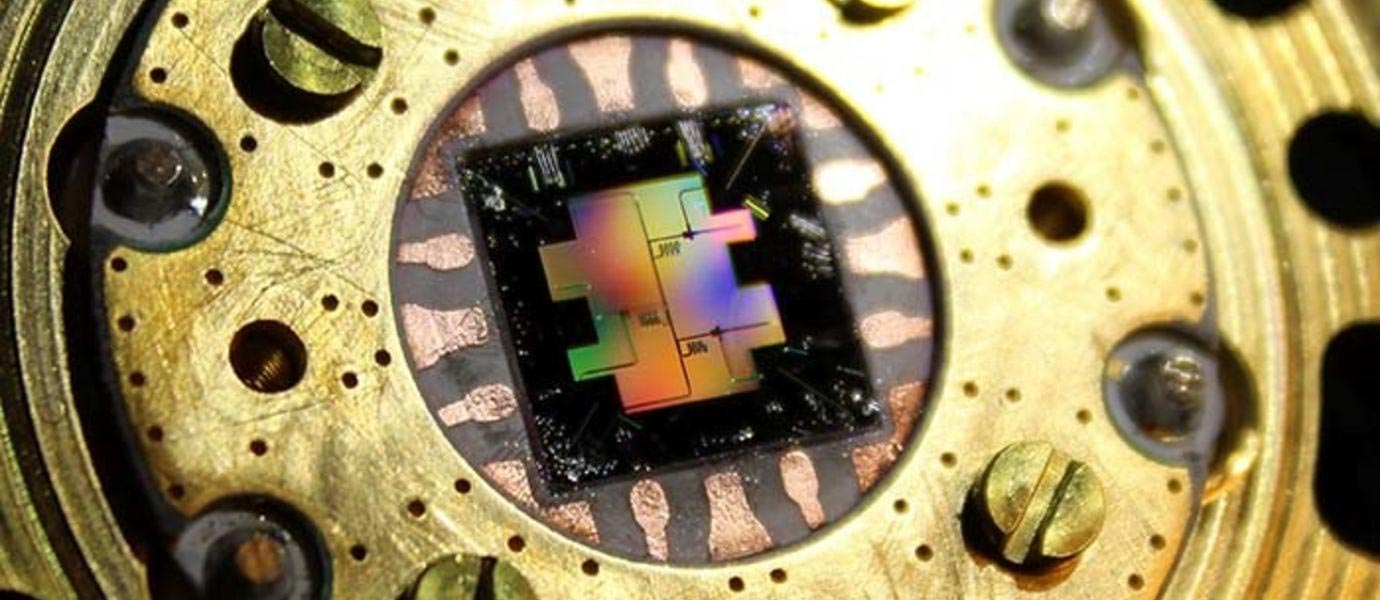
Simulation of non-Hermitian quantum mechanics using a quantum computer goes beyond centuries-old conventions.
Aalto researchers have used an IBM quantum computer to explore an overlooked area of physics, and have challenged 100-year-old cherished notions about information at the quantum level.
The rules of quantum physics — which govern how very small things behave — use mathematical operators called Hermitian Hamiltonians. Hermitian operators have underpinned quantum physics for nearly 100 years but recently, theorists have realized that it is possible to extend its fundamental equations to make use of Hermitian operators that are not Hermitian. The new equations describe a universe with its own peculiar set of rules: for example, by looking in the mirror and reversing the direction of time you should see the same version of you as in the actual world. In their new paper, a team of researchers led by Docent Sorin Paraoanu used a quantum computer to create a toy-universe that behaves according to these new rules. The team includes Dr. Shruti Dogra from Aalto University, first author of the paper, and Artem Melnikov, from MIPT and Terra Quantum.
Breaking Quantum Rules with Qubits
The researchers made qubits, the part of the quantum computer that carries out calculations, behave according to the new rules of non-Hermitian quantum mechanics. They demonstrated experimentally a couple of exciting results which are forbidden by regular Hermitian quantum mechanics. The first discovery was that applying operations to the qubits did not conserve quantum information — a behavior so fundamental to standard quantum theory that it results in currently unsolved problems like Stephen Hawking’s Black Hole Information paradox. The second exciting result came when they experimented with two entangled qubits.
Entanglement is a type of correlations that appears between qubits, as if they would experience a magic connection that makes them behave in sync with each other. Einstein was famously very uncomfortable with this concept, referring to it as “spooky action at a distance.” Under regular quantum physics, it is not possible to alter the degree of entanglement between two particles by tampering with one of the particles on its own. However, in non-Hermitian quantum mechanics, the researchers were able to alter the level of entanglement of the qubits by manipulating just one of them: a result that is expressly off-limits in regular quantum physics.
Unlocking Unconventional Quantum Behavior
“The exciting thing about these results is that quantum computers are now developed enough to start using them for testing unconventional ideas that have been only mathematical so far” said Sorin Paraoanu. “With the present work, Einstein’s spooky action at a distance becomes even spookier. And, although we understand very well what is going on, it still gives you the shivers.”
The research also has potential applications. Several novel optical or microwave-based devices developed in recent times do seem to behave according to the new rules. The present work opens the way to simulating these devices on quantum computers.
The paper “Quantum simulation of parity-time symmetry breaking with a superconducting quantum processor” is published in Communications Physics. The work was performed under the Finnish Center of Excellence in Quantum Technology (QTF) of the Academy of Finland.
Reference: “Quantum simulation of parity-time symmetry breaking with a superconducting quantum processor” by Shruti Dogra, Artem A. Melnikov and Gheorghe Sorin Paraoanu, 15 February 2021, Communications Physics.
DOI: 10.1038/s42005-021-00534-2
Never miss a breakthrough: Join the SciTechDaily newsletter.
Follow us on Google and Google News.
6 Comments
I keep seeing articles like this and my casual interest in physics has my mind boggled.
I mean, are we starting to see potential applications of faster than causality communications? Or is this simply a possible method of communications AT the speed of causality, but uninhibited by limitations of signal strength or noise?
I mean, I can only assume the computing applications are almost as mind blowing as the above, but I’m not a computer engineer so I cannot conceptualize these kind of applications.
T2 G2 m2
T Possibility of 2 m same as u to reach 0 G
Yeah, I think one day we be in awe as faster-than-light communication becomes a reality when someone figures out how to send morse code FasterThanLight thru quantuum entanglement. We will say we never thought we would live to see the day that the speed limit of the universe c, the Great C Constant, would be broken. It will probably be done by some bored high school kids, SECOND GENERATION, on Mars, who are trying to sneak p0rn to Mars from Earth. 🙂
Attempts to build and operate quantum
computation system in such a path is logical goal to function right ambition beside optimization eco nomicly is fruitful fundamental eay.
Attempts to build and operate quantum
computation system in such a path is logical goal to function right ambition beside optimization eco nomicly is fruitful fundamental way.