
Close Menu
    Facebook X (Twitter) Instagram
    SciTechDaily
    • Biology
    • Chemistry
    • Earth
    • Health
    • Physics
    • Science
    • Space
    • Technology
    Facebook X (Twitter) Pinterest YouTube RSS
    SciTechDaily
    Home»Chemistry»New Polyurethane Designed to Easily Degrade for Reuse
    Chemistry

    New Polyurethane Designed to Easily Degrade for Reuse

    By University of Illinois at Urbana-ChampaignAugust 26, 2019No Comments2 Mins Read
    Facebook Twitter Pinterest Telegram LinkedIn WhatsApp Email Reddit
    Share
    Facebook Twitter LinkedIn Pinterest Telegram Email Reddit
    UIUC Steven Zimmerman Ephraim Morado
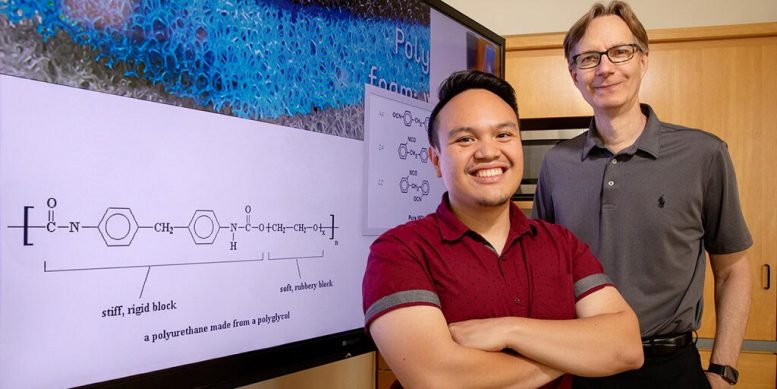
    University of Illinois chemistry professor Steven Zimmerman, right, graduate student Ephraim Morado and their colleagues are inventing new ways to degrade polyurethane and reuse the waste. Credit: L. Brian Stauffer

    Polyurethane is used in a wide range of materials, including paints, foam mattresses, seat cushions, and insulation. These diverse applications generate large amounts of waste. A team at the University of Illinois has developed a method to break down polyurethane waste and turn it into other useful products.

    The researchers will report their findings at the American Chemical Society National Meeting and Exposition.

    In the U.S. alone, 1.3 million tons of polyurethane waste is generated each year. The waste usually ends up in landfills or is incinerated, a process that requires a large energy input and generates toxic byproducts.

    “We want to solve the waste problem by repurposing polyurethane,” said Ephraim Morado, a graduate student in the laboratory of chemistry professor Steven Zimmerman, who led the research.

    Polyurethanes are made of two components that are hard to break down: isocyanates, which are composed of nitrogen, carbon, and oxygen; and alcohol groups called polyols.

    “The polyol is usually petroleum-based and is not degradable,” Morado said. To address this difficulty, the team incorporated a more easily degraded chemical unit, an acetal, to the polyol. And because polyurethanes are water-resistant, the researchers invented an acetal unit that degrades in solvents other than water.

    “When we add a combination of trichloroacetic acid and dichloromethane, the material swells and rapidly degrades at room temperature,” Morado said.

    The degradation products that are formed can then be repurposed to new materials. For example, the researchers were able to convert elastomers—a type of polyurethane used in rubber bands, packaging, and car parts—into an adhesive glue.

    “One of the challenges with our approach is that the starting material is costly,” Zimmerman said. “We are trying to find a better, cheaper way to accomplish this. Our second hurdle will be to get a patent and find someone who is interested in commercializing it.”

    The researchers are testing the same technique on other polyurethane materials. They also hope to use milder solvents, such as vinegar, to carry out the degradation.

    “The polyurethane materials have different properties based on the chemical structure of the isocyanate,” Zimmerman said. “We can change the structure of the acetal accordingly.”

    See Degradable Polyurethane Gives Its Components a Second Life for more information.

    Never miss a breakthrough: Join the SciTechDaily newsletter.
    Follow us on Google and Google News.

    American Chemical Society Materials Science Polyurethane University of Illinois at Urbana-Champaign
    Share. Facebook Twitter Pinterest LinkedIn Email Reddit

    Related Articles

    Reducing Blue Light: A New Type of LED That Won’t Keep You Up All Night

    Making Cleaner, Greener, Biodegradable Plastics From Waste Fish Parts

    Researchers Develop a Flexible Color-Changing Film Inspired by Chameleon Skin

    Sustainable Green Chemistry Used to Create Safer, More Comfortable Uniforms for Soldiers

    Fast, Colorful 3D Printing by Mimicking Chameleons at the Nanoscale

    New Solid Polymer-Based Electrolyte Helps Batteries Become Self-Healing, Recyclable

    Watch This Blacksmith Forge a Sword Using Chemistry

    Super Durable, Flexible, Water-Repelling Material Inspired by Porcupinefish

    Degradable Polyurethane Gives Its Components a Second Life

    Leave A Reply Cancel Reply

    • Facebook
    • Twitter
    • Pinterest
    • YouTube

    Don't Miss a Discovery

    Subscribe for the Latest in Science & Tech!

    Trending News

    New “Nanozyme Hypothesis” Could Rewrite the Story of Life’s Origins

    Anatomy Isn’t Finished: The Human Body Still Holds Secrets

    “Pretty Close to Home”: The Hidden Earthquake Threat Beneath Seattle

    The Surprising Reason You Might Want To Sleep Without a Pillow

    Scientists Say This Natural Hormone Reverses Obesity by Targeting the Brain

    35-Million-Year-Old Mystery: Strange Arachnid Discovered Preserved in Amber

    Is AI Really Just a Tool? It Could Be Altering How You See Reality

    JWST Reveals a “Forbidden” Planet With a Baffling Composition

    Follow SciTechDaily
    • Facebook
    • Twitter
    • YouTube
    • Pinterest
    • Newsletter
    • RSS
    SciTech News
    • Biology News
    • Chemistry News
    • Earth News
    • Health News
    • Physics News
    • Science News
    • Space News
    • Technology News
    Recent Posts
    • Saturn’s Magnetic Shield Isn’t What Scientists Expected
    • Hidden Oceans of Magma Could Be Protecting Alien Life
    • After Decades of Searching, Astronomers Finally Track Down the Universe’s Missing Hydrogen
    • Scientists Capture Hidden Electron Patterns Inside Quantum Materials
    • New Study Challenges Alzheimer’s Theories: It’s Not Just About Plaques
    Copyright © 1998 - 2026 SciTechDaily. All Rights Reserved.
    • Science News
    • About
    • Contact
    • Editorial Board
    • Privacy Policy
    • Terms of Use

    Type above and press Enter to search. Press Esc to cancel.