
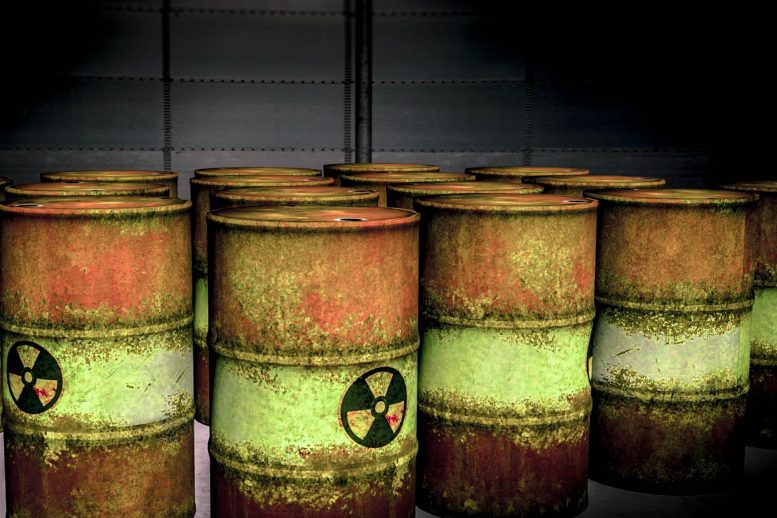
Study finds the materials — glass, ceramics and stainless steel — interact to accelerate corrosion.
The materials the United States and other countries plan to use to store high-level nuclear waste will likely degrade faster than anyone previously knew because of the way those materials interact, new research shows.
The findings, published today in the journal Nature Materials, show that corrosion of nuclear waste storage materials accelerates because of changes in the chemistry of the nuclear waste solution, and because of the way the materials interact with one another.
“This indicates that the current models may not be sufficient to keep this waste safely stored,” said Xiaolei Guo, lead author of the study and deputy director of Ohio State’s Center for Performance and Design of Nuclear Waste Forms and Containers, part of the university’s College of Engineering. “And it shows that we need to develop a new model for storing nuclear waste.”
The team’s research focused on storage materials for high-level nuclear waste — primarily defense waste, the legacy of past nuclear arms production. The waste is highly radioactive. While some types of the waste have half-lives of about 30 years, others — for example, plutonium — have a half-life that can be tens of thousands of years. The half-life of a radioactive element is the time needed for half of the material to decay.
The United States currently has no disposal site for that waste; according to the U.S. General Accountability Office, it is typically stored near the plants where it is produced. A permanent site has been proposed for Yucca Mountain in Nevada, though plans have stalled. Countries around the world have debated the best way to deal with nuclear waste; only one, Finland, has started construction on a long-term repository for high-level nuclear waste.
But the long-term plan for high-level defense waste disposal and storage around the globe is largely the same. It involves mixing the nuclear waste with other materials to form glass or ceramics, and then encasing those pieces of glass or ceramics — now radioactive — inside metallic canisters. The canisters then would be buried deep underground in a repository to isolate it.
In this study, the researchers found that when exposed to an aqueous environment, glass and ceramics interact with stainless steel to accelerate corrosion, especially of the glass and ceramic materials holding nuclear waste.
The study qualitatively measured the difference between accelerated corrosion and natural corrosion of the storage materials. Guo called it “severe.”
“In the real-life scenario, the glass or ceramic waste forms would be in close contact with stainless steel canisters. Under specific conditions, the corrosion of stainless steel will go crazy,” he said. “It creates a super-aggressive environment that can corrode surrounding materials.”
To analyze corrosion, the research team pressed glass or ceramic “waste forms” — the shapes into which nuclear waste is encapsulated — against stainless steel and immersed them in solutions for up to 30 days, under conditions that simulate those under Yucca Mountain, the proposed nuclear waste repository.
Those experiments showed that when glass and stainless steel were pressed against one another, stainless steel corrosion was “severe” and “localized,” according to the study. The researchers also noted cracks and enhanced corrosion on the parts of the glass that had been in contact with stainless steel.
Part of the problem lies in the Periodic Table. Stainless steel is made primarily of iron mixed with other elements, including nickel and chromium. Iron has a chemical affinity for silicon, which is a key element of glass.
The experiments also showed that when ceramics — another potential holder for nuclear waste — were pressed against stainless steel under conditions that mimicked those beneath Yucca Mountain, both the ceramics and stainless steel corroded in a “severe localized” way.
Reference: “Self-accelerated corrosion of nuclear waste forms at material interfaces” by Xiaolei Guo, Stephane Gin, Penghui Lei, Tiankai Yao, Hongshen Liu, Daniel K. Schreiber, Dien Ngo, Gopal Viswanathan, Tianshu Li, Seong H. Kim, John D. Vienna, Joseph V. Ryan, Jincheng Du, Jie Lian and Gerald S. Frankel, 27 January 2020, Nature Materials.
DOI: 10.1038/s41563-019-0579-x
Other Ohio State researchers involved in this study include Gopal Viswanathan, Tianshu Li, and Gerald Frankel.
This work was funded in part by the U.S. Department of Energy Office of Science.
Never miss a breakthrough: Join the SciTechDaily newsletter.
Follow us on Google and Google News.
4 Comments
Perhaps a solution is to put 12″ or more of dirt or sand or another ingredient between the materials used to store the waste. Just use something that will stop the transfer of molecules from one object to another forever!
Natural nuclear reactors in Gabon Africa showed us that a permanent repository for spent nuclear fuel isn’t so hard a thing to manage. At least 9 natural breeder reactors went critical at Oklo, in Gabon about 1.8 billion years ago, for around half a million years. Thousands of pound of Plutonium was produced and it barely migrated through the rock it happened to form in, as evidenced by radio-decay products. This rock was fractured, in a geologically unstable area. The Plutonium was uncontained, unvitrified and it wasn’t surrounded by bentonite clay (as is planned for man made spent fuel repositories). As well, boiling water flowed over this Plutonium for around half a million years (more than 20 half lives of Plutonium 239). So putting spent nuclear fuel in containers, & surrounding it with bentonite clay, in ground rock with substantially lower ground water motion than at Gabon, is not only more than acceptable, it’s serious over kill, even if the container corrodes away completely in several decades.
Spent nuclear fuel isn’t hurting anyone sitting in open topped pools of water on the surface. As well, spent nuclear fuel declines in it’s level of radiation by a factor of around 10,000 times in about a decade.
>> Spent nuclear fuel isn’t hurting anyone sitting in open topped pools of water on the surface.
Tornadoes, for one thing …
Vitrification has always been a waste of money for unprocessed waste, but Congress in their wisdom mandated that process.
Now that we have evidence of a flaw we should move forward with modern materials science and test other solutions like grout.