
Close Menu
    Facebook X (Twitter) Instagram
    SciTechDaily
    • Biology
    • Chemistry
    • Earth
    • Health
    • Physics
    • Science
    • Space
    • Technology
    Facebook X (Twitter) Pinterest YouTube RSS
    SciTechDaily
    Home»Earth»New Reason Why Arctic Is Warming So Fast Found by Scientists
    Earth

    New Reason Why Arctic Is Warming So Fast Found by Scientists

    By National Science FoundationMarch 2, 20203 Comments2 Mins Read
    Facebook Twitter Pinterest Telegram LinkedIn WhatsApp Email Reddit
    Share
    Facebook Twitter LinkedIn Pinterest Telegram Email Reddit
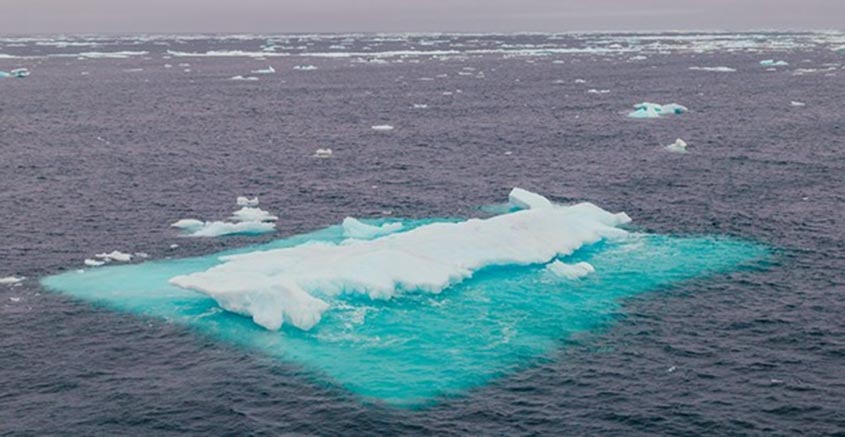
    Arctic Ocean Sea Ice 2018
    Arctic Ocean sea ice seen during a 2018 research cruise. Credit: San Nguyen

    Explanation is proposed for extra heat in the oceans.

    The Arctic has experienced the warming effects of global climate change faster than any other region on the planet. Scientists at the Scripps Institution of Oceanography have developed a new theory aided by computer simulations and observations that helps explain why this occurs.

    A team led by Scripps researcher Emma Beer observed the changes taking place in the Arctic Ocean, which is largely covered by sea ice for most of the year. There, an unusual situation exists where the water is warm at depth and cold near the surface. The deeper waters are fed by the relatively warm Pacific and Atlantic oceans, whereas the near-surface waters are in contact with sea ice and remain close to the freezing point. Heat flows upward from the warmer water to the colder water.

    The scientists found that the deeper water is getting still warmer as a result of climate change, but the near-surface water below the sea ice remains close to the freezing point. The increasing difference in temperature leads to a greater upward flow of heat. Beer, Scripps climate scientist Ian Eisenman, and researcher Till Wagner of the University of North Carolina estimate that this phenomenon is responsible for about 20% of the amplification of global warming that occurs in the Arctic.

    “While previous work has found mechanisms related to the surface and the atmosphere that cause Arctic amplification, our finding is that there is also a fundamental reason why the ocean causes polar amplification when the polar region is covered with sea ice,” Eisenman said of the National Science Foundation-supported study. The results are published in the journal Geophysical Research Letters.

    Reference: “Polar Amplification Due to Enhanced Heat Flux Across the Halocline” by E. Beer, I. Eisenman and T. J. W. Wagner, 3 February 2020, Geophysical Research Letters.
    DOI: 10.1029/2019GL086706

    Never miss a breakthrough: Join the SciTechDaily newsletter.
    Follow us on Google and Google News.

    Arctic Global Warming National Science Foundation Oceanography Popular
    Share. Facebook Twitter Pinterest LinkedIn Email Reddit

    Related Articles

    Flawed Climate Models? Arctic Ocean Started Getting Warmer Decades Earlier Than We Thought

    The Arctic’s Peculiar Ocean Turbulence Puzzled Scientists for Decades – Now MIT Has an Explanation

    Soon the North Pole Will Be Ice Free in Summer

    Half of Late 20th-Century Arctic Warming Caused by Ozone-Depleting Substances – “It’s a Good-News Story”

    Sea-Level Rise From Antarctic Ice Cliffs May Be Overestimated Because of Faulty Assumptions

    Upside-Down “Rivers” of Warm Ocean Water Attacking Antarctic Ice Shelves [Video]

    Arctic Sea Ice Set for a Record Breaking Melt

    Melting Arctic Ice May Lead to Severe Weather Changes

    New Research Shows Southern Ocean as a Powerful Influence on Climate Change

    3 Comments

    1. carla mc ewen on March 2, 2020 6:27 am

      are there not also underground volcanoes? i was watching the chuckchi sea data last year..the southern part, did not freeze until late december. In the northern Pacific, the blob is back..is that heat coming from the bedrock the ocean sits on at that point? Is the bedrock being heated by underground caldera? And venting methane out the chuckchi?

      Reply
    2. Randall C. Page on March 2, 2020 9:21 am

      carla mc ewen, that is a very good question. I’m on the Olympic Peninsula and there has been seismic activity recently. The “blob” is of great concern to the local fishing industry.

      Reply
    3. William Hughes-Games on March 4, 2020 3:17 am

      And as there is more open water, winds can cause more mixing of the lower and upper levels. Add to this, if you have a storm which induces a counter clockwise current in the Arctic, to-the-right (Coriolis) is away from the center of the circular current expelling water out through the Fram and Bearing Straights, making the surface cold water layer thinner, further aiding the mixing. Surface waves also induce internal waves between the layers and they break as they reach shallow water, further mixing the layers. At some point the ice melt will accelerate markedly.

      Reply
    Leave A Reply Cancel Reply

    • Facebook
    • Twitter
    • Pinterest
    • YouTube

    Don't Miss a Discovery

    Subscribe for the Latest in Science & Tech!

    Trending News

    Mezcal “Worm” in a Bottle Mystery: DNA Testing Reveals a Surprise

    New Research Reveals That Your Morning Coffee Activates an Ancient Longevity Switch

    This Is What Makes You Irresistible to Mosquitoes

    Shockingly Powerful Giant Octopuses Ruled the Seas 100 Million Years Ago

    Scientists Stunned by New Organic Molecules Found on Mars

    Rewriting Dinosaur Evolution: Scientists Unearth Remarkable 150-Million-Year-Old Stegosaur Skull

    Omega-3 Supplements Linked to Cognitive Decline in Surprising New Study

    First-of-Its-Kind Discovery: Homer’s Iliad Found Embedded in a 1,600-Year-Old Egyptian Mummy

    Follow SciTechDaily
    • Facebook
    • Twitter
    • YouTube
    • Pinterest
    • Newsletter
    • RSS
    SciTech News
    • Biology News
    • Chemistry News
    • Earth News
    • Health News
    • Physics News
    • Science News
    • Space News
    • Technology News
    Recent Posts
    • This Tiny World in the Outer Solar System Should Be Airless, but It Has an Atmosphere
    • NASA’s Webb Space Telescope Reveals a Dark Airless Super-Earth That Looks Like Mercury
    • These Simple Daily Habits Can Quickly Improve Blood Pressure and Heart Risk Factors
    • A Common Nutrient May Play a Surprising Role in Anxiety
    • Doing This After 9 p.m. Could Double Your Risk of Gut Issues
    Copyright © 1998 - 2026 SciTechDaily. All Rights Reserved.
    • Science News
    • About
    • Contact
    • Editorial Board
    • Privacy Policy
    • Terms of Use

    Type above and press Enter to search. Press Esc to cancel.