
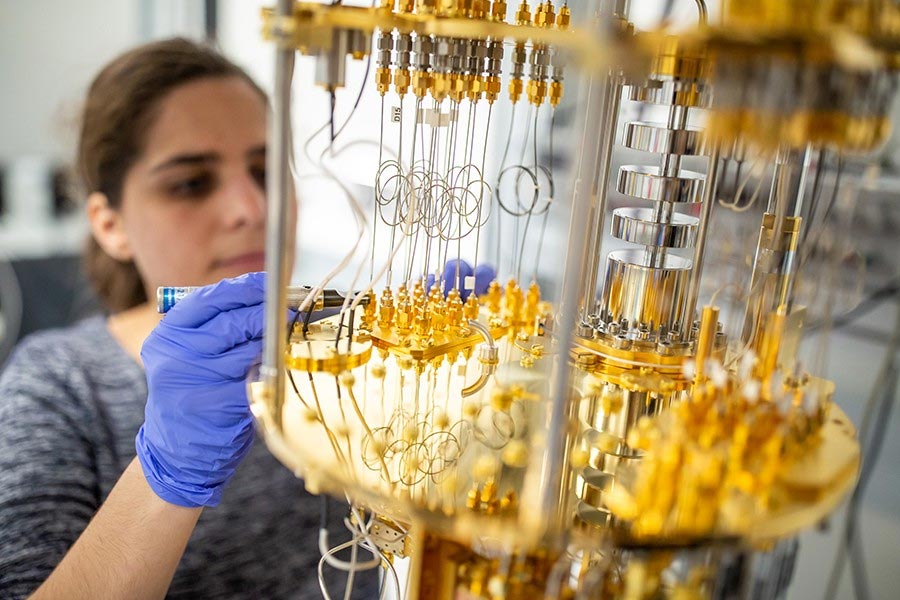
Two U.S. Army research projects advance quantum networking, which will likely play a key role in future battlefield operations.
Quantum networks will potentially deliver multiple novel capabilities not achievable with classical networks, one of which is secure quantum communication. In quantum communication protocols, information is typically sent through entangled photon particles. It is nearly impossible to eavesdrop on quantum communication, and those who try leave evidence of their tampering; however, sending quantum information via photons over traditional channels, such as fiber-optic lines, is difficult – the photons carrying the information are often corrupted or lost, making the signals weak or incoherent.
In the first project, the University of Chicago research team, funded and managed by the U.S. Army’s Combat Capability Development’s Army Research Laboratory’s Center for Distributed Quantum Information, demonstrated a new quantum communication technique that bypasses those traditional channels. The research linked two communication nodes with a channel and sent information quantum-mechanically between the nodes—without ever occupying the linking channel.
“This result is particularly exciting not only because of the high transfer efficiency the team achieved, but also because the system they developed will enable further exploration of quantum protocols in the presence of variable signal loss,” said Dr. Sara Gamble, program manager at the lab’s Army Research Office and co-manager of the Center for Distributed Quantum Information. “Overcoming loss is a key obstacle in realizing robust quantum communication and quantum networks.”
The research, published in the journal Physical Review Letters, developed a system that entangled two communication nodes using microwave photons—the same photons used in cell phones—through a microwave cable. For this experiment, they used a microwave cable about a meter in length. By turning the system on and off in a controlled manner, they were able to quantum-entangle the two nodes and send information between them—without ever having to send photons through the cable.
“We transferred information over a one-meter cable without sending any photons to do this, a pretty unusual achievement,” said Dr. Andrew Cleland, the John A. MacLean Sr. Professor of Molecular Engineering at Pritzker Molecular Engineering at University of Chicago and a senior scientist at Argonne National Laboratory. “In principle, this would also work over a much longer distance. It would be much faster and more efficient than systems that send photons through fiber-optic channels.”
Though the system has limitations, it must be kept very cold, at temperatures a few degrees above absolute zero, the researchers said it could also potentially work at room temperature with atoms instead of photons.
The team is now conducting experiments that would entangle several photons together in a more complicated state, which could ultimately enable enhanced quantum communication protocols and capabilities.
Entangled particles aren’t just limited to photons or atoms, however. In a second paper published June 12, 2020, in the peer-reviewed journal Physical Review X, the same Chicago team entangled two phonons—the quantum particle of sound—for the first time.
Using a system built to communicate with phonons, similar to the photon quantum communication system, the team entangled two microwave phonons, which have roughly a million times higher pitch than can be heard with the human ear.
Once the phonons were entangled, the team used one of the phonons as a herald, which was used to affect how their quantum system used the other phonon. The herald allowed the team to perform a so-called quantum eraser experiment, in which information is erased from a measurement, even after the measurement has been completed.
“Phonons give you a much bigger time window to do things and relieve some of the challenges in doing a quantum eraser experiment,” Cleland said.
Though phonons have a lot of disadvantages over photons—for example, they tend to be shorter-lived—they interact strongly with a number of solid-state quantum systems that may not interact strongly with photons. As a result, phonons could provide a better way to couple to these systems.
This coupling is a critical capability for many quantum networking applications, and may also benefit other quantum information science applications such as quantum computing. Additionally, the wavelengths of phonons are shorter than those of photons for the same frequency, potentially enabling smaller quantum circuits.
“Together, these experiments provide multiple avenues for future research into how we construct quantum networks that function in non-ideal environments, and reliably transfer quantum information between systems,” said Dr. Fredrik Fatemi, researcher at the laboratory and co-manager of the Center for Distributed Quantum Information. “Both are critically important for developing future quantum technologies.”
For more on this research, read New Quantum Communication Technique Sends Information Using “Spooky Action at a Distance.”
References:
“Remote entanglement via adiabatic passage using a tunably-dissipative quantum communication system” by A. Bienfait, Y. P. Zhong, H.-S. Chang, M.-H. Chou, C. R. Conner, É. Dumur, J. Grebel, G. A. Peairs, R. G. Povey, K. J. Satzinger and A. N. Cleland, 12 June 2020, Physical Review Letters.
DOI: 10.1103/PhysRevLett.124.240502
“Quantum Erasure Using Entangled Surface Acoustic Phonons” by A. Bienfait, Y. P. Zhong, H.-S. Chang, M.-H. Chou, C. R. Conner, É. Dumur, J. Grebel, G. A. Peairs, R. G. Povey, K. J. Satzinger and A. N. Cleland, 12 June 2020, Physical Review X.
DOI: 10.1103/PhysRevX.10.021055
CCDC Army Research Laboratory is an element of the U.S. Army Combat Capabilities Development Command. As the Army’s corporate research laboratory, ARL discovers, innovates, and transitions science and technology to ensure dominant strategic land power. Through collaboration across the command’s core technical competencies, CCDC leads in the discovery, development, and delivery of the technology-based capabilities required to make Soldiers more lethal to win the nation’s wars and come home safely. CCDC is a major subordinate command of the U.S. Army Futures Command.
Never miss a breakthrough: Join the SciTechDaily newsletter.
Follow us on Google and Google News.