
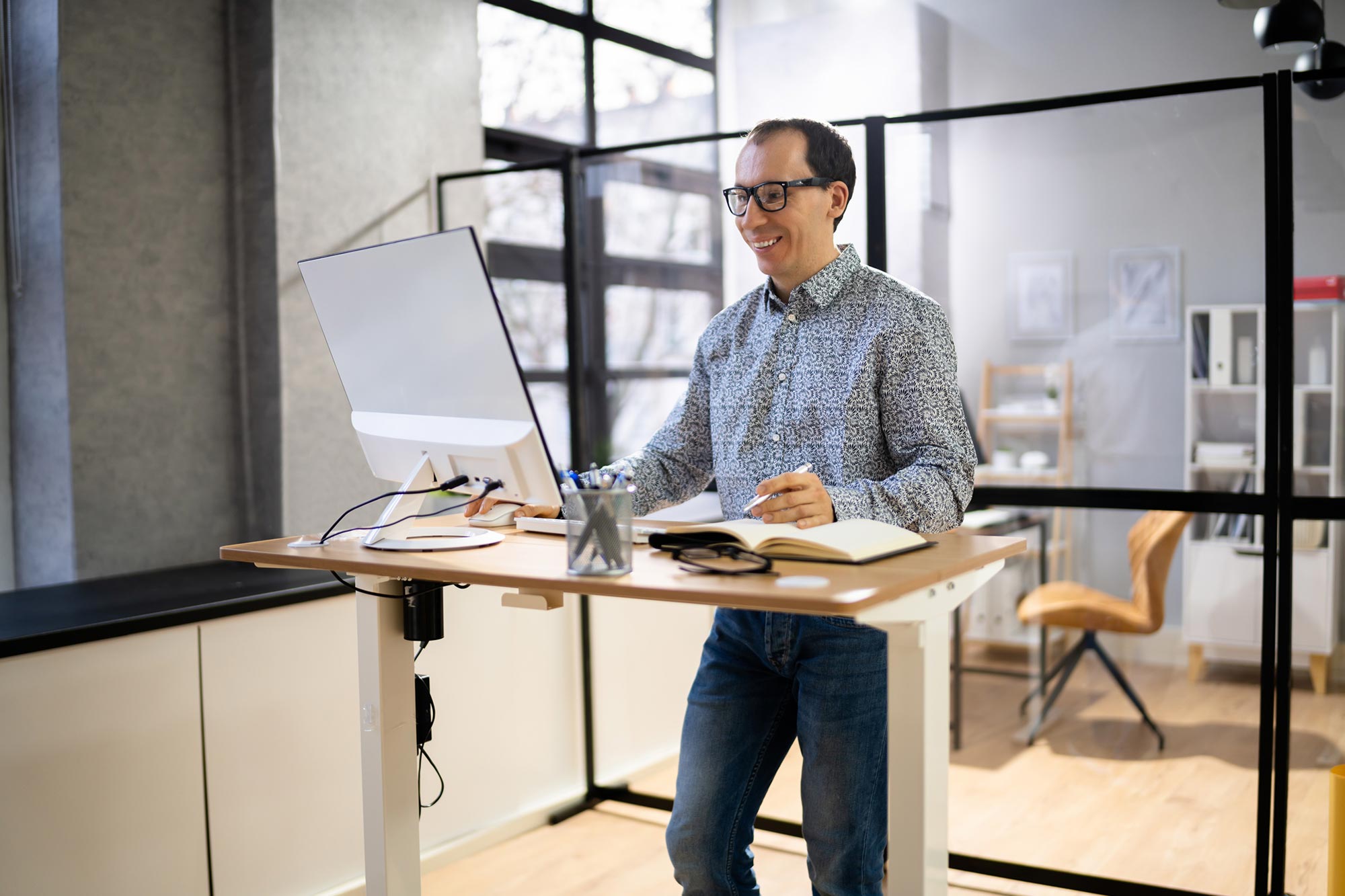
Sit-stand desks reduce sitting but don’t lower blood pressure, and prolonged standing without movement may harm cardiovascular health, according to a recent study.
A study led by an epidemiologist from West Virginia University found that alternating between sitting and standing at work reduces sedentary behavior but does not help lower blood pressure. The researchers also discovered that prolonged standing during work might negatively impact cardiovascular health.
In a clinical trial, researchers expected to determine that people with hypertension could lower their blood pressure with a behavioral intervention including a sit-stand desk to reduce sitting.
“People decreased their sedentary behavior by over an hour a day by standing at their desks and that was really good because there’s still a lot of evidence that suggests too much sitting is not good for us and we need to be moving more,” said Bethany Barone Gibbs, chair and professor in the Department of Epidemiology and Biostatistics at the WVU School of Public Health.
“However, blood pressure didn’t improve at all, not with resting blood pressure, ambulatory blood pressure or pulse wave velocity. That’s important because I think a lot of people are using sit-stand desks and think that might help their blood pressure.”
Nearly half of U.S. adults have high blood pressure, according to the American Heart Association. Increasing physical activity is one lifestyle change that can help lower the numbers.
“We know moderate to vigorous intensity physical activity like brisk walking or biking absolutely decreases blood pressure,” Barone Gibbs said. “But over the past 10 years, we now understand that even if you’re exercising as much as you’re supposed to, which is 20 to 30 minutes every day, there are another 16 hours during the day where you’re doing something else. Nowadays, many people are sitting for most of that other time.”
Prior Research and Observational Studies
Barone Gibbs said previous observational studies — including some she led — suggest people who sat a lot had worse cardiovascular health than people who were more active.
“Some of those showed that if you sat for a long time in one sitting, bad cardiovascular things started to happen, like blood pooling in your legs and your blood pressure would go up to compensate for the lack of circulation,” she said.
For the clinical trial, researchers recommended that participants stand 15 to 30 minutes each hour and take a walking break every hour. However, some stood longer than others, and that increased their measure of aortic arterial stiffness, a factor that makes your heart work harder and marks an early stage of cardiovascular disease.
Although Barone Gibbs deemed the result “statistically significant, but not gigantic,” she said it indicates prolonged static standing may have the same effect as sitting for long periods.

The reason, she explained, is a physiological mechanism called a muscle pump — or musculovenous pump — which helps circulate blood from the legs back to the heart.
“The veins in our legs have a one-way valve that once the blood gets pushed up, it can’t come back down. That helps your heart pump the blood back up from your legs to your heart and brain,” she said. “Whenever you flex the muscles in your calves by walking or moving, those muscle contractions are helping to push the blood up through this one-way valve. So, if you’re standing at your desk, not moving, that probably results in the same blood-pooling effects we see with sitting but even worse because it’s even harder for your blood to push back up to your brain in a standing posture.”
Their work was published in the American Heart Association journal Circulation and will also appear in a special null hypothesis article collection.
“I know we did a good study and, even though it’s a null result, that’s important because we need to know what doesn’t work just like we need to know what works for improving blood pressure,” Barone Gibbs said.
Study Design and Participant Activity
To conduct the study, Barone Gibbs and her team recruited 271 desk workers who had elevated blood pressure and set a goal of increasing their workday physical activity.
Participants were given sit-stand desks and wearable activity trackers that buzzed if they didn’t get in at least 250 steps an hour. They were also fitted with activity monitors and asked to keep a diary so researchers could understand their behaviors inside and outside of work. Assessments included blood pressure and arterial stiffness.
Researchers found that standing outside of office hours had a positive effect at lowering blood pressure, a result Barone Gibbs attributes to the differences in the way people stand in leisure or work time.
“More active standing is happening when you’re on your own time,” she said. “Say I’m standing watching my daughter’s soccer game, I might be standing, but I am probably moving around talking to people and watching the game. I’m not just standing still for a long time. I am using my leg muscles and promoting blood flow. That’s an important distinction to make. Whereas someone using a sit-stand desk, a cashier, or other types of occupational standing are more likely going to be standing still or static standing for a long period. My hypothesis is that months of this static and prolonged type of standing is what could cause the arteries to get stiffer over time.”
Still, Barone Gibbs said sit-stand desks are beneficial in several ways, including providing relief for chronic low back pain and regulating glucose levels, as some studies suggest.
However, she advises people to avoid static standing and instead keep their muscles moving — a behavior she plans to address in her next study.
“What we want to investigate are the small things you do at your desk, such as heel raises to work the muscle pump, using a balance board, or marching in place to get those muscles moving. Does that make standing at a desk beneficial rather than harmful? We think it will, but we don’t know for sure,” she said.
“We need more research on this so we can tell people what they can do to improve their health. It’s our job as researchers to inform the public how to spend their time and energy most effectively for health benefits.”
Reference: “Effects of Sedentary Behavior Reduction on Blood Pressure in Desk Workers: Results From the RESET-BP Randomized Clinical Trial” by Bethany Barone Gibbs, Subashan Perera, Kimberly A. Huber, Joshua L. Paley, Molly B. Conroy, John M. Jakicic and Matthew F. Muldoon, , Circulation.
DOI: 10.1161/CIRCULATIONAHA.123.068564
Never miss a breakthrough: Join the SciTechDaily newsletter.
Follow us on Google and Google News.