
Scientists have dramatically revised the universe’s expiration date, suggesting everything from black holes to humans could vanish far sooner than we ever imagined
The universe may be disappearing far faster than scientists once believed. New research from three Dutch scientists suggests that the final remnants of stars could vanish in “just” 10^78 years. That’s a 1 followed by 78 zeros. While this still feels like an unimaginably long time, it is dramatically shorter than earlier estimates, which placed the universe’s end at around 10^1100 years. Their findings, with a wink and dead-seriously, were published in the Journal of Cosmology and Astroparticle Physics.
This study is a follow-up to a 2023 paper by the same team: black hole expert Heino Falcke, quantum physicist Michael Wondrak, and mathematician Walter van Suijlekom, all from Radboud University. In that earlier work, the trio proposed that not only black holes but also dense objects like neutron stars could slowly “evaporate” through a process similar to Hawking radiation.
The idea sparked a flood of questions from scientists and curious minds alike. One question came up again and again: how long would this cosmic evaporation actually take?
Ultimate end
The researchers calculated that the end of the universe, if only Hawking-like radiation is taken into account, will take about 10^78 years (a 1 with 78 zeros). That is the time that white dwarf stars, the most persistent celestial objects, need to perish via Hawking-like radiation. Previous studies, which did not take Hawking radiation into account, arrived at 10^1100 years for white dwarfs (a 1 with 1100 zeros). Lead author Heino Falcke: “The ultimate end of the universe will therefore come a lot faster than expected, but fortunately it will still take a very long time.”
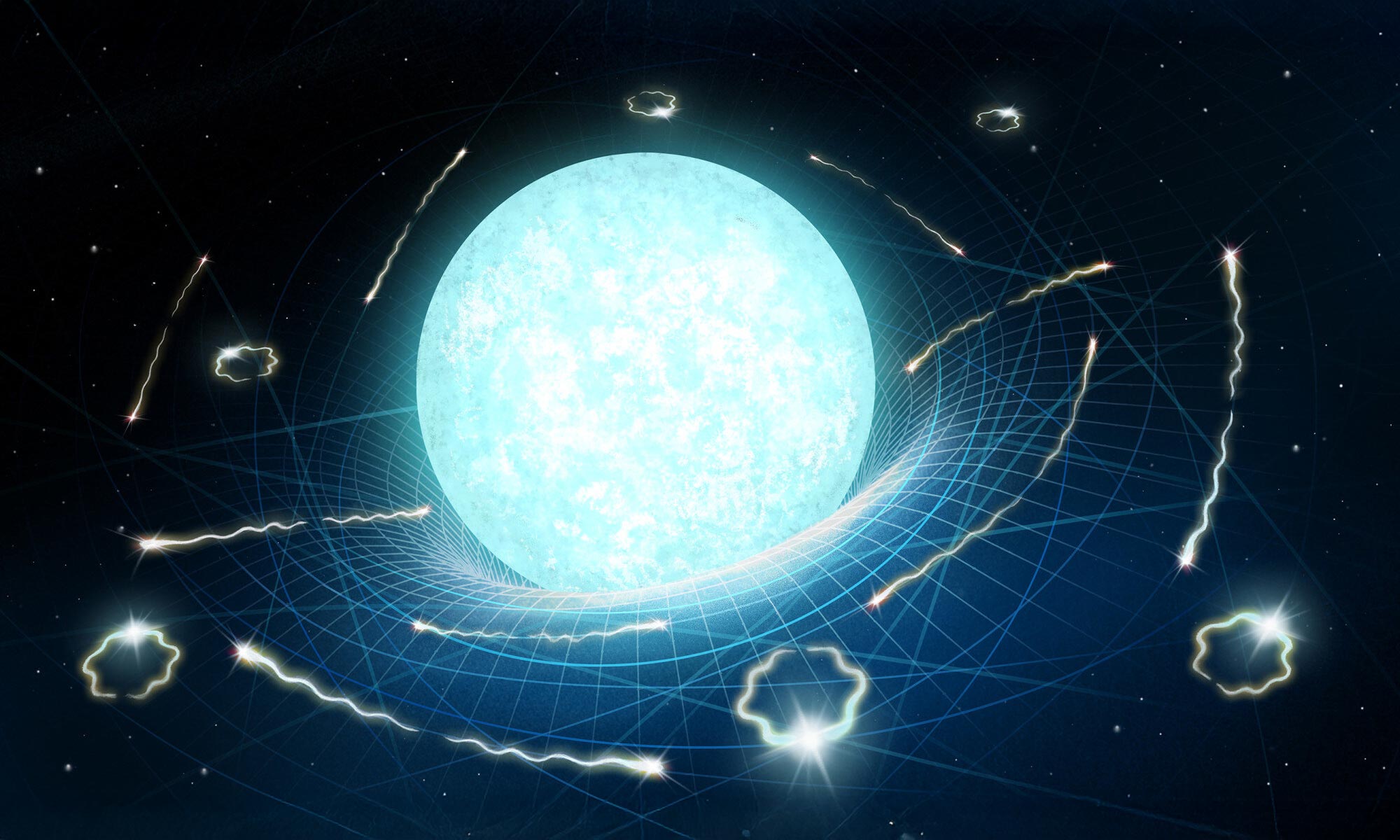
The researchers did the calculations deadly serious and with a wink. The basis is the reinterpretation of Hawking radiation. In 1975, physicist Stephan Hawking came up with the idea that, contrary to what the theory of relativity prescribes, particles and radiation can escape from a black hole.
Two temporary particles could be formed on the edge of a black hole, whereby, before the particles merge again, one particle is sucked into the black hole and the other particle escapes. The consequence of this Hawking radiation is, among other things, that a black hole dissolves very slowly into radiation and particles. This clashes with Albert Einstein’s theory of relativity, which states that black holes can only grow.
Neutron star is as slow as a black hole
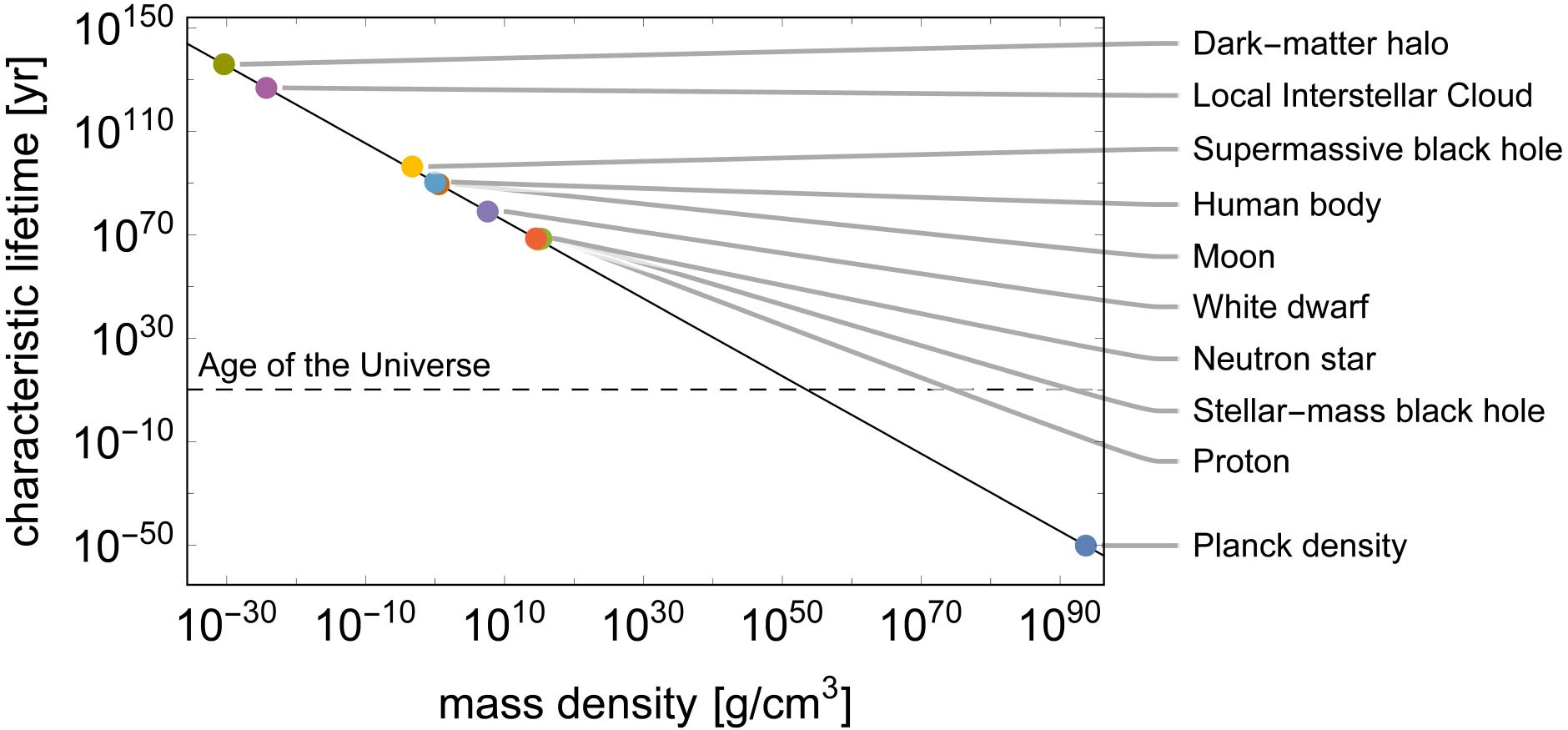
The researchers calculated that the process of Hawking radiation also works in principle for other objects with a gravitational field. Furthermore, the calculations showed that the ‘evaporation time’ of an object in principle only depends on its density.
To the surprise of the researchers, neutron stars and stellar black holes take the same amount of time to decay: 10^67 years. This was unexpected because black holes have a stronger gravitational field and that should ensure a faster ‘evaporation.’ “But black holes have no surface,” says co-author and postdoc researcher Michael Wondrak, “They reabsorb some of their own radiation. That slows down the process.”
Man and Moon: 10^90 years
Because the researchers were at it anyway, they also calculated how long it takes for the Moon and a human to evaporate via Hawking-like radiation. That’s 10^90 years (a 1 with 90 zeros). Of course, the researchers subtly note, there are other processes that may cause humans and the moon to disappear faster than calculated.
Co-author Walter van Suijlekom, professor of mathematics at Radboud University, adds that the research is an exciting collaboration of different disciplines and that combining astrophysics, quantum physics and mathematics leads to new insights. “By asking these kinds of questions and looking at extreme cases, we want to better understand the theory, and perhaps one day, we will unravel the mystery of Hawking radiation.”
Reference: “An upper limit to the lifetime of stellar remnants from gravitational pair production” by Heino Falcke, Michael F. Wondrak and Walter D. van Suijlekom, 12 May 2025, Journal of Cosmology and Astroparticle Physics.
DOI: 10.1088/1475-7516/2025/05/023
Never miss a breakthrough: Join the SciTechDaily newsletter.
Follow us on Google and Google News.
8 Comments
NOTE 2506130452_Source1. Analyzing
New research suggests that the universe could end much sooner than we thought.
There are natural and sudden deaths. Fastened fate is sudden death. And the universe is just one msbase in our universe, like a small grain of sand. There are so many grains of sand on the white sand beach. Uh-huh.
_[2-2]#1 Hawking radiation seems to be qcell.qvix.qms thermal radiation on one side of vix.bar . Of course, if the thermal radiation is in vix, the two ends of the vix2 neutron pair stars are also considered to be ‘in the form of becoming a supernova bar in the future’. Uh-huh.
Therefore, Hawking radiation would be a kind of bar superstring. Thermal radiation appeared in qms.dark_energy and should be considered as ‘small particle c’, as shown in qvixr.bar 2.
View 2.
2506060925
dark_energy
.qms.qvix.qcell
.c3.proton(neutron).xyz/3
.quark.uud(ddu)
0d000000uu
000d00uu00
00000duu00
0000du00u0
000uu0000d
0u0u000d00
00u00ud000
0ud0u00000
c000000000
00u00000du
#In physics, Hawking radiation, or Beckenstein-Hawking radiation, is the thermal radiation emitted by a black hole due to quantum mechanical effects. Simply put, quantum perturbations result in the pair production of particles and antiparticles near the event horizon of a black hole.
_[2-3,3] Is it an ironic intuition?
I’ve studied maglev for a long time and found out that the principles unfold the msbase galactic mode or the basic structure of stars on the basis of qpeoms.
When this was defined as qpeoms, the black hole was seen as having compatibility between the vixer and the neutron star vixxer (smolas, vix2). They are the boss and subordinates, the king and the people, the subject and the subtitle. They are the representatives and employees of the company. When the country collapses, it is the same fate.
The time it takes for a neutron star and a stellar black hole to decay is the same as 10^67 years? It means a ‘covalent destiny’. As shown in Figure 1, the gravitational field in one structure is applied in principle to all objects within the same range. Therefore, it is the same fate because vix and vix2 are together.
vix.blackhole shall satisfy three conditions, xyz, on the diagonal. However, vix2 basically satisfies only two xy conditions. Since this is the basic structure of qpeoms.msbase, magicsums in the same range under conditions are surprisingly interconverted and have the same fate of evolving together or facing apocalypse.bending(ni2=-n). Huh.
View 1.
01000000_vix.black.x.hole
00000100_
00010000*vix2.neutron.n.star
00000100*
≈≈==========
Source 1.
https://scitechdaily.com/new-research-reveals-that-the-universe-could-end-way-sooner-than-we-thought/
1.
Space may be disappearing at a much faster rate than scientists once thought. New research by three Dutch scientists suggests that the last remnants of a star could “just” disappear in 10^78 years. This is the time when there are 78 zeros after one. Although this seems like an unimaginably long time, it is much shorter than previous estimates, which predicted the end of the universe to be around 10^1100 years.
1-1.
Previous studies have suggested that not only black holes but also high-density objects such as neutron stars can be slowly “evaporated” through Hawking radiation-like processes.
The idea has raised numerous questions for both scientists and curious people. One question has been constantly asked. How long will the evaporation of this universe actually take?
1-3. The ultimate end
The researchers calculated that if Hawking radiation alone was to be considered, the end of the universe would take about 10^78 years (78 zeros per 1 ). This is the time required for the white dwarf, the longest-lasting celestial body, to be annihilated by Hawking radiation. Previous studies that did not consider Hawking radiation have shown that 10^1100 years (1100 zeros per 1) were needed for white dwarfs. Main author Heino Falke said, “So the ultimate end of the universe will come much sooner than expected, but fortunately it will still take a very long time.
2.
The researchers calculated how long it takes for 10 different celestial bodies to “evaporate” through Hawking-like radiation in an ideal environment without any other effects. White dwarfs decompose in about 10^78 years (78 zeros per 1). The human body collapses after 10^90 years (90 zeros per 1) if only Hawking-like radiation is present.
2-1.
The researchers worked out the calculations fatally seriously, and in the blink of an eye. The basis for this is a reinterpretation of Hawking’s radiation. In 1975, physicist Stephen Hawking proposed the idea that particles and radiation could escape from a black hole, contrary to the theory of relativity.
2-2.
Two temporary particles can form at the edge of the black hole, with one being sucked into the black hole and the other exiting the black hole before the particles regroup.
[As a result of Hawking’s radiation, above all, black holes decompose very slowly into radiation and particles] This contradicts Albert Einstein’s theory of relativity, which argues that black holes have no choice but to grow.
2-3. Neutron stars are as slow as black holes
The researchers calculated that Hawking’s radiation process applies in principle to other objects with gravitational fields. Furthermore, the calculation revealed that the ‘evaporation time’ of an object depends only on the density in principle.
3.
What surprised the researchers is that [the time taken for neutron stars and stellar black holes to decay is the same as 10^67 years]. This was an unexpected result considering that black holes have a stronger gravitational field, so ‘evaporation’ should be faster. However, black holes have no surface. Black holes reabsorb some of their radiation.
The multiverse is eternal and recycles. Most galaxies are caught up in the gravitational tides of the superclusters at the edges, which go dark and become energy, before starting over in a ‘big swirl with similar structures from the edges of other universes. Some galaxies escape this fate and are observable as fully formed spirals that are being observed and confused as being formed by our own early universe. These come from the infinate multivrse surrounding our own, and are merely being caught up in the gravitational ebb and flow.
Recycling universes (bouncing universes) or multiverses run afoul on increasing entropy. (Plus our universe started out with zero entropy density, thanks to inflation.)
That is still longer than we can guarantee that a potentially quasi-stable Higgs vacuum won’t decay and destroy our universe as we know it:
“A direct calculation within the Standard Model of the lifetime of our vacuum state finds that it is greater than 10^65 years with 95% confidence.” [“False vacuum”. Wikipedia]
Potato, potatoe.
A vacuum collapse would expand at the speed of light. As time presses on, exponentially more and more of our universe will have crossed the light horizon. If one does occur, the chances of it affecting us is pretty low.
“Expiration” date? Does the universe respire? Expiration is breathing out from one’s lungs.
“Expiry date”, SciTech Daily. Yes; ok,”expiration date” is some damn silly use of of English as spoken in that quaint little country, the USA.
i just wanna know if EVEN THOUGH THE UNIVERSE WILL END SOONER THAN WE EXPECTED, are researchers working on ways to SURVIVE ??
i just wanna know if EVEN THOUGH THE UNIVERSE WILL END SOONER THAN WE EXPECTED, what are the different ways [[ besides a building a BATTERY complex ]] can we survive ??