

Research provides new insights into how the brain forms habits and explains why they can be so difficult to break.
Neuroscientists at the Sainsbury Wellcome Centre (SWC) at UCL have discovered that the brain uses two distinct systems to learn through trial and error. This is the first time a second learning system has been identified, offering new insight into how habits are formed.
The discovery could provide a scientific foundation for developing strategies to treat conditions linked to habitual behavior, such as addictions and compulsions. Published in Nature, the study, conducted in mice, may also lead to new therapeutic approaches for Parkinson’s disease.
“Essentially, we have found a mechanism that we think is responsible for habits. Once you have developed a preference for a certain action, then you can bypass your value-based system and just rely on your default policy of what you’ve done in the past. This might then allow you to free up cognitive resources to make value-based decisions about something else,” explained Dr Marcus Stephenson-Jones, Group Leader at SWC and lead author of the study.
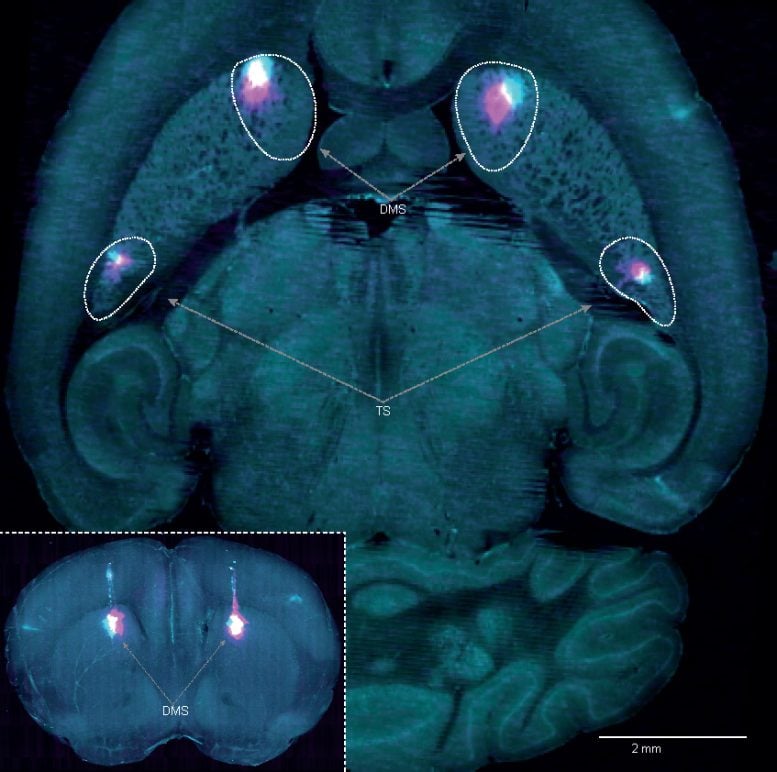
Discovery of action prediction error
The researchers identified a new type of dopamine signal in the brain that functions differently from the one previously known. Dopamine was already understood to generate reward prediction errors (RPE), which tell the brain whether an outcome is better or worse than expected.
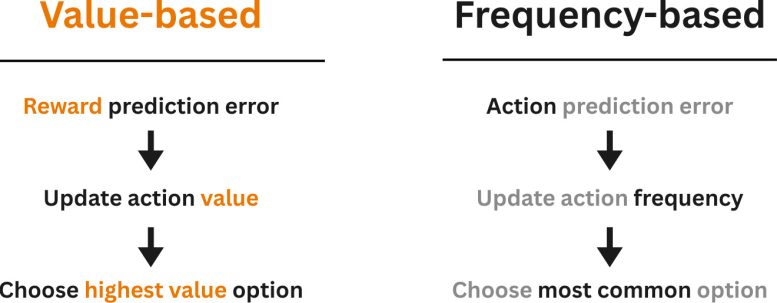
In this study, the scientists discovered a second dopamine signal, called action prediction error (APE), which tracks how often an action is repeated. Together, RPE and APE give animals two distinct ways to learn: by choosing the most rewarding option or by repeating the most frequently chosen one.
“Imagine going to your local sandwich shop. The first time you go, you might take your time choosing a sandwich and, depending on which you pick, you may or may not like it. But if you go back to the shop on many occasions, you no longer spend time wondering which sandwich to select and instead start picking one you like by default. We think it is the APE dopamine signal in the brain that is allowing you to store this default policy,” explained Dr Stephenson-Jones.
Simplifying memory through repetition
The newly discovered learning system offers a simpler way for the brain to store information, without needing to constantly compare the value of different choices. This efficiency may allow the brain to handle multiple tasks at once. For instance, after learning how to drive, you can hold a conversation while driving. Your default system manages the routine driving tasks, while your value-based system focuses on the conversation.
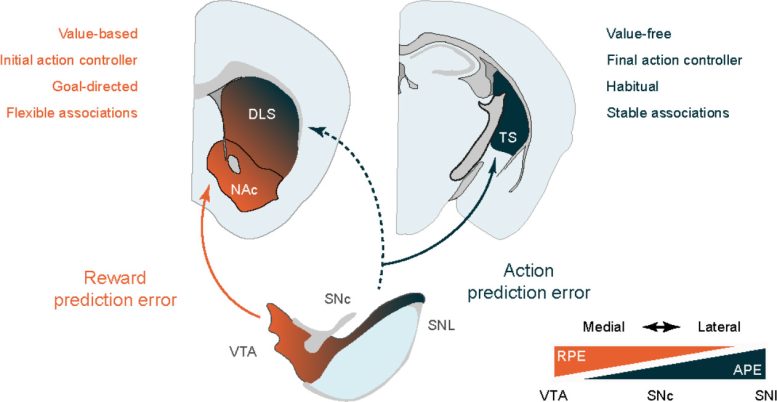
Earlier research found that the dopamine neurons involved in learning are located in three parts of the midbrain: the ventral tegmental area, the substantia nigra pars compacta, and the substantia nigra pars lateralis. While some studies showed these neurons play a role in processing reward, previous findings revealed that about half of them are linked to movement—but the purpose of this connection remained unclear.
RPE neurons project to all areas of the striatum apart from one, called the tail of the striatum. Whereas the movement-specific neurons project to all areas apart from the nucleus accumbens. This means that the nucleus accumbens exclusively signals reward, and the tail of the striatum exclusively signals movement.
Dopamine release linked to movement
By investigating the tail of the striatum, the team were able to isolate the movement neurons and discover their function. To test this, the researchers used an auditory discrimination task in mice, which was originally developed by scientists at Cold Spring Harbor Laboratory. Co first authors, Dr Francesca Greenstreet, Dr Hernando Martinez Vergara and Dr Yvonne Johansson, used a genetically encoded dopamine sensor, which showed that dopamine release in this area was not related to reward, but it was related to movement.
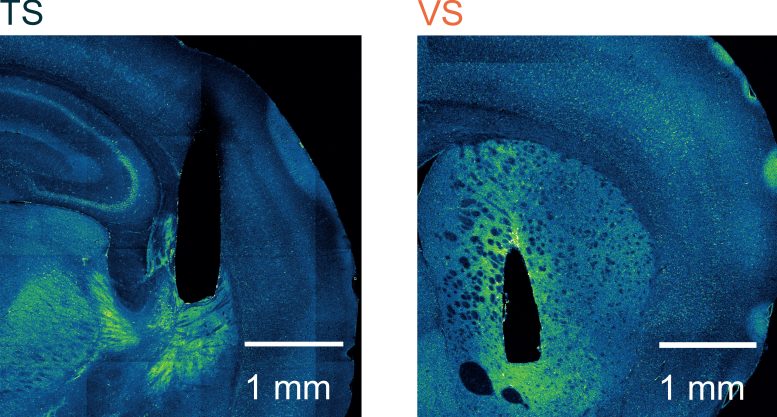
“When we lesioned the tail of the striatum, we found a very characteristic pattern. We observed that lesioned mice and control mice initially learn in the same way, but once they get to about 60-70% performance, i.e. when they develop a preference (for example, for a high tone go left, for a low tone, go right), then the control mice rapidly learn and develop expert performance, whereas the lesioned mice only continue to learn in a linear fashion. This is because the lesioned mice can only use RPE, whereas the control mice have two learning systems, RPE and APE, which contribute to the choice,” explained Dr Stephenson Jones.
APE dominates in late-stage learning
To further understand this, the team silenced the tail of striatum in expert mice and found that this had a catastrophic effect on their performance in the task. This showed that while in early learning animals form a preference using the value-based system based on RPE, in late learning they switch to exclusively use APE in the tail of striatum to store these stable associations and drive their choice. The team also used extensive computational modelling, led by Dr Claudia Clopath, to understand how the two systems, RPE and APE, learn together.
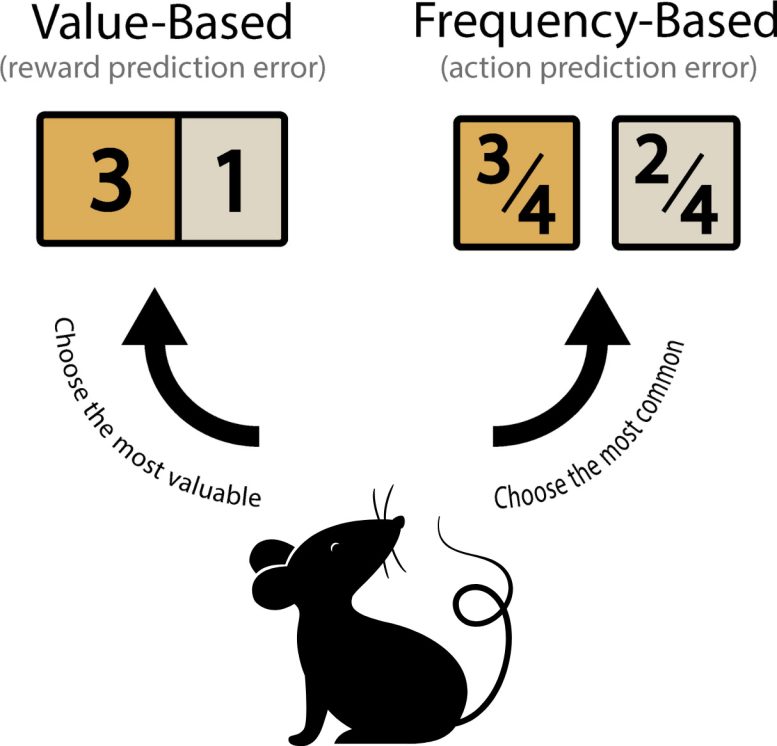
These findings hint at why it is so hard to break bad habits and why replacing an action with something else may be the best strategy. If you replace an action consistently enough, such as chewing on nicotine gum instead of smoking, the APE system may be able to take over and form a new habit on top of the other one.
Targeting the brain’s habit system
“Now that we know this second learning system exists in the brain, we have a scientific basis for developing new strategies to break bad habits. Up until now, most research on addictions and compulsions has focused on the nucleus accumbens. Our research has opened up a new place to look in the brain for potential therapeutic targets,” commented Dr Stephenson Jones.
This research also has potential implications for Parkinson’s, which is known to be caused by the death of midbrain dopamine neurons, specifically in substantia nigra pars compacta. The type of cells that have been shown to die are movement-related dopamine neurons, which may be responsible for coding APE. This may explain why people with Parkinson’s experience deficits in doing habitual behaviours such as walking, however they do not experience deficits in more flexible behaviors such as ice skating.
“Suddenly, we now have a theory for paradoxical movement in Parkinson’s. The movement related neurons that die are the ones that drive habitual behavior. And so, movement that uses the habitual system is compromised, but movement that uses your value-based flexible system is fine. This gives us a new place to look in the brain and a new way of thinking about Parkinson’s,” concluded Dr Stephenson-Jones.
The research team is now testing whether APE is really needed for habits. They are also exploring what exactly is being learned in each system and how the two work together.
Reference: “Dopaminergic action prediction errors serve as a value-free teaching signal” by Francesca Greenstreet, Hernando Martinez Vergara, Yvonne Johansson, Sthitapranjya Pati, Laura Schwarz, Stephen C. Lenzi, Jesse P. Geerts, Matthew Wisdom, Alina Gubanova, Lars B. Rollik, Jasvin Kaur, Theodore Moskovitz, Joseph Cohen, Emmett Thompson, Troy W. Margrie, Claudia Clopath and Marcus Stephenson-Jones, 14 May 2025, Nature.
DOI: 10.1038/s41586-025-09008-9
This research was funded by an EMBO Long-Term Fellowship (ALTF 827-2018), a Swedish Research Council International Postdoc Grant (2020-06365), the Sainsbury Wellcome Centre Core Grant from the Gatsby Charitable Foundation and Wellcome (219627/Z/19/Z), the Sainsbury Wellcome Centre PhD Programme, and a European Research Council grant (Starting #557533).
Never miss a breakthrough: Join the SciTechDaily newsletter.
Follow us on Google and Google News.
3 Comments
HELLO SCIENTIFIC FRIENDS *
Reminder :: As we all know , Two + two doesn’t always equal 4
******* THANK YOU ******* GOOD LUCK *****
Finally the answer to the “Three Blind Mice” nursery rhyme, as to why the Farmer’s Wife, “cut off their tails with a carving knife”!!!
I can hardly wait for them to upgrade the test animals and move to cats.
Cats are the new rats (considering that the cat inside the house double our risk of lung cancer)…