
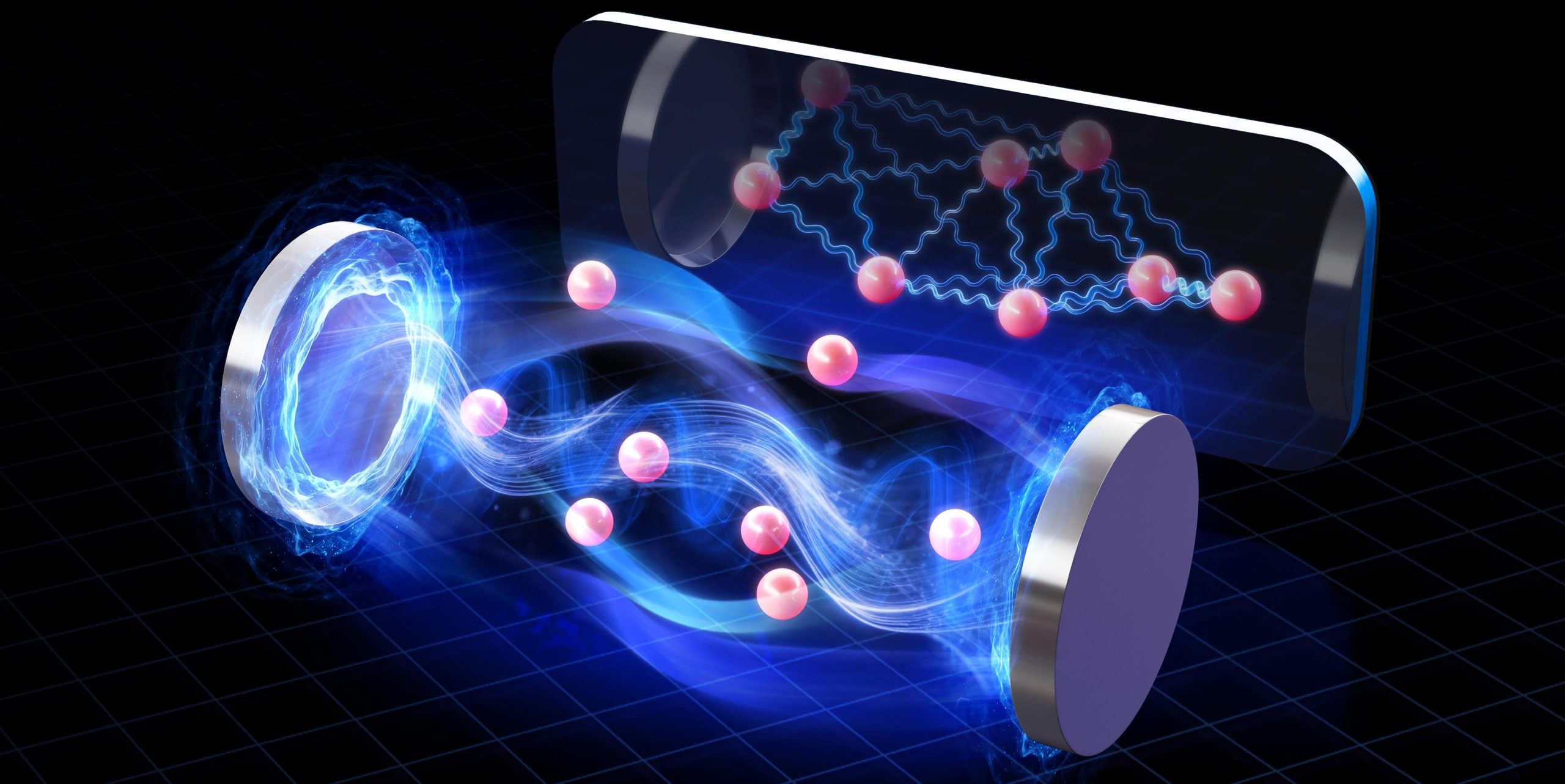
Researchers discovered that when atoms interact and remain entangled with light, they emit stronger, more coordinated bursts of energy.
This breakthrough could lead to faster, more efficient quantum devices and improved control over light-matter systems.
Collective Light Behavior in Cavity Systems
Light–matter systems bring many emitters (e.g., atoms) into a shared optical mode inside a cavity. This mode forms a stable pattern of light between mirrors placed very close together, creating conditions that allow the atoms to act collectively in ways that isolated atoms cannot. One of the most striking examples is superradiance, a coordinated quantum effect in which a large group of atoms emits light in perfect synchrony, producing a much stronger burst than they would individually.
Many theoretical studies assume that the interaction between light and matter is the dominant force in these systems. Under this assumption, researchers often treat the entire group of atoms as a unified “giant dipole,” evenly linked to the cavity field. This field creates interactions across the whole ensemble as if every atom were connected to all others.
“Photons act as mediators that couple each emitter to all others inside the cavity,” says Dr. João Pedro Mendonça, the first author of the article, who completed his PhD at the Faculty of Physics of the University of Warsaw and is now working as a researcher at the Centre for New Technologies at the University of Warsaw.
In actual materials, however, atoms that sit close together also influence one another through short-range dipole–dipole interactions that are frequently ignored. The researchers examined what happens when these intrinsic atom-atom effects are included. Their findings show that these local interactions can either weaken or strengthen the longer-range processes driven by photons, directly affecting whether superradiance occurs. Understanding this relationship is crucial for interpreting experiments in conditions where light and matter strongly affect one another.
Why Entanglement Matters in Light–Matter Physics
Entanglement plays a central role in how light and matter respond together, linking their behavior in subtle but important ways. Despite this, many widely used analytical and numerical tools treat light and matter as if they are separate, which removes this link from the picture.
“Semiclassical models greatly simplify the quantum problem but at the cost of losing crucial information; they effectively ignore possible entanglement between photons and atoms, and we found that in some cases this is not a good approximation,” the authors explain.
To address this gap, the team developed a computational method that explicitly includes entanglement. This approach captures correlations within the atomic group and between the atoms and photons. The results show that local interactions between nearby emitters can reduce the threshold needed for superradiance. They also reveal an overlooked ordered state that exhibits superradiant features. Altogether, the work demonstrates that incorporating entanglement is necessary to fully identify the possible states that can emerge in light–matter systems.
Impact on Quantum Energy Technologies
Beyond theoretical interest, cavity-based light–matter platforms are central to several developing quantum technologies. One prominent example is quantum batteries, which are expected to charge and discharge more rapidly and efficiently by taking advantage of collective quantum behavior. Superradiant dynamics can speed up both processes, potentially boosting overall energy-transfer performance.
This study explains how short-range atomic interactions shape these behaviors. By changing the microscopic conditions that support superradiance, these interactions act as adjustable parameters for optimizing charging and energy flow in real materials and cavities.
“Once you keep light–matter entanglement in the model, you can predict when a device will charge quickly and when it won’t. That turns a many-body effect into a practical design rule,” said João Pedro Mendonça. Similar control over light–matter correlations is also relevant for other platforms, including quantum networks and precision sensors.
International Collaboration Behind the Findings
The project emerged through close cooperation across several institutions. João Pedro Mendonça completed multiple research visits to the United States, supported by the University of Warsaw “Excellence Initiative – Research University” (IDUB) program and the Polish National Agency for Academic Exchange (NAWA). The researchers emphasize that collaboration played a key role in achieving these results. “This is a great example of how international mobility and collaboration can open the door to breakthroughs,” the team notes.
Reference: “Role of Matter Interactions in Superradiant Phenomena” by João Pedro Mendonça, Krzysztof Jachymski and Yao Wang, 23 September 2025, Physical Review Letters.
DOI: 10.1103/z8gv-7yyk
Never miss a breakthrough: Join the SciTechDaily newsletter.
Follow us on Google and Google News.
9 Comments
Entanglement plays a central role in how light and matter respond together, linking their behavior in subtle but important ways.
very good.
Please ask researchers to think deeply:
1. How do you understand the entanglement?
2. How do you understand the entanglement of quanta or entanglement of topological vortices?
Why is physics today obsessed with confusing itself with the elusive speculation of quantum?
The new interpretation of the Schrödinger equation by Topological Vortex Theory (TVT) carries profound physical implications.
1)Origin of Quantization: In TVT, quantization conditions (such as Bohr-Sommerfeld quantization) are no longer independent postulates. They are a direct consequence of the single-valuedness condition that the topological vortex phase must satisfy on a closed path: ∮ ∇θ · d**l** = 2πn, which naturally leads to the discretization of physical quantities like angular momentum [2].
2)Interference and Superposition Principle: The interference of wave functions is essentially the phase superposition of different topological vortex paths. In TVT, this corresponds to the coherence of topological charges from different paths of the topological vortex field in spacetime.
3)Measurement Problem: TVT offers a perspective different from the Copenhagen interpretation. When a quantum system interacts with a macroscopic apparatus, the apparatus itself consists of a vast number of topological vortices, and their interaction leads to decoherence and “localization” of the topological vortex state, thereby presenting a classical measurement outcome. Wave function “collapse” is the result of the evolution of topological correlations between the subsystem and the environment [13].
4)Geometric Phase and AB Effect: Phenomena such as the Aharonov-Bohm effect find a natural explanation in TVT. They are a direct manifestation of the non-integrable phase accumulated by the topological charge as the vortex moves in a non-trivial gauge potential [4].
Schrödinger equation can be regarded as the effective field equation of the TVT in the low-energy, non-relativistic limit. This discovery attributes part of the mystery of quantum mechanics to the microscopic topological structure of spacetime [7, 11], providing a more intuitive and geometric picture for understanding quantum phenomena.
Future research directions include:
1)Relativistic Extension: Extending the TVT framework to the Dirac and Klein-Gordon equations, exploring their deeper connection with the spacetime metric.
2)Reconstruction of Quantum Field Theory: Attempting to reconstruct quantum field theory on the basis of TVT, regarding field quanta as excitations of topological vortices [7, 13].
3)Experimental Verification: Searching for subtle effects predicted by TVT that deviate from standard quantum mechanics, such as modifications to the quantum potential under extreme conditions [3].
4)Unification with Gravitational Theory: Exploring the potential correspondence between topological vortices in TVT and spacetime curvature in general relativity, providing new ideas for a theory of quantum gravity [8, 11, 12].
——Excerpted from https://scitechdaily.com/microscope-spacecrafts-most-precise-test-of-key-component-of-the-theory-of-general-relativity/#comment-911110.
The quantum age of both gods and ghosts is coming to an end. The era of topological materials and their related artificial intelligence is striding forward. Scientific development will not give any dignity to pseudoscientific theories and their groups.
Topological Vortex Theory (TVT) not only profoundly explains the classic puzzle of the quantum Hall effect but also opens up the vibrant frontier research field of topological states of matter and topological quantum computing, possessing profound theoretical significance and immense application potential.
——Excerpted from https://scitechdaily.com/microscope-spacecrafts-most-precise-test-of-key-component-of-the-theory-of-general-relativity/#comment-911733.
The Physical Review Letters and its series of publications opened the dirtiest and most vicious age in the history of physics via parity violation.
When we pursue the ultimate truth of all things, the space in which our bodies and all things exist may itself be the final and deepest puzzle we need to explore. This is not only the pursuit of physics, but also the most magnificent exploration of the origin of the universe by human reason.
Based on the Topological Vortex Theory (TVT), space is an uniformly incompressible physical entity. Space-time vortices are the products of topological phase transitions of the tipping points in space, are the point defects in spacetime. Point defects do not only impact the thermodynamic properties, but are also central to kinetic processes. They create all things and shape the world through spin and self-organization.
In today’s physics, some so-called peer-reviewed journals—including Physical Review Letters, Nature, Science, and others—stubbornly insist on and promote the following:
1. Even though θ and τ particles exhibit differences in experiments, physics can claim they are the same particle. This is science.
2. Even though topological vortices and antivortices have identical structures and opposite rotational directions, physics can define their structures and directions as entirely different. This is science.
3. Even though two sets of cobalt-60 rotate in opposite directions and experiments reveal asymmetry, physics can still define them as mirror images of each other. This is science.
4. Even though vortex structures are ubiquitous—from cosmic accretion disks to particle spins—physics must insist that vortex structures do not exist and require verification. Only the particles that like God, Demonic, or Angelic are the most fundamental structures of the universe. This is science.
5. Even though everything occupies space and maintains its existence in time, physics must still debate and insist on whether space exists and whether time is a figment of the human mind. This is science.
6. Even though space, with its non-stick, incompressible, and isotropic characteristics, provides a solid foundation for the development of physics, physics must still insist that the ideal fluid properties of space do not exist. This is science.
and go on.
Is this the counterintuitive science they widely promote? Compromising with pseudo academic publications and peer review by pseudo scholars is an insult to science and public intelligence. Some so-called scholars no longer understand what shame is. The study of Topological Vortex Theory (TVT) reminds us that the most profound problems in physics often lie at the intersection of different theories. By exploring these border regions, we can not only resolve contradictions in existing theories but also discover new physical phenomena and application possibilities.
Under the topological vortex architecture, it is highly challenging for even two hydrogen atoms or two quarks to be perfectly symmetrical, let alone counter-rotating two sets of cobalt-60. Contemporary physics and so-called peer-reviewed publications (including Physical Review Letters, Science, Nature, etc.) stubbornly believe that two sets of counter rotating cobalt-60 are two mirror images of each other, constructing a more shocking pseudoscientific theoretical framework in the history of science than the “geocentric model”. This pseudo scientific framework and system have seriously hindered scientific progress and social development.
For nearly a century, physics has been manipulated by this pseudo scientific theoretical system and the interest groups behind it, wasting a lot of manpower, funds, and time. A large amount of pseudo scientific research has been conducted, and countless pseudo scientific papers have been published, causing serious negative impacts on scientific and social progress, as well as humanistic development.
Complexity does not necessarily mean that there is no logical and architectural framework to follow. Mathematics is the language and tool that reveals the motion of spacetime, rather than the motion itself. Although the physical form of spacetime vortices is extremely simple, their interaction patterns are highly complex, and we must develop more and richer mathematical languages to describe and understand them.
The development of the Topological Vortex Theory (TVT) reflects a progression from concrete physical phenomena to abstract mathematical modeling and, ultimately, to interdisciplinary unification. Its core innovation lies in forging the continuous spacetime geometry of general relativity with the discrete interactions of quantum field theory within the same topological dynamical system.
——Excerpted from https://scitechdaily.com/microscope-spacecrafts-most-precise-test-of-key-component-of-the-theory-of-general-relativity/#comment-909171.
Memo 2512011431_Source 1. Reinterpretation Storytelling []
Source 1.
https://scitechdaily.com/new-research-shows-how-entanglement-amplifies-light/
1.
Why Entanglement Matters in Light-Matter Physics
Entanglement plays a central role in how light and matter interact, linking their behaviors in subtle but important ways. Yet, many widely used analytical and numerical tools treat light and matter as distinct entities, leaving this connection out of the picture.
1-1.
“Semiclassical models greatly simplify quantum problems, but at the cost of losing important information. They effectively ignore possible entanglement between photons and atoms, and we found that in some cases, this is not a good approximation,” the authors explain.
To bridge this gap, the team developed a computational method that explicitly incorporates entanglement. This approach captures the correlations within atomic clusters and between atoms and photons. The results demonstrate that localized interactions between nearby emitters can lower the threshold for superradiance.
Furthermore, they reveal a previously overlooked ordered state that exhibits superradiance properties. Ultimately, this study demonstrates that integrating entanglement is essential to fully understanding the possible states that can arise in light-matter systems.
【While it’s true that quantum entanglement can occur on a large scale, the question is whether the mechanisms for managing and applying it are up to the current scientific standards. I doubt it.
1437>>>>>> Personally, in terms of QPEOMs theory, the unit of quantum entanglement is a susqer, but it’s not a large quantity, but rather a single text sample (sample1).
Building a quantum battery requires a googol of susqers. Are you trying to realize that at your level? It’s completely unrealistic. Haha.
1430>>>>>To use an analogy, are you saying humanity can immediately interpret all the light energy from the sun right now? Yeah? No way.
Then what are you talking about? Hehe.
>>>>You mention quantum batteries that utilize quantum entanglement commercially, but that level seems far off. Perhaps practical applications could be studied at CERN or space stations within the scope of local point scarcity for research purposes.
】
2. Impact on Quantum Energy Technology
_Beyond theoretical interest, a cavity-based light-matter platform is at the heart of several quantum technologies under development.
_A prime example is quantum batteries, which are expected to charge and discharge more quickly and efficiently by leveraging collective quantum behavior. Superradiant dynamics can accelerate both processes, improving overall energy transfer performance.
3.
_This study explains how short-range atomic interactions shape this behavior.
By varying the microscopic conditions that support superradiance, these interactions act as tunable parameters that optimize charge and energy flow in real materials and cavities.
“Incorporating light-matter entanglement into the model allows us to predict when devices will charge rapidly and when they will not.
This translates many-body effects into practical design rules,” said João Pedro Mendonça. Similar control over light-matter correlations holds promise for other platforms, including quantum networks and precision sensors.
If I read this right and my thought that the smaller the matter particle is , has a greater effect of entanglement to other particles , when light beams are used to show the effect , the compatibility of each separate beam exhibits the entanglement of flow . Similar matter would be the best for a stronger entanglement but distinctively different types of matter would be less apt to have a strong effect of entanglement .