
Researchers considered more variables and took global weather patterns into account to create maps of where water might be found.
Water on Mars, in the form of brines, may not be as widespread as previously thought, according to a new study by researchers at the Arkansas Center for Space and Planetary Sciences.
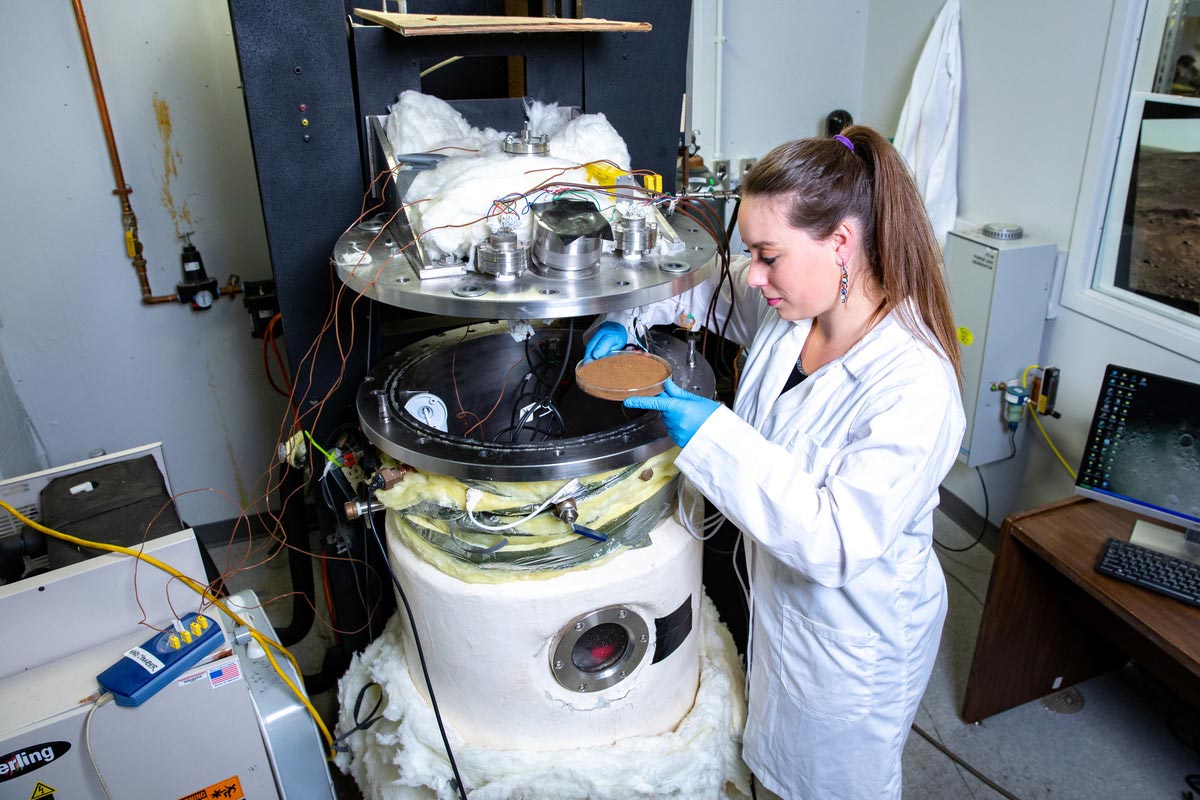
Researchers combined data on brine evaporation rates, collected through experiments at the center’s Mars simulation chamber, with a global weather circulation model of the planet to create planetwide maps of where brines are most likely to be found.
Brines are mixtures of water and salts that are more resistant to boiling, freezing, and evaporation than pure water. Finding them has implications for where scientists will look for past or present life on Mars and where humans who
eventually travel to the planet could look for water.
The scientists took all major phase changes of liquids into account — freezing, boiling and evaporation – instead of just a single phase, as has commonly been the approach in the past, said Vincent Chevrier, associate professor and first author of a study published in The Planetary Science Journal. Former U of A doctoral students Edgard G. Rivera-Valentín and Travis S. Altheide were coauthors of the paper.
“It is looking at all the properties at the same time, instead of one at a time,” said Chevrier. “Then we build maps taking into account all those processes simultaneously.”
Doing so indicates that previous studies may have overestimated how long brines remain on the surface in the cold, thin, and arid Martian atmosphere, Chevrier said. “The most important conclusion is that if you do not take all these processes together, you always overestimate the stability of brines. That is the reality of the situation.”
Favorable conditions for stable brines on the planet’s surface are most likely to be present in mid- to high-northern latitudes, and in large impact craters in the southern hemisphere, he said. In the shallow subsurface, brines might be present near the equator.
In the best-case scenario, brines could be present for up to 12 hours per day. “Nowhere is any brine stable for an entire day on Mars,” he said.
Water on Mars, in the form of brines, may not be as widespread as previously thought, according to a new study by researchers at the Arkansas Center for Space and Planetary Sciences.
Researchers combined data on brine evaporation rates, collected through experiments at the center’s Mars simulation chamber, with a global weather circulation model of the planet to create planetwide maps of where brines are most likely to be found.
Brines are mixtures of water and salts that are more resistant to boiling, freezing, and evaporation than pure water. Finding them has implications for where scientists will look for past or present life on Mars and where humans who
eventually travel to the planet could look for water.
The scientists took all major phase changes of liquids into account — freezing, boiling and evaporation – instead of just a single phase, as has commonly been the approach in the past, said Vincent Chevrier, associate professor and first author of a study published in The Planetary Science Journal. Former U of A doctoral students Edgard G. Rivera-Valentín and Travis S. Altheide were coauthors of the paper.
“It is looking at all the properties at the same time, instead of one at a time,” said Chevrier. “Then we build maps taking into account all those processes simultaneously.”
Doing so indicates that previous studies may have overestimated how long brines remain on the surface in the cold, thin, and arid Martian atmosphere, Chevrier said. “The most important conclusion is that if you do not take all these processes together, you always overestimate the stability of brines. That is the reality of the situation.”
Favorable conditions for stable brines on the planet’s surface are most likely to be present in mid- to high-northern latitudes, and in large impact craters in the southern hemisphere, he said. In the shallow subsurface, brines might be present near the equator.
In the best-case scenario, brines could be present for up to 12 hours per day. “Nowhere is any brine stable for an entire day on Mars,” he said.
Reference: “Global Temporal and Geographic Stability of Brines on Present-day Mars” by Vincent F. Chevrier, Edgard G. Rivera-Valentín, Alejandro Soto and Travis S. Altheide, 12 November 2020, The Planetary Science Journal.
DOI: 10.3847/PSJ/abbc14
Never miss a breakthrough: Join the SciTechDaily newsletter.
Follow us on Google and Google News.