
Close Menu
    Facebook X (Twitter) Instagram
    SciTechDaily
    • Biology
    • Chemistry
    • Earth
    • Health
    • Physics
    • Science
    • Space
    • Technology
    Facebook X (Twitter) Pinterest YouTube RSS
    SciTechDaily
    Home»Space»Scientists Use Seasonal Variations To Find Water for Future Mars Astronauts
    Space

    Scientists Use Seasonal Variations To Find Water for Future Mars Astronauts

    By EuroplanetSeptember 28, 2021No Comments4 Mins Read
    Facebook Twitter Pinterest Telegram LinkedIn WhatsApp Email Reddit
    Share
    Facebook Twitter LinkedIn Pinterest Telegram Email Reddit
    First Humans on Mars
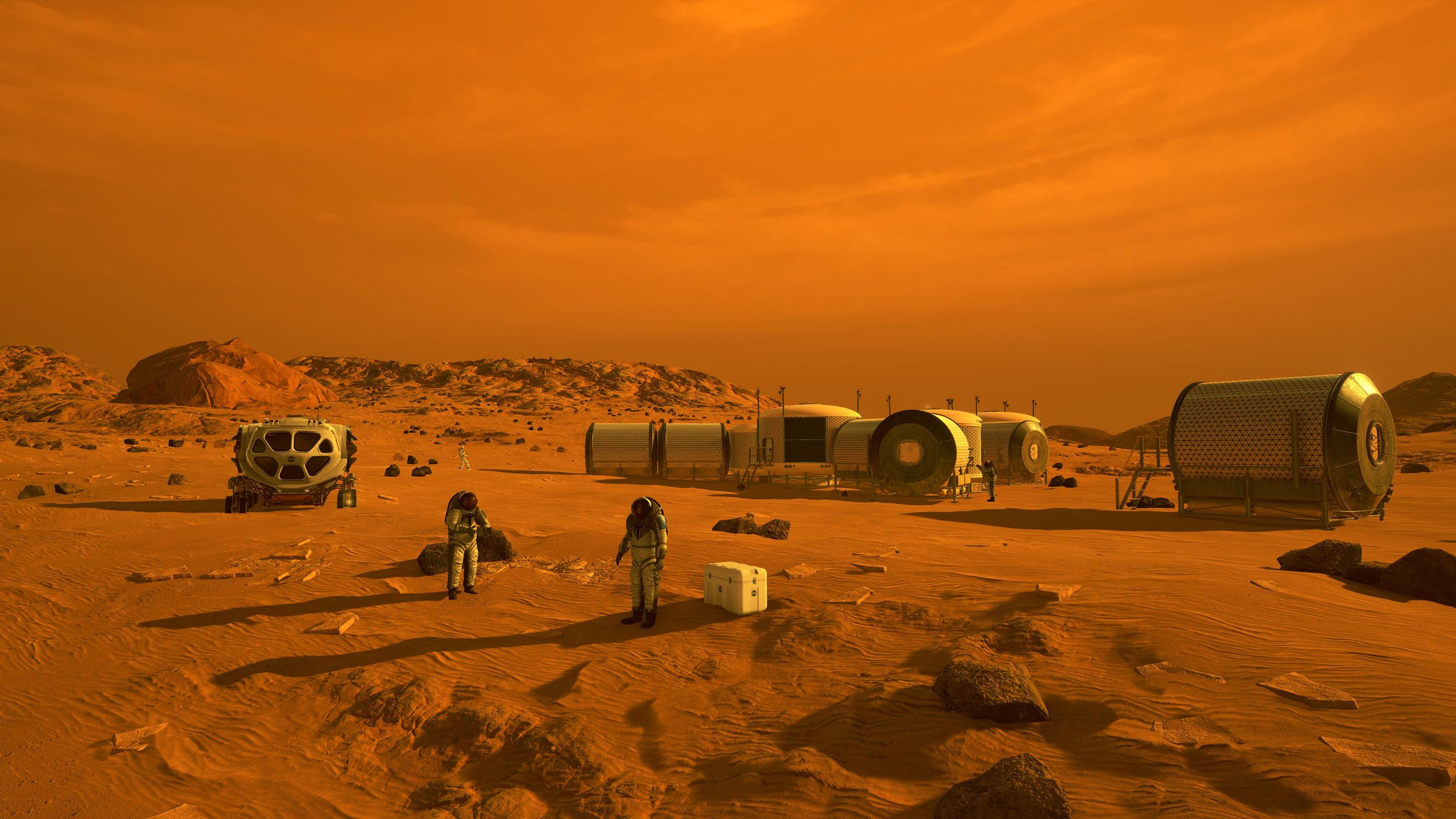
    This artist’s concept depicts astronauts and human habitats on Mars. Credit: NASA

    Seasonal hydrogen changes reveal water ice near the surface in mid-latitude Martian regions, offering ideal conditions for future manned missions.

    An international team of researchers has used seasonal variations to identify likely sub-surface deposits of water ice in the temperate regions of Mars where it would be easiest for future human explorers to survive. The results are being presented this week by Dr. Germán Martínez at the European Planetary Science Conference (EPSC) 2021.

    Using data from NASA’s Mars Odyssey, which has spent almost 20 years orbiting the Red Planet, Martínez and his colleagues have identified two areas of particular interest: Hellas Planitia and Utopia Rupes, respectively in the southern and northern hemisphere. Seasonal variations in levels of hydrogen detected suggests that significant quantities of water ice can be found in the meter or so below the surface in these regions.

    Global Map of Mars With Overlaid Topography
    Global map of Mars with overlaid topography indicating areas with significant seasonal variations in hydrogen content during northern spring (top) and fall (bottom). Green (red) represents increase (decrease) in hydrogen content. The areas highlighted in orange are Hellas Planitia in the southern hemisphere, and Utopia Rupes in the northern hemisphere. These are the only extended regions undergoing a significant variation throughout the Martian year. Credit: G. Martínez.

    Martínez, of the Lunar and Planetary Institute, said: “Data from Mars Odyssey’s Neutron Spectrometer showed signs of hydrogen beneath the surface of Mars from mid to equatorial latitudes, but we still had the challenge of working out whether this is in the form of water ice, which can readily be used as a resource, or locked away in mineral salts or in soil grains and minerals. This is where the seasonal variation provides an important clue. As the coldest ground temperatures occur at the same time as the largest observed increase in hydrogen content, it suggests that water ice is forming in the shallow subsurface of these regions during the fall and winter seasons, and then sublimating into gas during the warm season of each hemisphere.”

    Equatorial Ice is a Game-Changer

    Water ice in the shallow subsurface has been found in plentiful supply at the poles. However, the frigid temperatures and the limited solar light make polar regions a hostile environment for human exploration. The areas from equatorial to mid latitudes are much more hospitable for both humans and robotic rovers, but only deeper reservoirs of water ice have been detected to date, and these are hard to reach.

    To survive on Mars, astronauts would need to rely on resources already available in situ, as sending regular supplies across the 55 million kilometers between Earth and Mars at their closest point is not an option. As liquid water is not available in the cold and arid Martian environment, ice is a vital resource. Water will not only be essential for the life-support of the explorers, or the growth of plants and food, but could also be broken down into oxygen and hydrogen for use as rocket fuel.

    Two other regions are rich in hydrogen: Tharsis Montes and the Medusae Fossae Formation. However, these do not display seasonal variations and appear to be the less accessible forms of water.

    “Definitely, those regions too are interesting for future missions,” added Martínez. “What we plan to do now for them or Hellas Planitia and Utopia Rupes, is to study their mineralogy with other instruments in the hope of spotting types of rock altered by water. Such areas would be ideal candidates for robotic missions, including sample return ones, as the ingredients for rocket fuel would be available there too.”

    Reference: “Looking for Non-Polar Shallow Subsurface Water Ice in Preparation for Future Human Exploration of Mars” by German Martinez, Antonio Segura, Michael D. Smith, Erik Fischer and Nilton O. Renno, September 2021, European Planetary Science Congress 2021.
    DOI: 10.5194/epsc2021-443

    Never miss a breakthrough: Join the SciTechDaily newsletter.
    Follow us on Google and Google News.

    Astronaut Mars Planets The Europlanet Society Water
    Share. Facebook Twitter Pinterest LinkedIn Email Reddit

    Related Articles

    Life Unlikely: Meteorite From Mars Indicates Limited Water Circulation Late in the History of the Red Planet

    ExoMars Discovers Hidden Water in Mars’ Grand Canyon – The Largest Canyon in the Solar System

    Planetary Scientists Discover That Water Was Once Present in Arabia Terra on Mars

    Several Oceans’ Worth of Ancient Water May Reside in Minerals Buried Below Mars’ Surface

    Up to 99% of Mars’ Water May Still Be Trapped in Planet’s Crust – Not Lost to Space As Long Theorized

    New Science Indicates Mars’ Water Didn’t Escape to Space – It’s Trapped in the Red Planet’s Crust

    New Research Shows Water on Mars Not As Widespread as Previously Thought

    Escape From Mars: Surprising Discovery in the Red Planet’s Atmosphere Helps Explain Martian Mystery

    Water on Ancient Mars: Analysis of a Martian Meteorite Reveals Evidence of Water 4.4 Billion Years Ago

    Leave A Reply Cancel Reply

    • Facebook
    • Twitter
    • Pinterest
    • YouTube

    Don't Miss a Discovery

    Subscribe for the Latest in Science & Tech!

    Trending News

    Artificial Sweeteners May Harm Future Generations, Study Suggests

    Splashdown! NASA Artemis II Returns From Record-Breaking Moon Mission

    What If Consciousness Exists Beyond Your Brain

    Scientists Finally Crack the 100-Million-Year Evolutionary Mystery of Squid and Cuttlefish

    Beyond “Safe Levels”: Study Challenges What We Know About Pesticides and Cancer

    Researchers Have Found a Dietary Compound That Increases Longevity

    Scientists Baffled by Bizarre “Living Fossil” From 275 Million Years Ago

    Your IQ at 23 Could Predict Your Wealth at 27, Study Finds

    Follow SciTechDaily
    • Facebook
    • Twitter
    • YouTube
    • Pinterest
    • Newsletter
    • RSS
    SciTech News
    • Biology News
    • Chemistry News
    • Earth News
    • Health News
    • Physics News
    • Science News
    • Space News
    • Technology News
    Recent Posts
    • Scientists Break Optical Limits With Quantum Dot-Powered Nanoscopy
    • Scientists Shrink a Lab Spectrometer to the Size of a Grain of Sand
    • Quantum Reality Gets Stranger: Physicists Put a Lump of Metal in Two Places at Once
    • 34-Million-Year-Old Snake Found in Wyoming Rewrites Our Understanding of Evolution
    • Prehistoric “Vomit Fossil” Reveals Never-Before-Seen Flying Reptile
    Copyright © 1998 - 2026 SciTechDaily. All Rights Reserved.
    • Science News
    • About
    • Contact
    • Editorial Board
    • Privacy Policy
    • Terms of Use

    Type above and press Enter to search. Press Esc to cancel.