

New research shows that the climate conditions dragonfly nymphs experience underwater have a stronger influence on adult trait diversity than the conditions they face later on land.
A new study has found that the effects of climate change on an animal’s traits can begin much earlier in life than scientists previously believed—a finding that could change how researchers and policymakers approach biodiversity conservation.
Focusing on dragonflies, the researchers developed a statistical framework to measure how much early-life traits contribute to adult trait diversity and overall biodiversity.
They discovered that environmental factors during the aquatic juvenile stage, such as water temperature and seasonal variation, influenced adult trait diversity more than the conditions experienced later on land. Biodiversity refers to the variety of living organisms in an area, including both the number of species and the differences in their traits, such as body size and shape.
According to the researchers, this means that climate adaptation strategies should consider not only adult populations but also the conditions species face earlier in life.
“This is really useful going forward as the results will provide a new general rule to guide how biodiversity scientists forecast climate responses – depending on juvenile or adult characteristics,” said lead author Professor Lars L. Iversen, a biology researcher at McGill University. “The results can also help members of the public to understand how environmental shifts in life stages is important in driving climate responses.”
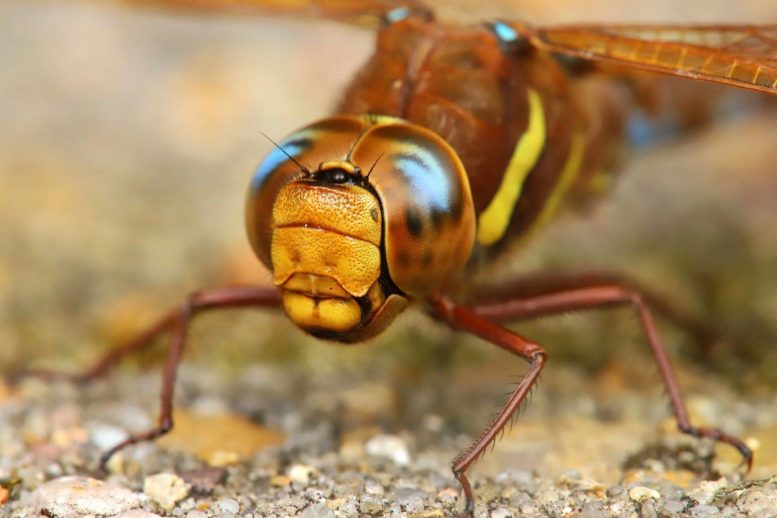
Although most biodiversity models focus on adult traits—because adults are easier to observe due to their size, movement, and visibility—the study shows that early-life conditions can leave lasting biological effects. In the case of dragonflies, these early influences occur underwater and often go unnoticed.
Toward better biodiversity models
The team, which included scientists from McGill University, the University of Aberdeen, and the Leibniz Institute in Germany, analyzed data from 87 dragonfly species across Europe. They compared climate, landscape, and habitat data with traits observed in both aquatic nymphs and airborne adults, revealing strong carryover effects from early life stages. The study was published in Global Ecology and Biogeography.
“This is a really important study, as many predictions for how climate might affect diversity are based on observations of adult stages, because these tend to be more active, visible, and larger,” said co-author Lesley Lancaster from the University of Aberdeen. “However, we find that the observed climate impacts are actually largely indirect consequences of processes affecting juveniles.”
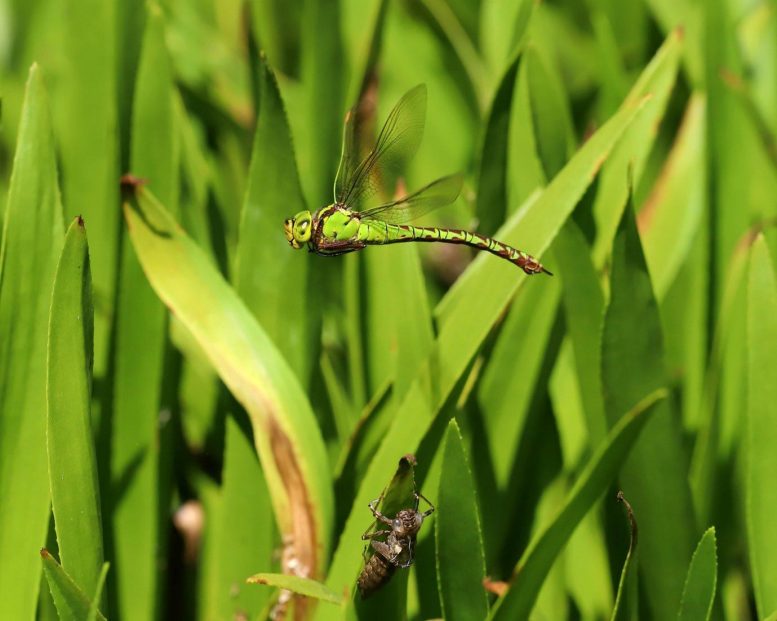
“Scientists and policymakers will be able to use this knowledge to determine whether they should target juveniles or adults for active climate adaptation and mitigation practices,” Iversen said.
Reference: “Complex Life Cycles Shape the Functional Biogeography of European Dragonflies” by Lars L. Iversen, Jaime Garcia-Marquez, Afroditi Grigoropoulou, Michael O’Connor, Sami Domisch and Lesley T. Lancaster, 13 May 2025, Global Ecology and Biogeography.
DOI: 10.1111/geb.70056
This study was funded by the Natural Sciences and Engineering Research Council of Canada, the German Federal Ministry of Education and Research, and the Leibniz Association.
Never miss a breakthrough: Join the SciTechDaily newsletter.
Follow us on Google and Google News.
2 Comments
This is all well & good (& very interesting), but can one really ‘plan’ for an uncertain future? What it does show is ‘natural’ resilience & an existing ability to adapt quickly.
With such large human populations there is little effort to contain the accompanying demand for space & resources & this, it appears, will lead to war.
Yours truly mrs masenya-mashile