
Close Menu
    Facebook X (Twitter) Instagram
    SciTechDaily
    • Biology
    • Chemistry
    • Earth
    • Health
    • Physics
    • Science
    • Space
    • Technology
    Facebook X (Twitter) Pinterest YouTube RSS
    SciTechDaily
    Home»Space»New Study Maps Out Bright Galaxies within 35-Million Light Years of the Earth
    Space

    New Study Maps Out Bright Galaxies within 35-Million Light Years of the Earth

    By Royal Astronomical SocietyMarch 12, 2014No Comments4 Mins Read
    Facebook Twitter Pinterest Telegram LinkedIn WhatsApp Email Reddit
    Share
    Facebook Twitter LinkedIn Pinterest Telegram Email Reddit
    New Study Maps Out Bright Galaxies within 35 Million Light Years of the Earth
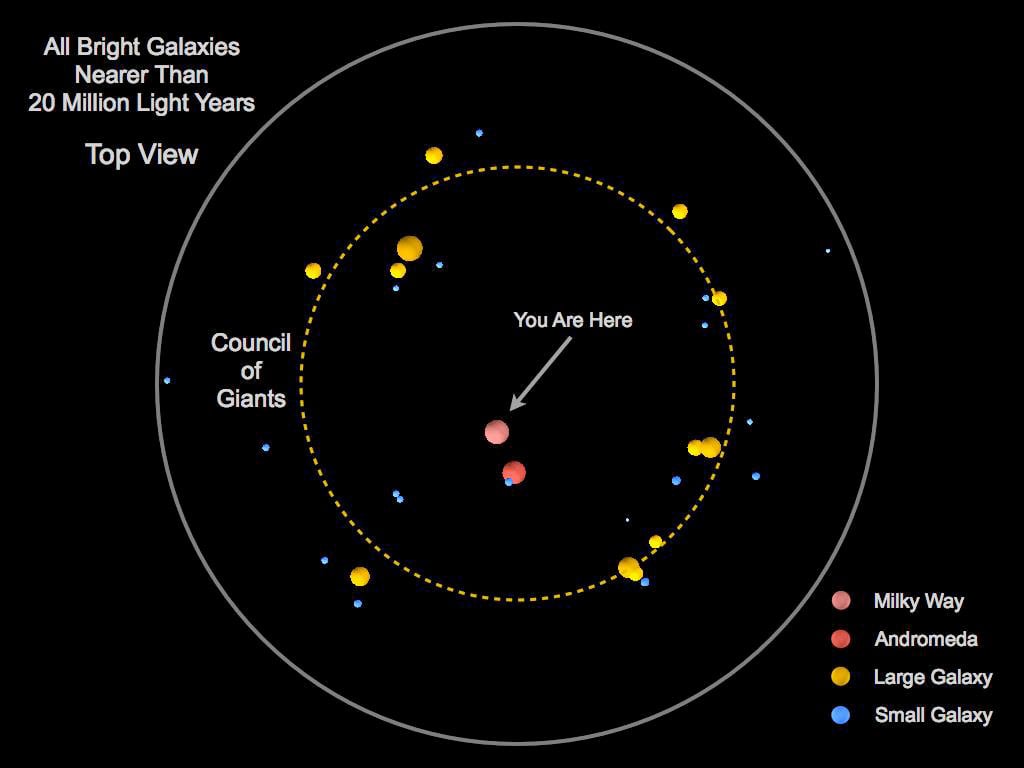
    A diagram showing the brightest galaxies within 20 million light-years of the Milky Way, as seen from above. The largest galaxies, here shown in yellow at different points around the dotted line, make up the ‘Council of Giants’. Credit: Marshall McCall / York University.

    A newly published study maps out bright galaxies within 35 million light-years of the Earth, providing an expanded view of what lies beyond Earth’s doorstep.

    We live in a galaxy known as the Milky Way – a vast conglomeration of 300 billion stars, planets whizzing around them, and clouds of gas and dust floating in between.

    Although it has long been known that the Milky Way and its orbiting companion the Andromeda Galaxy are the dominant members of a small group of galaxies called the Local Group, which is about 3 million light-years across, much less was known about our immediate neighborhood in the universe.

    A new paper by Professor Marshall McCall of York University, Canada, maps out bright galaxies within 35 million light-years of the Earth, offering up an expanded picture of what lies beyond our doorstep. The work was published in the journal Monthly Notices of the Royal Astronomical Society.

    “All bright galaxies within 20 million light years, including us, are organized in a ‘Local Sheet’ 34-million light-years across and only 1.5-million light-years thick,” says McCall. “The Milky Way and Andromeda are encircled by twelve large galaxies arranged in a ring about 24-million light-years across – this ‘Council of Giants’ stands in gravitational judgment of the Local Group by restricting its range of influence.”

    An animation that illustrates the positions of the nearby galaxies, including those in the ‘Council of Giants’, in three dimensions. Credit: Marshall McCall / York University

    McCall says twelve of the fourteen giants in the Local Sheet, including the Milky Way and Andromeda, are “spiral galaxies” which have highly flattened disks in which stars are forming. The remaining two are more puffy “elliptical galaxies”, whose stellar bulks were laid down long ago. Intriguingly, the two ellipticals sit on opposite sides of the Council. Winds expelled in the earliest phases of their development might have shepherded gas towards the Local Group, thereby helping to build the disks of the Milky Way and Andromeda.

    McCall also examined how galaxies in the Council are spinning. He comments: “Thinking of a galaxy as a screw in a piece of wood, the direction of spin can be described as the direction the screw would move (in or out) if it were turned the same way as the galaxy rotates. Unexpectedly, the spin directions of Council giants are arranged around a small circle on the sky. This unusual alignment might have been set up by gravitational torques imposed by the Milky Way and Andromeda when the universe was smaller.”

    The boundary defined by the Council has led to insights about the conditions which led to the formation of the Milky Way. Most importantly, only a very small enhancement in the density of matter in the universe appears to have been required to produce the Local Group. To arrive at such an orderly arrangement as the Local Sheet and its Council, it seems that nearby galaxies must have developed within a pre-existing sheet-like foundation comprised primarily of dark matter.

    “Recent surveys of the more distant universe have revealed that galaxies lie in sheets and filaments with large regions of empty space called voids in between,” says McCall. “The geometry is like that of a sponge. What the new map reveals is that structure akin to that seen on large scales extends down to the smallest.”

    Reference: “A Council of Giants” by Marshall L. McCall,  28 February 2014, MNRAS.
    DOI: 10.1093/mnras/stu199

    Never miss a breakthrough: Join the SciTechDaily newsletter.
    Follow us on Google and Google News.

    Astronomy Astrophysics Royal Astronomical Society York University
    Share. Facebook Twitter Pinterest LinkedIn Email Reddit

    Related Articles

    Martian Meteorite Hunters: Paving the Way for Future Rovers To Search for Meteorites on Mars

    Planetary Shields Will Buckle Under Furious Stellar Winds From Their Dying Stars – Nearly Impossible for Life To Survive

    Lucky Encounter: Solar Orbiter Spacecraft Flies Through the Tail of a Disintegrated Comet

    A Bug’s Life: Mountains on Neutron Stars May Be Only Fractions of Millimeters Tall

    Habitable Planets With Earth-Like Biospheres May Be Much Rarer Than Thought

    Mysterious Hydrogen-Free Supernova Sheds Light on Massive Stars’ Violent Death Throes

    New Research Finds That Supermassive Black Holes Could Form From Dark Matter

    Stunning “Honeycomb Heart” Revealed in Iconic Supernova Explosion Remnant

    Giant Radio Galaxies: Cosmic Beasts and Where to Find Them

    Leave A Reply Cancel Reply

    • Facebook
    • Twitter
    • Pinterest
    • YouTube

    Don't Miss a Discovery

    Subscribe for the Latest in Science & Tech!

    Trending News

    The Universe Is Expanding Too Fast and Scientists Can’t Explain Why

    “Like Liquid Metal”: Scientists Create Strange Shape-Shifting Material

    Early Warning Signals of Esophageal Cancer May Be Hiding in Plain Sight

    Common Blood Pressure Drug Shows Surprising Power Against Deadly Antibiotic-Resistant Superbug

    Scientists Uncover Dangerous Connection Between Serotonin and Heart Valve Disease

    Scientists Discover a “Protector” Protein That Could Help Reverse Hair Loss

    Bone-Strengthening Discovery Could Reverse Osteoporosis

    Scientists Uncover Hidden Trigger Behind Stem Cell Aging

    Follow SciTechDaily
    • Facebook
    • Twitter
    • YouTube
    • Pinterest
    • Newsletter
    • RSS
    SciTech News
    • Biology News
    • Chemistry News
    • Earth News
    • Health News
    • Physics News
    • Science News
    • Space News
    • Technology News
    Recent Posts
    • Scientists Overcome Major Quantum Bottleneck, Potentially Transforming Teleportation and Computing
    • Quantum Physics’ Strangest Problem May Hold the Key to Time Itself
    • Scientists Create “Liquid Gears” That Spin Without Touching
    • The Simple Habit That Could Help Prevent Cancer
    • Forgotten Medicinal Plant Shows Promise in Fighting Dangerous Superbugs
    Copyright © 1998 - 2026 SciTechDaily. All Rights Reserved.
    • Science News
    • About
    • Contact
    • Editorial Board
    • Privacy Policy
    • Terms of Use

    Type above and press Enter to search. Press Esc to cancel.