
Close Menu
    Facebook X (Twitter) Instagram
    SciTechDaily
    • Biology
    • Chemistry
    • Earth
    • Health
    • Physics
    • Science
    • Space
    • Technology
    Facebook X (Twitter) Pinterest YouTube RSS
    SciTechDaily
    Home»Physics»New Type of Topological Defect Observed in Chiral Magnets for the First Time
    Physics

    New Type of Topological Defect Observed in Chiral Magnets for the First Time

    By Nagoya UniversityJuly 11, 2021No Comments3 Mins Read
    Facebook Twitter Pinterest Telegram LinkedIn WhatsApp Email Reddit
    Share
    Facebook Twitter LinkedIn Pinterest Telegram Email Reddit
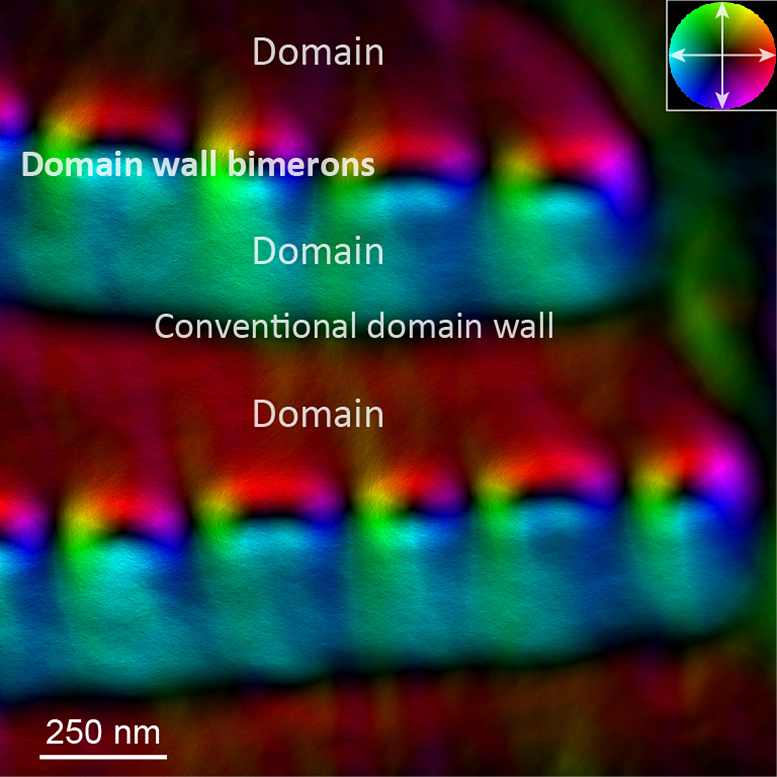
    Magnetic Flux Density Map
    Magnetic flux density (magnetization) map obtained using the transport of intensity equation analysis. Credit: Masahiro Nagao

    Scientists have observed DW bimerons in chiral magnets for the first time, confirming theoretical predictions and revealing new insights into magnetic topological defects.

    “Topological defects” are formed when the symmetry of a magnetic material is disrupted. Domain walls (DWs) are a type of topological defect that separates regions of different magnetic orientations. A widely studied phenomenon, the manipulation of these defects has potential applications in high-performance memory storage devices, energy processing devices, and quantum computing.

    Recently, the possibility of other topological defects embedded in or combined with DWs has gained attention for their potential applications in different fields of physics. Some examples of these “defects within defects” are called DW skyrmions and DW bimerons. While theoretical models have supported the existence of these defects, they have not been experimentally observed — not before now.

    In a new study published in Nature Communications, Associate Professor Masahiro Nagao from Nagoya University, Japan, and his colleagues used Lorentz transmission electron microscopy (LTEM) to visualize these defects. They were able to do so by passing electrons and observing their deflections through a thin magnetic film. The topological defects were observed as contrasting pairs of bright and dark areas. Using this technique, the team imaged topological defects in a chiral magnetic thin film made of cobalt, zinc, and manganese.

    Magnetic Field Effects Reveal New Defect Patterns

    Initially, the researchers observed a single DW defect when the film was not magnetized. On magnetizing the film by passing a magnetic field perpendicular to the film, they could observe the development of two types of DWs. The conventional DWs were seen as black lines, while chains of DW bimerons were seen as bright elliptical dots on the LTEM images. These two types of DWs appeared alternatively and in pairs. The researchers noted that these DWs increased as the strength of the magnetic field was increased and finally disappeared after a certain threshold was reached. To confirm their discovery, the researchers used the transport of intensity equation to obtain the magnetic distributions which revealed opposite magnetizations on both sides of the chain of DWs, confirming them to be DW bimerons.

    The researchers could finally propose an explanation of these defects and their mechanism of formation. As Nagao explains: “In our chiral magnet thin films, we show chained and isolated bimerons playing the role of and bound to DWs respectively, which are realized by not only in-plane magnetic anisotropy component but also the combination of Dzyaloshinskii-Moriya interaction, out-of-plane magnetic anisotropy, dipolar interaction, and Zeeman effect.”

    The team’s findings shed light on topological defects in chiral magnets and have implications in fields of physics related to topology, ranging from cosmological length scales to condensed matter.

    Reference: “Observation of domain wall bimerons in chiral magnets” by Tomoki Nagase, Yeong-Gi So, Hayata Yasui, Takafumi Ishida, Hiroyuki K. Yoshida, Yukio Tanaka, Koh Saitoh, Nobuyuki Ikarashi, Yuki Kawaguchi, Makoto Kuwahara and Masahiro Nagao, 9 June 2021, Nature Communications.
    DOI: 10.1038/s41467-021-23845-y

    Never miss a breakthrough: Join the SciTechDaily newsletter.
    Follow us on Google and Google News.

    Electromagnetics Materials Science Nagoya University Skyrmions
    Share. Facebook Twitter Pinterest LinkedIn Email Reddit

    Related Articles

    Giant Nonlinearity of UV Hybrid Light-Matter States With a Wide Bandgap Semiconductor Waveguide

    RAMBO Reveals Magnetic Phenomenon Useful for Quantum Simulation and Sensing

    Next-Gen Information Technology: The Spintronics Revolution Could Be Just a Hopfion Away

    Search for Strange Skyrmion Phenomenon Fails but Finds Stranger Magnetic Beaded Necklace

    Surprise in Solid-State Physics: Magnetic Effect Without a Magnet

    A New Class of Superconductors: Commonly Mistaken Name Leads to Discovery

    A New Kind of Magnetism Formed by “Magnetic Graphene” – Could Reveal Secrets of Superconductivity

    New Material System Developed to Convert and Generate Terahertz Waves for Tomorrow’s Technologies

    Faster and More Efficient Information Transfer Using Antiferromagnetic Rust

    Leave A Reply Cancel Reply

    • Facebook
    • Twitter
    • Pinterest
    • YouTube

    Don't Miss a Discovery

    Subscribe for the Latest in Science & Tech!

    Trending News

    Bone-Strengthening Discovery Could Reverse Osteoporosis

    Scientists Uncover Hidden Trigger Behind Stem Cell Aging

    Scientists Find Way to Reverse Fatty Liver Disease Without Changing Diet

    Could Humans Regrow Limbs? New Study Reveals Promising Genetic Pathway

    Scientists Reveal Eating Fruits and Vegetables May Increase Your Risk of Lung Cancer

    Scientists Reverse Brain Aging With Simple Nasal Spray

    Scientists Uncover Potential Brain Risks of Popular Fish Oil Supplements

    Scientists Discover a Surprising Way To Make Bread Healthier and More Nutritious

    Follow SciTechDaily
    • Facebook
    • Twitter
    • YouTube
    • Pinterest
    • Newsletter
    • RSS
    SciTech News
    • Biology News
    • Chemistry News
    • Earth News
    • Health News
    • Physics News
    • Science News
    • Space News
    • Technology News
    Recent Posts
    • Europe’s Most Active Volcano Just Got Stranger – Here’s Why Scientists Are Rethinking It
    • Why Are Giant Ants Letting Tiny Ants Crawl All Over Them?
    • Revolutionary Technique Sends Healthy Mitochondria Exactly Where They’re Needed
    • This Student Recreated the Universe in a Bottle. What She Discovered Could Help Reveal How Life Started on Earth
    • Alzheimer’s Symptoms May Start Outside the Brain, Study Finds
    Copyright © 1998 - 2026 SciTechDaily. All Rights Reserved.
    • Science News
    • About
    • Contact
    • Editorial Board
    • Privacy Policy
    • Terms of Use

    Type above and press Enter to search. Press Esc to cancel.