

FEL X-ray pulses captured the rapid reshaping and fragmentation of C60 molecules exposed to increasingly strong laser fields.
The results expose gaps in current theoretical models and point toward new pathways for controlling molecular behavior with light.
Revealing Many-Body Molecular Dynamics With Intense X-Ray Pulses
A clear grasp of how many interacting particles behave inside laser-driven polyatomic molecules is essential for any effort to guide chemical reactions using intense light fields. Recent advances make this possible in new ways, as ultrashort and powerful X-ray pulses produced by accelerator-based free electron lasers (FELs) allow researchers to directly observe how strong laser fields reshape molecules.
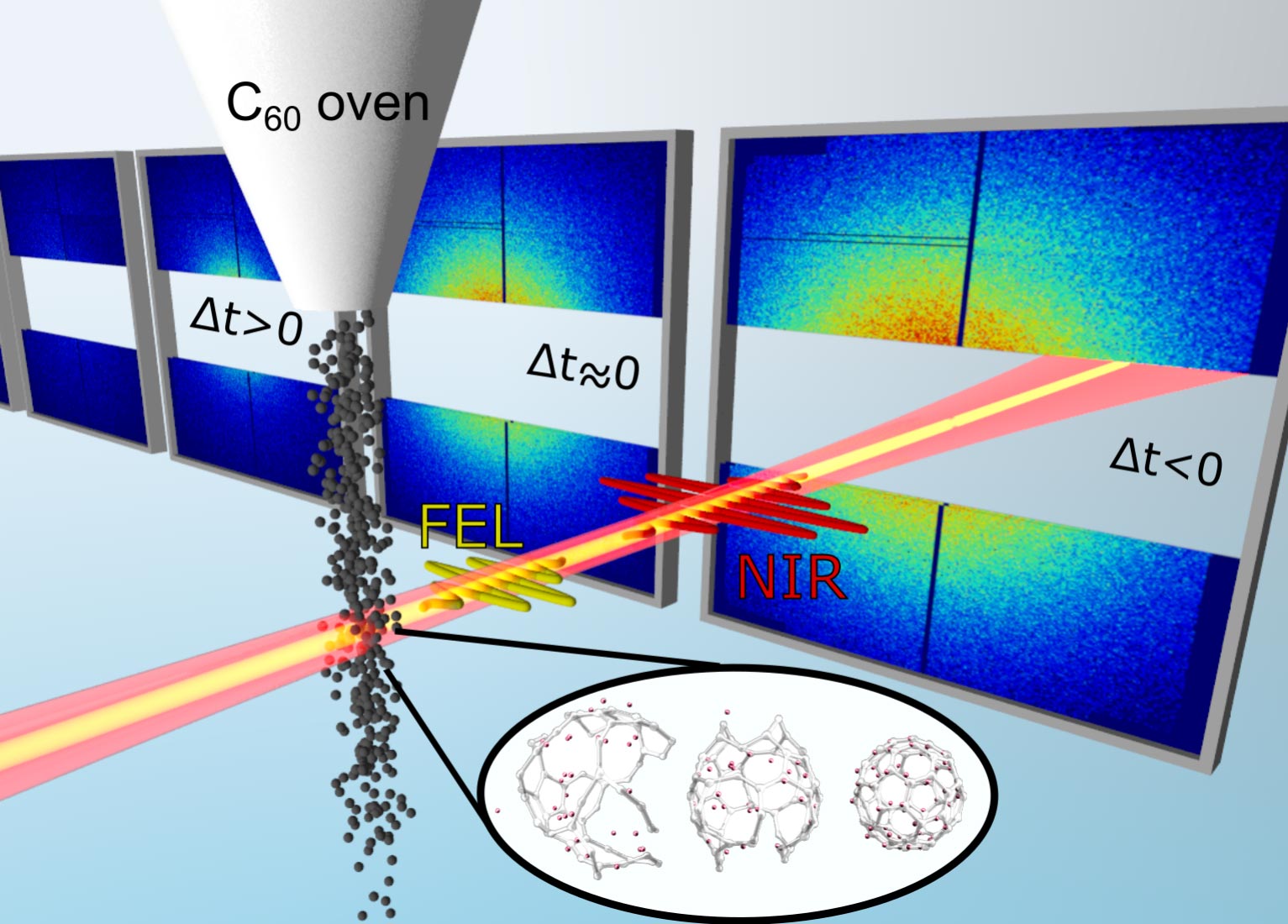
The well-known “Buckminsterfullerene” C60, often compared to a tiny football, served as the test case for this work. Teams from the Max Planck Institute for Nuclear Physics (MPIK) in Heidelberg and the Max Planck Institute for the Physics of Complex Systems (MPI-PKS) in Dresden joined forces with colleagues at the Max Born Institute (MBI) in Berlin and collaborators in Switzerland, the USA and Japan. Their experiment at the Linac Coherent Light Source (LCLS) at the SLAC National Accelerator Laboratory provided the first direct images of how C60 responds to strong laser fields.
Extracting Radius and Fragmentation Data From X-Ray Scattering
To understand the molecular response, the researchers analyzed the X-ray diffraction pattern produced as the molecule interacted with a strong infrared (IR) laser pulse. From this pattern, they determined two key quantities: the (average) radius R of the molecule and the Guinier amplitude A. The Guinier amplitude reflects the overall strength of the X-ray scattering signal and scales with N2, the squared (effective) number of atoms that contribute as scattering centers. While R tracks how much the molecule and its fragments expand or deform, A provides insight into how the molecule breaks apart, especially the size distribution of its fragments.
Tracking Expansion, Deformation, and Fragmentation Across Laser Intensities
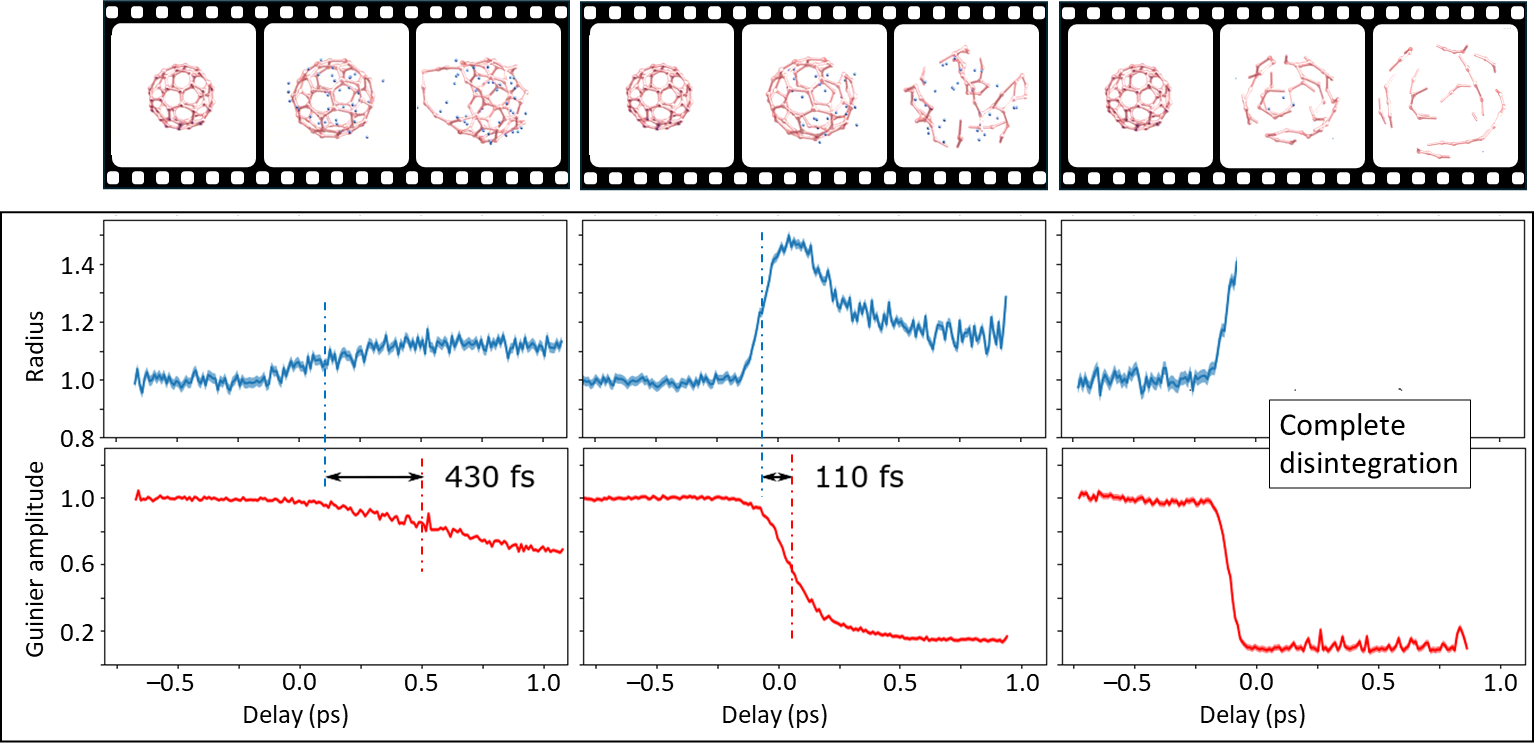
Figure 2 highlights results across three intensity ranges described as “low” (1×10¹⁴ W/cm2), “intermediate” (2×10¹⁴ W/cm2) and “high” (8×10¹⁴ W/cm2). The values of R and A are shown relative to those at negative delays, a condition in which the X-ray pulse reaches the molecule before the IR pulse and captures an intact C60. Movies generated from MPI-PKS model calculations illustrate how the molecule evolves over time at each intensity level, showing expansion, deformation and fragmentation. Electrons freed and propelled by the laser field appear as small blue spheres in these visualizations, with sample still images displayed in the upper portion of Figure 2.
Fragmentation Patterns at Low and Intermediate Laser Strengths
At low laser intensities, the molecule first grows larger before fragmenting, a process signaled by a delayed and moderate decline in the Guinier amplitude. Under intermediate intensities, the initial expansion is soon followed by a reduction in the radius observed via X-ray imaging. This reduction points to scattering from smaller fragments and agrees with a slightly delayed decrease in the Guinier amplitude, which shows that many molecules have already broken into pieces.
Violent High-Intensity Laser Kicks and Rapid Electron Removal
At the highest intensity, the molecule undergoes rapid expansion accompanied by an immediate and sharp drop in Guinier amplitude beginning at the front of the strong laser pulse. Nearly all outer valence (binding) electrons are stripped away in this brief moment. Model calculations reproduce this effect and confirm the abrupt nature of the intense laser “kick.”
Model Discrepancies Reveal Ultrafast Heating Effects
However, at low and intermediate intensities there is only some qualitative agreement with the experiment. In particular, the model predicts an oscillatory behavior both in the radius and the amplitude caused by a periodic “breathing” of the molecule (see movies), which is completely absent in the observed data. Implementing an additional ultrafast heating mechanism acting on the atomic positions in the molecule led a better agreement with the experiment, showing that more work, experimentally as well as theoretically, is necessary to better understand, and finally steer, intense-laser interactions with matter.
Toward Controlling Chemical Reactions With Laser Fields
Multi-electron dynamics driven by intense laser fields still poses a challenge for the theoretical description as a full quantum mechanical treatment is currently out of reach. Thus, X-ray movies of structural dynamics as this one in C60 are an ideal testbed for the understanding of fundamental quantum processes in molecular systems of increasing size and complexity, illuminating our path towards the control of chemical reactions with laser fields.
Reference: “Visualizing the strong field–induced molecular breakup of C60 via x-ray diffraction” by Kirsten Schnorr, Sven Augustin, Ulf Saalmann, Georg Schmid, Arnaud Rouzée, Razib Obaid, Andre AlHaddad, Nora Berrah, Cosmin I. Blaga, Christoph Bostedt, Manuel Cardosa-Gutierrez, Gabriella Carini, Ryan Coffee, Louis F. DiMauro, Philip Hart, Yuta Ito, Katharina Kubicek, Yoshiaki Kumagai, Jochen Küpper, Yu Hang Lai, Hannes Lindenblatt, Ruth A. Livingstone, Severin Meister, Robert Moshammer, Koji Motomura, Thomas Möller, Kaz Nakahara, Timur Osipov, Gaurav Pandey, Dipanwita Ray, Francoise Remacle, Daniel Rolles, Jan Michael Rost, Ilme Schlichting, Rüdiger Schmidt, Simone Techert, Florian Trost, Kiyoshi Ueda, Joachim Ullrich, Marc J.J. Vrakking, Julian Zimmermann, Claus Peter Schulz and Thomas Pfeifer, 21 November 2025, Science Advances.
DOI: 10.1126/sciadv.adz1900
Never miss a breakthrough: Join the SciTechDaily newsletter.
Follow us on Google and Google News.
2 Comments
thanks for this
Multi-electron dynamics driven by intense laser fields still poses a challenge for the theoretical description as a full quantum mechanical treatment is currently out of reach. WHY? WHY? WHY?
The Topological Vortex Theory (TVT) predicts the existence of spacetime vortices in the universe, and has been validated and applied in multiple fields:
1. Climate Change Research: Studies based on TVT have analyzed paleoclimate data and fluid dynamics simulations, verifying the influence of the axial tilt coupling effect of cosmic-scale vortex networks on Earth’s energy redistribution. This provides a new explanation for climate phenomena that cannot be explained by traditional Earth-Sun distance theories.
2. Antimatter Research: The theory offers a new perspective on understanding antimatter, suggesting that the distinction between matter and antimatter has strict topological origins. It also questions whether the “antiparticles” observed in existing experiments are the strict antimatter counterparts of their corresponding particles.
3. Artificial Intelligence (AI): TVT has been applied to simulate the abrupt, leap-like characteristics of human thought. By abstracting the activation patterns of neuronal clusters as a topological phase transition process in a spacetime vortex network, it provides a theoretical framework for developing AI systems with human-like cognitive abilities.
Although vortex rings are extremely simple, their interactions are exceptionally complex. Physics needs to develop more and richer mathematical languages to understand and describe them. Multi-electron dynamics and quantum mechanical treatments are just the tip of the iceberg of these vortex ring interactions.
The key difference between TVT and traditional physics (e.g., Newtonian mechanics, relativity, quantum mechanics) lies in its perspective on describing the universe. TVT emphasizes the ideal fluid properties and topological structure of space, rather than focusing solely on the direct interactions of particles and forces. This perspective offers a new paradigm for understanding the structure of the universe. Its core predictions (e.g., cosmic-scale vortex networks) have been confirmed across multiple disciplines. For example:
Topological structures, such as vortices, are prevalent in nature and science across a wide range of length scales, ranging from macroscopic cosmic strings (1), mesoscale liquid crystals (2, 3) and ferromagnets (4), nanoscale ferroelectrics and superconductor/superfluid Bose-Einstein condensate states (5, 6), down to the atomic nucleus (7).
——Excerpted from https://www.science.org/doi/10.1126/sciadv.adu6223.