
Close Menu
    Facebook X (Twitter) Instagram
    SciTechDaily
    • Biology
    • Chemistry
    • Earth
    • Health
    • Physics
    • Science
    • Space
    • Technology
    Facebook X (Twitter) Pinterest YouTube RSS
    SciTechDaily
    Home»Physics»Topological Quantum States in Graphene Created by Laser Pulses
    Physics

    Topological Quantum States in Graphene Created by Laser Pulses

    By Max Planck Institute for the Structure and Dynamics of MatterNovember 9, 2019No Comments3 Mins Read
    Facebook Twitter Pinterest Telegram LinkedIn WhatsApp Email Reddit
    Share
    Facebook Twitter LinkedIn Pinterest Telegram Email Reddit
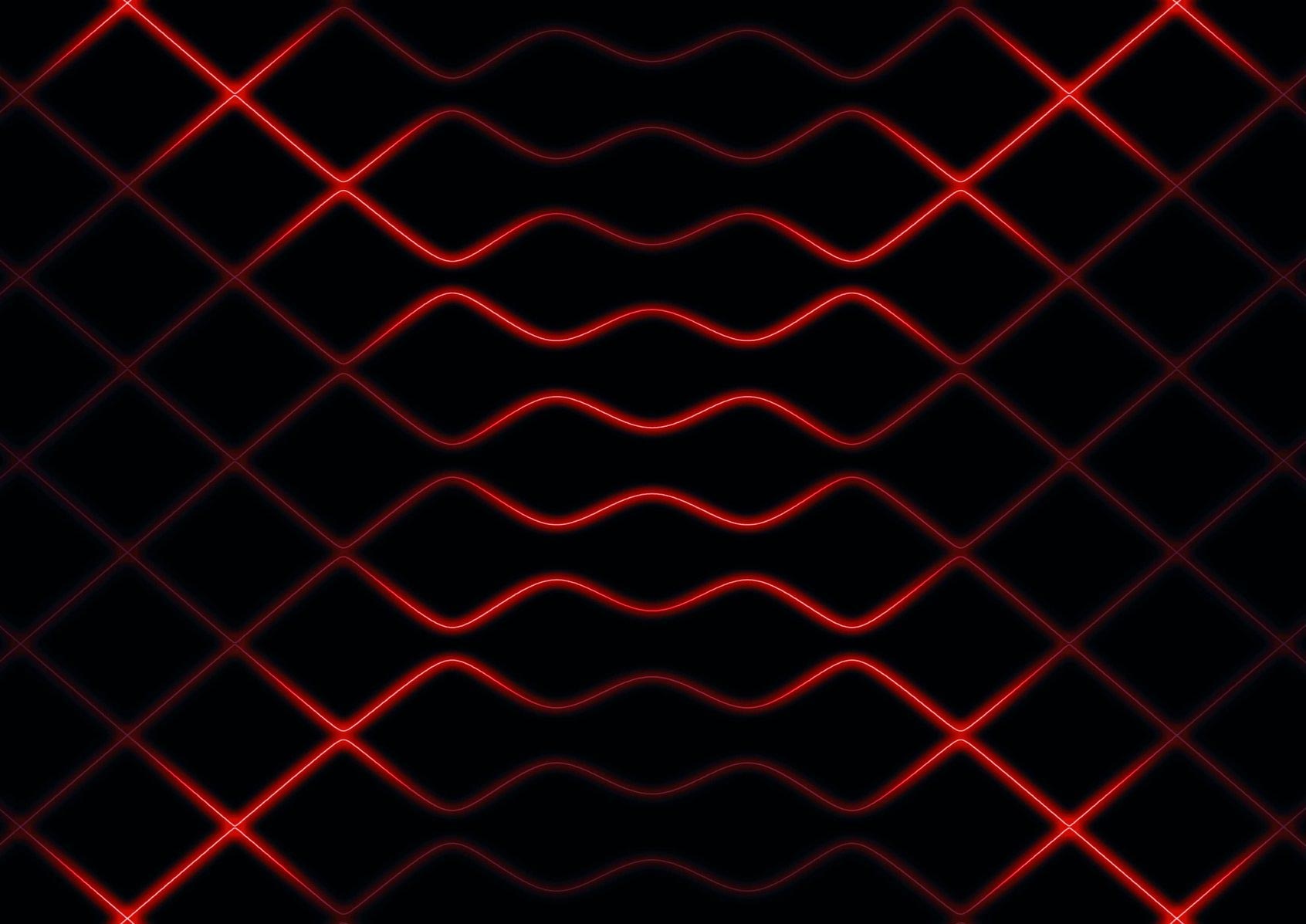
    Topological Quantum States Graphene
    Topological quantum states in graphene induced by light. Credit: © Benedikt Schulte

    Discovering ways to control the topological aspects of quantum materials is an important research frontier because it can lead to desirable electrical and spin transport properties for future device technologies. Now Max Planck Institute for the Structure and Dynamics of Matter (MPSD) scientists have discovered a pioneering laser-driven approach to generate a topological state in graphene. Their work has just been published in Nature Physics.

    In topological materials, electrons experience a twisted world. Instead of simply moving straight ahead when feeling a force, they may be pushed sideways. In such a material current actually flows orthogonally to an applied voltage.

    The basic model describing the effect was developed by Duncan Haldane in the late 1980s, but even its inventor was skeptical that it could ever be implemented in a real material. Nevertheless, elaborate chemical synthesis eventually allowed for very similar effects to be observed, sparking a technological revolution — and eventually earning Haldane the 2016 Nobel Prize in Physics.

    Topological transport is usually induced in materials by applying strong magnetic fields or by crafting compounds with strong spin-orbit coupling. Researchers in Andrea Cavalleri’s group at the MPSD have now demonstrated that a coherent interaction with circularly polarized light can also induce topological electrical currents in the material graphene.

    The team’s radically different approach consists of illuminating graphene with a strong, circularly polarized laser pulse, whose electric field drives electrons in loops. When the material is illuminated, it suddenly behaves like a topological material. It returns to its normal state once the pulse is gone.

    Whilst this mechanism had been tested in simulations, it was entirely unclear whether it would work in the more complicated context of real solids – and whether it would be possible to detect it.

    To prove their discovery, the physicists had to show currents flowing in a direction orthogonal to an applied voltage. However, there was a major challenge: “As the effect persists only for about a millionth of a millionth of a second, we had to develop a novel type of electronic circuit to measure this,” says lead author James McIver.

    The result was an ultrafast optoelectronic device architecture based on photoconductive switches. It confirmed the existence of the effect. Moving forward, the researchers plan to use this circuitry to study a variety of compelling problems in quantum materials, such as light-induced superconductivity and photon-dressed topological edge states.

    “This work shows that light is capable of engineering topological properties in topologically trivial materials”, says co-author Gregor Jotzu. “The ultrafast appearance of this effect holds great potential for the construction of extremely fast sensors or computers.”

    Reference: “Light-induced anomalous Hall effect in graphene” by J. W. McIver, B. Schulte, F.-U. Stein, T. Matsuyama, G. Jotzu, G. Meier and A. Cavalleri, 4 November 2019, Nature Physics.
    DOI: 10.1038/s41567-019-0698-y

    Never miss a breakthrough: Join the SciTechDaily newsletter.
    Follow us on Google and Google News.

    Graphene Lasers Max Planck Institute Quantum Mechanics
    Share. Facebook Twitter Pinterest LinkedIn Email Reddit

    Related Articles

    Stronger and Faster Than Lightning: Scientists Achieve Rare Quantum State in Polycrystals

    Graphene and an Intense Laser Open the Door to Extreme Energetic Ion Acceleration

    Tuning the Bonds of Paired Quantum Particles To Create Flow Without Losing Energy

    Integrated Photonics Meets Electron Microscopy in Unconventional Collaboration

    Quantum Computing Breakthrough: Exotic Quantum Particles – Less Magnetic Field Required

    New Concept Improves Gravitational Wave Detectors

    Atomic Collapse State Observed on Graphene

    Simulating Quantum Walks in Two Dimensions

    Dynamics of a System of Ultracold Potassium Atoms

    Leave A Reply Cancel Reply

    • Facebook
    • Twitter
    • Pinterest
    • YouTube

    Don't Miss a Discovery

    Subscribe for the Latest in Science & Tech!

    Trending News

    Bone-Strengthening Discovery Could Reverse Osteoporosis

    Scientists Uncover Hidden Trigger Behind Stem Cell Aging

    Scientists Find Way to Reverse Fatty Liver Disease Without Changing Diet

    Could Humans Regrow Limbs? New Study Reveals Promising Genetic Pathway

    Scientists Reveal Eating Fruits and Vegetables May Increase Your Risk of Lung Cancer

    Scientists Reverse Brain Aging With Simple Nasal Spray

    Scientists Uncover Potential Brain Risks of Popular Fish Oil Supplements

    Scientists Discover a Surprising Way To Make Bread Healthier and More Nutritious

    Follow SciTechDaily
    • Facebook
    • Twitter
    • YouTube
    • Pinterest
    • Newsletter
    • RSS
    SciTech News
    • Biology News
    • Chemistry News
    • Earth News
    • Health News
    • Physics News
    • Science News
    • Space News
    • Technology News
    Recent Posts
    • What Makes Rubber So Strong? Scientists Finally Solve 100-Year-Old Mystery
    • Scientists Decode Mysterious Magnetic “Maze Domains” To Boost EV Efficiency
    • Scientists Say This Fungus Could Survive the Trip to Mars
    • The Universe Is Expanding Too Fast and Scientists Can’t Explain Why
    • Gaining Weight Young May Be More Dangerous Than You Think
    Copyright © 1998 - 2026 SciTechDaily. All Rights Reserved.
    • Science News
    • About
    • Contact
    • Editorial Board
    • Privacy Policy
    • Terms of Use

    Type above and press Enter to search. Press Esc to cancel.