
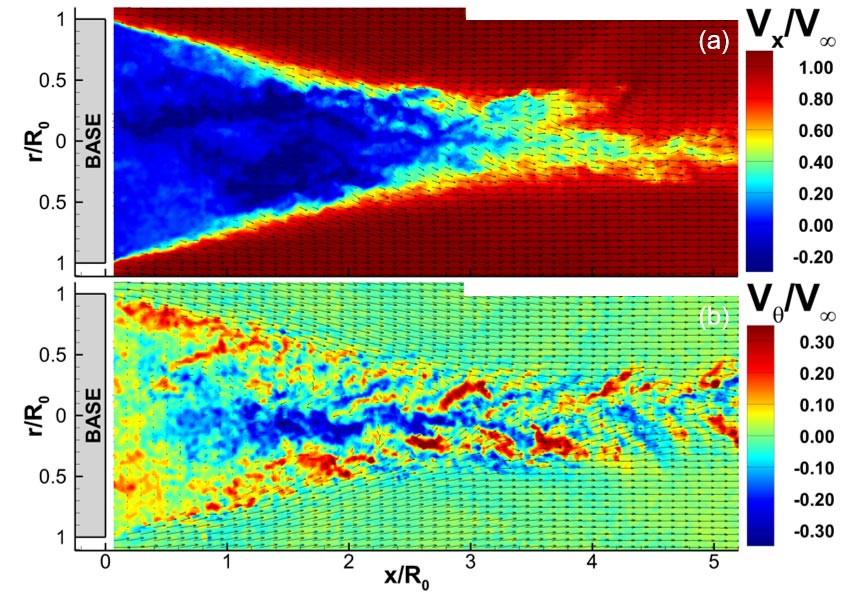
Imaging technology has vastly improved over the past 30 years. It’s been about that long since the flow coming off of the base of projectiles, such as ballistic missiles, has been measured. Researchers in the Department of Aerospace Engineering at the University of Illinois at Urbana-Champaign used a modern measurement technique called stereoscopic particle image velocimetry to take high-resolution measurements of the complicated flow field downstream of a blunt-based cylinder moving at supersonic speeds, which is representative of a projectile or an unpowered rocket.
The experiment was done in a Mach 2.5 wind tunnel in the Gas Dynamics Laboratory in The Grainger College of Engineering at Illinois. Researchers mounted a large cylinder model and forced a high-pressure air supply mixed with a large amount of smoke particles across it.
“We shine a laser at the smoke particles to illuminate a desired region and then we can take a picture of those particles from multiple angles. Imaging the same region from different perspectives simultaneously allows us to measure all three components of velocity” said doctoral student Branden Kirchner. “The images are taken 600 nanoseconds apart at high resolution.
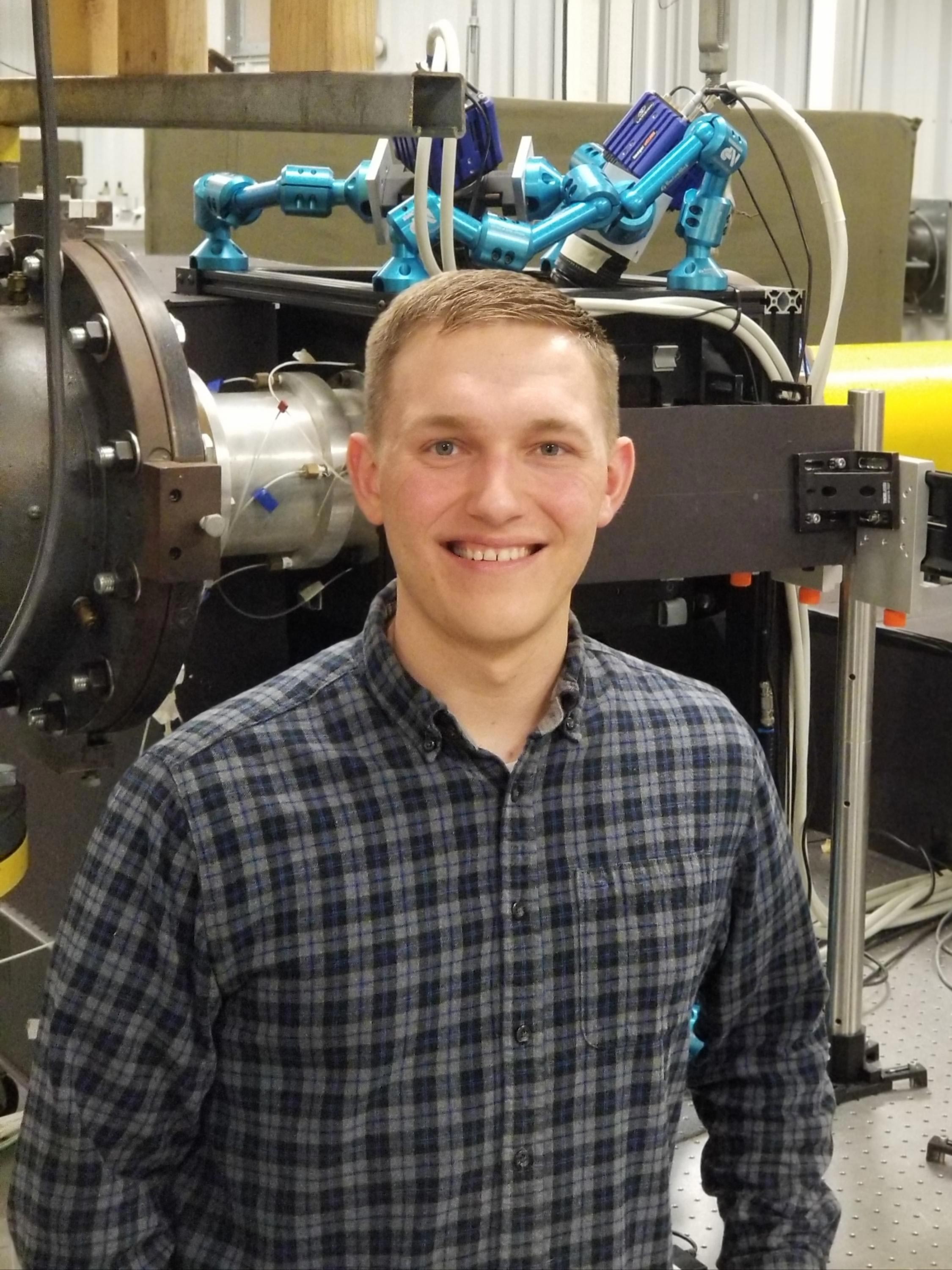
“This technique allows us to simultaneously measure velocity at a lot of points very close together, instead of measuring one point and then moving on to the next. We now have a map of velocity throughout the flow field as a snapshot in time.”
Kirchner said the 3,000 snapshots imaged by four cameras aimed at the flow provide much higher spatial resolution measurements than any previous studies. He said computationalists who study this flow will benefit from having these new data to compare with their simulations.
Illinois aerospace engineering Professor J. Craig Dutton, the co-author on the study, has been working on this complicated flow for decades, using the same wind tunnel while working on his Ph.D. Kirchner said, “I remember the first time we took data using this technique, I showed Professor Dutton and he said ‘in 90 seconds you took more data than we used to take in six months.’”
When the flow separates off of the cylinder, it creates a wake, like what trails from a boat or an airplane. That’s where the important flow features begin, downstream of the cylinder, which represents the body of a rocket or projectile.
“There’s a thin layer just downstream of separation, called the shear layer, where friction between slow-moving and fast-moving air is really dominant,” he said. “This shear layer extracts fluid particles from the region immediately behind the cylinder base, in a process called entrainment. This process causes really low pressures on the base of the cylinder, and it is something that we don’t currently understand well.
Kirchner said the example he likes to use to explain the physics of what’s happening in the flow is the drafting technique some people use to get better gas mileage on a highway. They drive their car at a certain distance behind a semi-truck to get better fuel economy.
“The pressure right behind the semi-truck is really low, so if you can get the front end of your car in the low-pressure zone and the back end in a high-pressure zone, you actually get thrust out of it, but the aerodynamic drag on the semi-truck is very high because of this low-pressure zone,” Kirchner said.
Having a better understanding of how the flow actually creates this low-pressure region could give other researchers the knowledge they need to come up with a way to change the pressure.
“We’re not changing anything along the cylinder body or the front of the cylinder in this study,” he said. “But if we know what mechanisms could cause a change in the pressure distribution on the base and develop a method to raise that pressure, we can decrease the drag or have better vehicle directional control.”
Reference: “Three-Component Turbulence Measurements and Analysis of a Supersonic, Axisymmetric Base Flow” by Branden M. Kirchner, James V. Favale, Gregory S. Elliott, and J. Craig Dutton, 29 April 2019, AIAA Journal.
DOI: 10.2514/1.J057859
This research was supported by grants from the U.S. Army Research Office and a fellowship from the Air Force Research Laboratory.
Never miss a breakthrough: Join the SciTechDaily newsletter.
Follow us on Google and Google News.