
Close Menu
    Facebook X (Twitter) Instagram
    SciTechDaily
    • Biology
    • Chemistry
    • Earth
    • Health
    • Physics
    • Science
    • Space
    • Technology
    Facebook X (Twitter) Pinterest YouTube RSS
    SciTechDaily
    Home»Space»Space Warping Creates Stunning Kaleidoscope View of Distant Galaxy
    Space

    Space Warping Creates Stunning Kaleidoscope View of Distant Galaxy

    By Space Telescope Science InstituteNovember 9, 2019No Comments3 Mins Read
    Facebook Twitter Pinterest Telegram LinkedIn WhatsApp Email Reddit
    Share
    Facebook Twitter LinkedIn Pinterest Telegram Email Reddit
    Sunburst Arc Galaxy
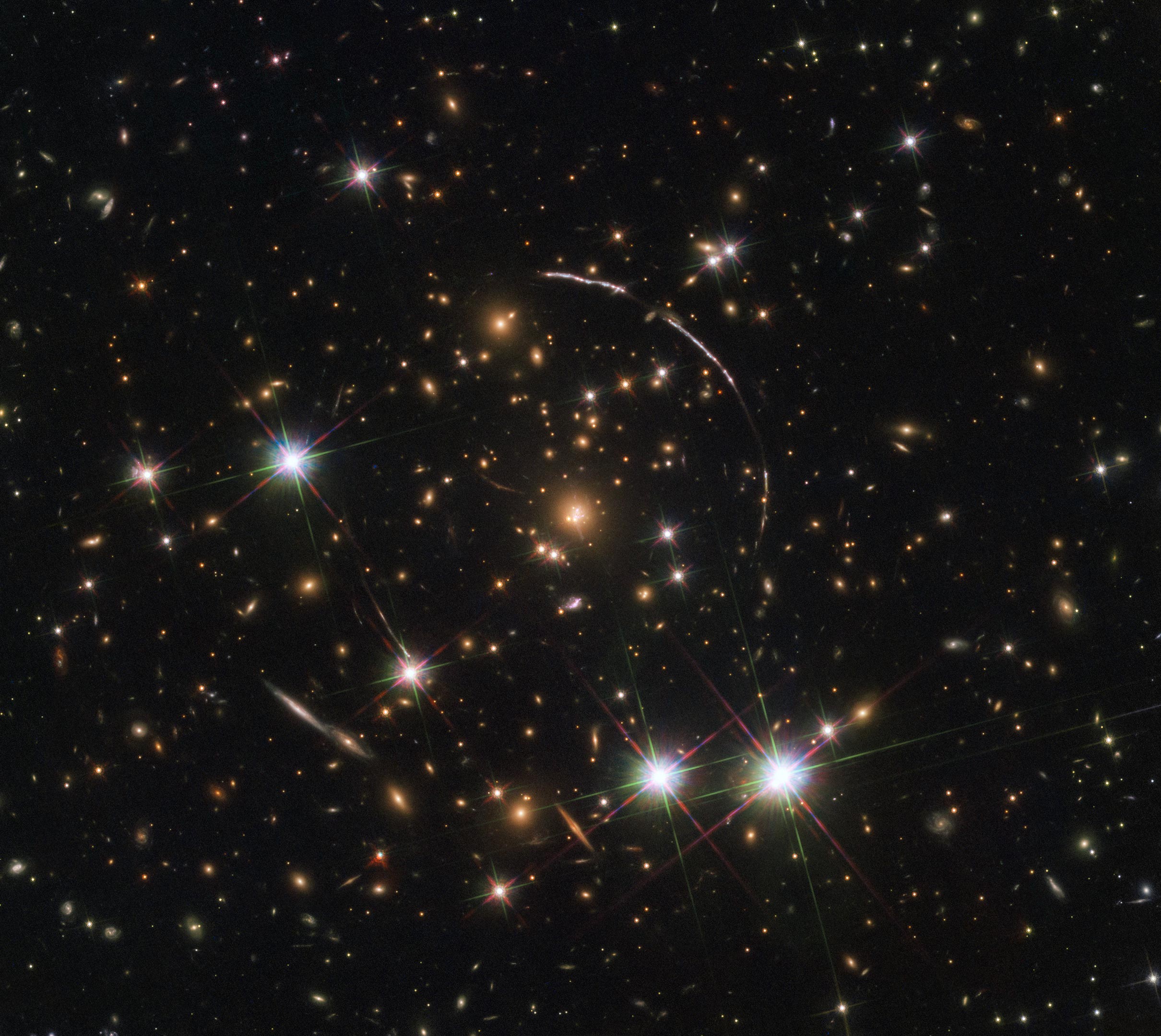
    This image, taken with the NASA/ESA Hubble Space Telescope, shows a massive galaxy cluster, about 4.6 billion light-years away. Along its borders four bright arcs are visible; these are copies of the same distant galaxy, nicknamed the Sunburst Arc.
    The Sunburst Arc galaxy is almost 11 billion light-years away and the light from it is being lensed into multiple images by gravitational lensing. The Sunburst Arc is among the brightest lensed galaxies known and its image is visible at least 12 times within the four arcs.
    Three arcs are visible in the top right of the image, and the fourth arc is in the lower left. The last one is partially obscured by a bright foreground star, which is located in the Milky Way. Credit: ESA/Hubble, NASA, Rivera-Thorsen et al.

    NASA’s Hubble Captures a Dozen Galaxy Doppelgangers

    The “funhouse mirror” has delighted carnival-goers for more than a century by twisting peoples’ images into wildly distorted shapes. Its prolific inventor, Charles Frances Ritchel, called it the “Ritchel’s Laugh-O-Graphs.” However, there was nothing funny – but instead practical – about warped images as far as Albert Einstein was concerned. In developing his general theory of relativity, Einstein imagined the universe as a grand funhouse mirror caused by wrinkles in the very fabric of space.

    This recent picture from Hubble shows a galaxy nicknamed the “Sunburst Arc” that has been split into a kaleidoscope illusion of no fewer than 12 images formed by a massive foreground cluster of galaxies 4.6 billion light-years away.

    This beautifully demonstrates Einstein’s prediction that gravity from massive objects in space should bend light in a manner analogous to a funhouse mirror. His idea of space warping was at last proven in 1919 by observations of a solar eclipse where the sun’s bending of space could be measured. A further prediction was that the warping would create a so-called “gravitational lens” that, besides distortion, would increase the apparent size and brightness of distant background objects.

    It wasn’t until 1979 that the first such gravitational lens was confirmed. An otherwise obscure galaxy split and amplified the light of a distant quasar located far behind it into a pair of images. Far more than a space-carnival novelty, gravitational lensing observations today are commonly used to find planets around other stars, zoom in on very distant galaxies, and map the distribution of otherwise invisible “dark matter” in the universe.

    For more on this image, along with related pictures and videos, read Sunburst Arc Doppelgangers Captured in Distant Region of the Universe.

    Never miss a breakthrough: Join the SciTechDaily newsletter.
    Follow us on Google and Google News.

    Astronomy Hubble Space Telescope NASA
    Share. Facebook Twitter Pinterest LinkedIn Email Reddit

    Related Articles

    Hubble Reveals a Star Disk Three Times Hotter Than the Sun’s Surface

    A Star’s Unexpected Heatwave: FU Orionis Challenges Astrophysics Models

    NASA’s Hubble Reveals How the LMC Defied Galactic Destruction

    Legendary Star’s Smooth Disk Mystifies Astronomers, Challenges Planet Formation Theories

    Cosmic Horror Unveiled: NASA Reveals “Blood-Soaked Eyes” Staring From Deep Space [Video]

    Spanning 248 Billion Miles: Stunning Hubble Timelapse Captures a Star’s Violent Eruptions

    Jupiter’s Great Red Spot Enigma: Unexplained Oscillations Baffle Astronomers

    Unlocking Uranus: NASA’s Dual Observations Pave the Way to Discovering New Worlds

    Astronomers Baffled by Black Hole Jets Igniting Star Explosions

    Leave A Reply Cancel Reply

    • Facebook
    • Twitter
    • Pinterest
    • YouTube

    Don't Miss a Discovery

    Subscribe for the Latest in Science & Tech!

    Trending News

    First-of-Its-Kind Discovery: Homer’s Iliad Found Embedded in a 1,600-Year-Old Egyptian Mummy

    Beyond Inflammation: Scientists Uncover New Cause of Persistent Rheumatoid Arthritis

    A Simple Molecule Could Unlock Safer, Easier Weight Loss

    Scientists Just Built a Quantum Battery That Charges Almost Instantly

    Researchers Unveil Groundbreaking Sustainable Solution to Vitamin B12 Deficiency

    Millions of People Have Osteopenia Without Realizing It – Here’s What You Need To Know

    Researchers Discover Boosting a Single Protein Helps the Brain Fight Alzheimer’s

    World-First Study Reveals Human Hearts Can Regenerate After a Heart Attack

    Follow SciTechDaily
    • Facebook
    • Twitter
    • YouTube
    • Pinterest
    • Newsletter
    • RSS
    SciTech News
    • Biology News
    • Chemistry News
    • Earth News
    • Health News
    • Physics News
    • Science News
    • Space News
    • Technology News
    Recent Posts
    • Scientists Flip Immune System “Switch,” Uncover Surprising Path To Stop Gut Inflammation
    • Magnesium Magic: New Drug Melts Fat Even on a High-Fat, High-Sugar Diet
    • Weight-Loss Drugs Like Ozempic May Come With an Unexpected Cost
    • After Decades, MIT Researchers Capture the First 3D Atomic View of a Mysterious Material
    • Your Favorite Fishing Spot Is Turning Brown – and the Fish Are Changing
    Copyright © 1998 - 2026 SciTechDaily. All Rights Reserved.
    • Science News
    • About
    • Contact
    • Editorial Board
    • Privacy Policy
    • Terms of Use

    Type above and press Enter to search. Press Esc to cancel.