
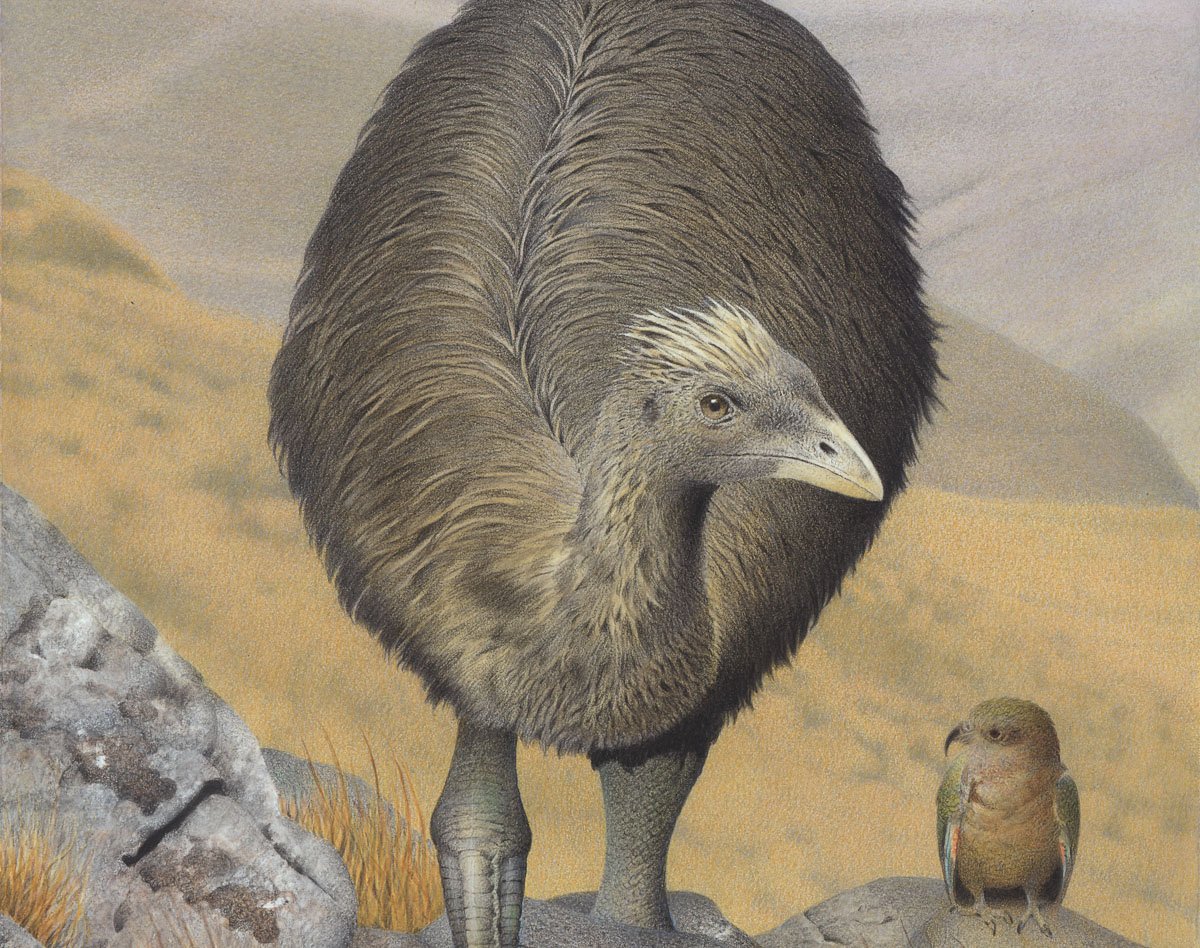
Research indicates that New Zealand’s endangered flightless birds inhabit regions once populated by extinct moa, emphasizing the conservation value of these minimally human-impacted areas and introducing a new method for studying island extinctions.
Researchers have discovered that New Zealand’s endangered flightless birds are taking refuge in the same areas where six species of moa were last found before their extinction.
An international team of researchers, led by scientists from the University of Adelaide, used fossils and computer modeling to make the discovery, shedding light on a mystery with important conservation benefits.
“Our research overcame past logistical challenges to trace the population dynamics of six species of moa at resolutions not considered possible before,” said senior author Associate Professor Damien Fordham, from the University of Adelaide’s Environment Institute.
“We did this by combining sophisticated computational models with extensive fossil records, paleoclimate information, and innovative reconstructions of colonization and expansion of people across New Zealand.
“Our research shows that despite large differences in the ecology, demography, and timing of extinction of moa species, their distributions collapsed and converged on the same areas on New Zealand’s North and South Islands.”
This recent discovery, published in Nature Ecology & Evolution, found these moa graveyards to be in the same isolated, cold, mountainous environments that today harbor many of the last populations of New Zealand’s most threatened flightless birds. These include Mount Aspiring on the South Island, and the Ruahine Range on the North Island.
Moa’s Last Refuges and Modern Flightless Birds
“Populations of moa are likely to have disappeared first from the highest quality lowland habitats that Polynesian colonists preferred, with rates of population declines decreasing with elevation and distance traveled inland,” said lead author Dr. Sean Tomlinson, from the University of Adelaide.
“By pinpointing the last populations of moa and comparing them with distributions of New Zealand’s living flightless birds, we found that these last havens shelter many of today’s persisting populations of takahē, weak, and great spotted kiwi”.
“What’s more, these ancient refugia for moa overlap with the last mainland populations of the critically threatened kākāpō”.
Although recent drivers of the decline of New Zealand’s native flightless birds are different from those that caused the ancient extinctions of moa, this research shows that their spatial dynamics remain similar.
“The key commonality among past and current refugia is not that they are optimal habitats for flightless birds, but that they continue to be the last and least impacted by humanity,” said author Dr Jamie Wood, also from the University of Adelaide’s Environment Institute.
Like earlier waves of Polynesian expansion, habitat conversion by Europeans across New Zealand, and the spread of the animals they brought, was directional, progressing from lowland sites to the less hospitable, cold, mountainous regions.”
This new research shows that the ghosts of species past can provide invaluable insights for conservation efforts directed at New Zealand’s living flightless birds, highlighting the immense importance of protecting remote, wild places.
It also provides an important new method for understanding past extinctions on islands where fossil and archaeological data are limited, which is the case for most Pacific Islands.
Reference: “Ecological dynamics of moa extinctions reveal convergent refugia that today harbour flightless birds” by Sean Tomlinson, Mark V. Lomolino, Jamie R. Wood, Atholl Anderson, Stuart C. Brown, Sean Haythorne, George L. W. Perry, Janet M. Wilmshurst, Jeremy J. Austin and Damien A. Fordham, 24 July 2024, Nature Ecology & Evolution.
DOI: 10.1038/s41559-024-02449-x
The study was funded by the Australian Research Council.
Never miss a breakthrough: Join the SciTechDaily newsletter.
Follow us on Google and Google News.