
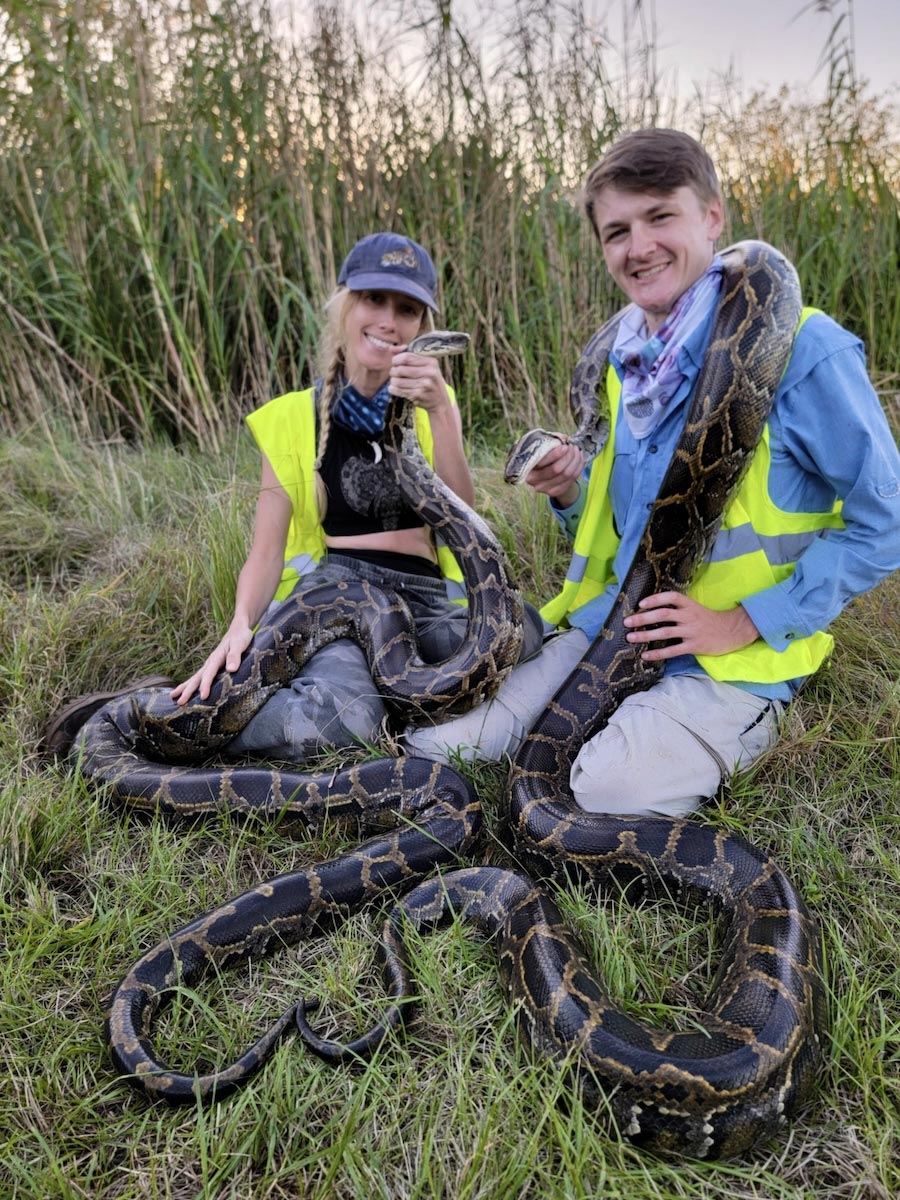
A UF study analyzed python removal data, identifying optimal survey conditions and key locations for increased removals. Researchers recommend targeting the wet season, surveying at night, and using aquatic vehicles.
A groundbreaking study by University of Florida scientists used statistical analysis of extensive data from Burmese python contractors to identify the most effective strategies for removing the invasive reptiles.
The researchers applied statistical modeling to examine how various survey conditions influenced python removals. They analyzed factors such as time of day and temperature to determine their impact on successful captures. Additionally, they assessed whether the most frequently surveyed areas corresponded with the highest python removal rates. Their findings revealed regions where a small number of contractors were capturing a disproportionately high number of pythons, suggesting that deploying more contractors in these areas could significantly increase removal efficiency.
“This collaboration among the UF Institute of Food and Agricultural Sciences (IFAS), South Florida Water Management District (SFWMD), and the contractors increases our ability to detect and remove pythons by providing guidelines for when and where to survey to optimize your chances of finding a python,” said Melissa Miller, an invasion ecologist at UF/IFAS Fort Lauderdale Research and Education Center. “Targeted surveys, guided by these data, can allow us to be more efficient and successful in our efforts to control Burmese pythons.”

These data were collected as part of the SFWMD Python Elimination Program between May 2020 and April 2022. The researchers from UF/IFAS analyzed 4,092 surveys from python contractors totaling over 16,000 hours of effort.
Key Areas Identified for Increased Python Removal
Researchers identified two regions where python removals could likely be increased with more surveys. These regions occurred toward the western edge of Big Cypress National Preserve along the Tamiami Trail and a stormwater treatment area in Palm Beach County. Additionally, researchers identified optimal conditions that improve survey outcomes, providing specific guidelines for contractors.
Based on their findings, researchers developed key recommendations to enhance python removal efforts:
- Surveys are most successful and efficient during the wet season from May to October.
- A drop in barometric pressure from the previous day, increases the likelihood of successful surveys.
- The most efficient survey period is between 8 pm to 2 am.
- Aquatic vehicles, including motorboats, canoes, kayaks, and airboats, enhance survey effectiveness.
- Nighttime surveys generally yield better results than daytime surveys, except during extreme cold events, such as mean daily air temperatures of 50 degrees Fahrenheit or lower.
Scientists see this as a pivotal point in research that now provides guidelines supported by data for successful detection and removal efforts from this point forward and all thanks to citizen science, researchers said.

“Pythons disrupt food webs, altering predator-prey dynamics and reducing populations of key native species. By refining removal strategies, we’re working to give native wildlife a chance to adapt and persist,” said Alex Romer, a quantitative ecologist at UF/IFAS Fort Lauderdale Research and Education Center and corresponding author on the paper.
Published in Scientific Reports, the study highlights effective python management strategies and demonstrates how researchers, natural resource managers, and residents can collaborate to improve wildlife conservation.
“Managing pythons is an enormous effort, undertaken by Floridians deeply invested in restoring the intricate ecological processes that define the Everglades,” said Romer. “This work is about safeguarding one of the world’s most unique ecosystems—not just for today, but for generations to come.”
Reference: “Optimizing survey conditions for Burmese python detection and removal using community science data” by Kelly R. McCaffrey, Melissa A. Miller, Sergio A. Balaguera-Reina, Alexander S. Romer, Michael Kirkland, Amy Peters, Edward F. Metzger III, LeRoy Rodgers and Frank J. Mazzotti, 18 January 2025, Scientific Reports.
DOI: 10.1038/s41598-024-84641-4
Never miss a breakthrough: Join the SciTechDaily newsletter.
Follow us on Google and Google News.
23 Comments
I bet they are giving the snakes the covid “vax”
Are you a two year old? Give it a rest you simpleton.
Stop insulting people that don’t agree with you. Geow up and accept people will disagree with you.
Could you just give it a rest and try and grow a brain?
Stop insulting people that don’t agree with you. Grow up and accept people will disagree with you. Name calling g is bullying.
Name calling g is bullying. People have a right to cmment and make jokes without you i sulking them.
Definitely, but difficult to swab the nasal passages and to make them wear masks…
All of the news about invasive animals and plants in Florida (and perhaps anywhere in the world) seems more like a horror entertainment show rather than a real effort to control the imbalance. A good start would be to stop exploiting it. And a BIGGER start will be to ban exotic animal sales globally so the animals are not escaping in the wild. But that seems to be too much for humans to get their stupid heads around. Too bad they didn’t eat humans more readily. OH! They’d be eradicated then wouldn’t they????
You want to get rid of them, make it a 365 day hunting season with no bag limit. Allow hunters to shoot or trap them and allow them to keep the skin. The meat you can feed to anything that will eat it.
You are right. Too little action too late. Letting hunters keep the skins would bring a profit incentive to promote participation in the removal of this devastating invader.
Yes you are right about that!!
Leave them alone. Humans are the world’s most dangerous creatures. They kill for pleasure, jealousy, revenge and difference in beliefs.
Dude, actually _go read_ Florida Fish and Game. They’ll pay you, cash money 🤑, by the foot for these dumb snakes if you sign up and are accepted. And yah, it’s Open season, year round. Don’t even need a hunting license, regardless. I think they have something similar for iguanas.
Yeah but Florida wouldn’t have those snakes if people didn’t have them as a pet and got tired of them when they grew too big and let them loose into the wild.
Snakes shouldn’t be a pet
A bunch of science to come up with common sense solutions? Thess things have been there for decades and they call hunters ‘surveys’ and tell us that a boat is useful in the swamps?
Funny article… every bit of that “psuedo” science is nothing more than common sense applied by real hunters who know what they are doing. But then some kid right out of college walks around with his tablet observing what the successful hunters are doing, and reporting on it. Now, the kid I taking credit for telling the hunter how to do what he was already doing. Hilarious!
Marshall, you hit the nail on the head…. I was hoping there may have been something significant that would help turn the tide in this battle that the pythons are winning rather convincingly at the moment. But unfortunately, most of the info in the article gives info that ALMOST any of us hunting and fishing type folks learned before our 10th birthday. That’s my honest take, NO sarcasm whatsoever
Yes I agree pay the hunters a decent fee and we can get a had on the problem money spent on research is just prolonging the problem and not fixing it z. The hunters need to be paid better and do it full time not just a few weeks a year
bounty would help also
Yep humans are very greedy creatures.
They’ve got one, but you have to apply to be part of the program. There’s also a “Roundup” that I don’t think you have to apply for, but has prizes.
Snake hunting can be lucrative in Florida.
Why are other states allowed to sell these invasive snakes in pet shops which maybe later end up in the Everglades or other swamps
Rond up and science isn’t slowing down the devistation from damaging the local native species. You want eradication allow full scale hunting . Pythons and Iguanas. You tried wrestling and science we know the results of how that works. Hunting them with shotguns leaving the carcassesbehind to help rejuvenate local species that the snakes have devistated.